The Radium Girls: How Factory Workers Fought Corporate America and Won Workers’ Rights

In the 1920s, hundreds of young women painted clock faces with radium paint, told it was perfectly safe. They were instructed to lick their paintbrushes to create fine points—consuming deadly radium with every stroke. These women, known as the Radium Girls, would eventually take on powerful corporations in a legal battle that transformed workers’ rights in America forever.

Their story is one of corporate cover-ups, scientific denial, and ordinary women who refused to die quietly. The Radium Girls didn’t just fight for their own lives—they fought for the safety of all American workers.

The Glow of Progress

Radium was discovered by Marie and Pierre Curie in 1898, and by the 1920s, it had captured the public imagination. This “miracle element” glowed in the dark and was marketed as a cure-all, added to everything from toothpaste to chocolate. Wealthy socialites paid premium prices for radium-infused cosmetics, believing it would give them a healthy, youthful glow.

The radium industry boomed during World War I when the military needed glow-in-the-dark watches and instrument panels. The largest employer of dial painters was the United States Radium Corporation in Orange, New Jersey, followed by the Radium Dial Company in Ottawa, Illinois.

The job was considered desirable—clean work in a bright factory, paying well above minimum wage. Young women, many just teenagers, were thrilled to land these positions. They called themselves “ghost girls” because their hair, clothes, and skin would glow green in the dark after work.

The Deadly Routine

Every day, hundreds of dial painters would arrive at the factory and take their places at long tables. Each woman received:

A small dish of radium paint mixed with adhesive and water
A fine camel-hair brush for precision painting
Detailed watch faces or instrument panels to paint
A quota of about 250 dials per day

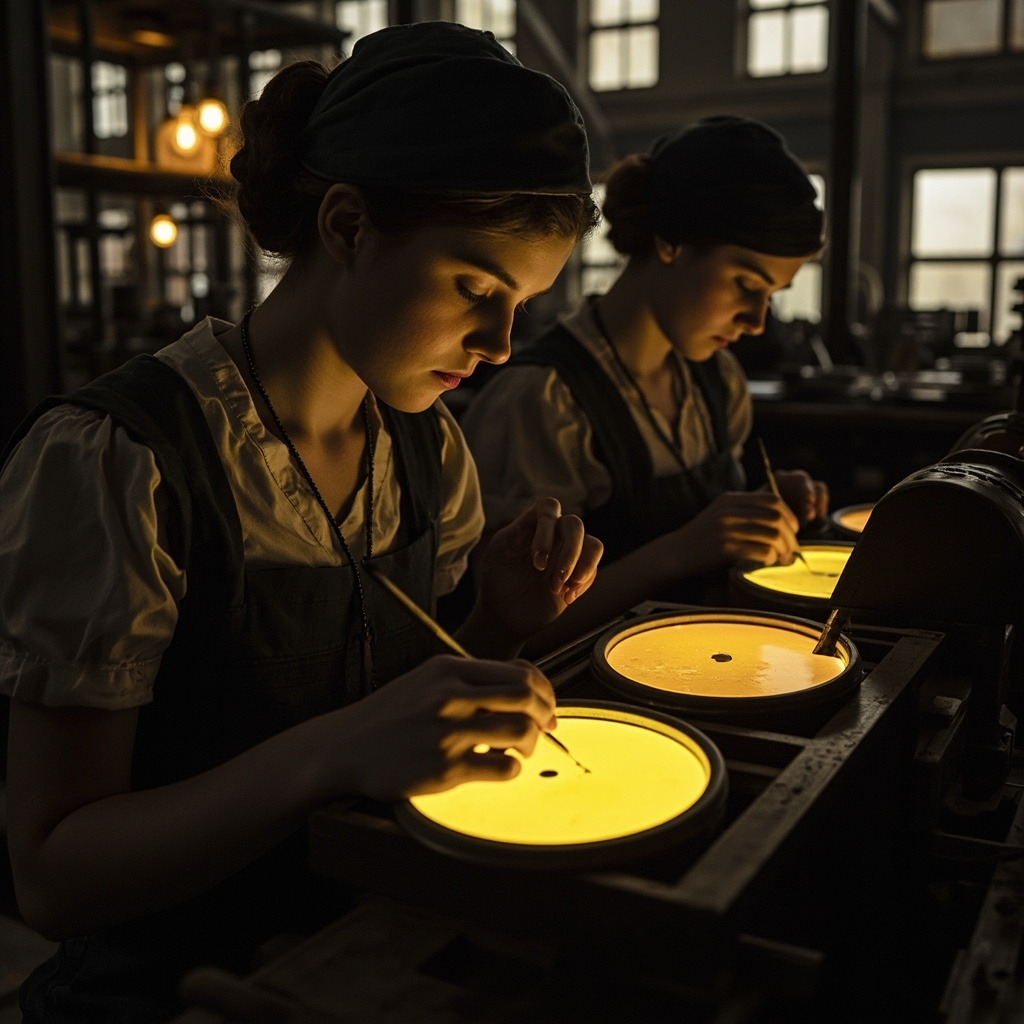
The technique was called “lip-pointing”—workers were instructed to shape their paintbrushes to fine points using their lips and tongues. Supervisors demonstrated the technique and assured workers it was completely harmless. “It’s no worse than eating salt,” they were told.

A 1920s factory worker demonstrating the dangerous lip-pointing technique with radium paint

What the women didn’t know was that their supervisors and the company scientists handling radium wore protective equipment and never touched the material directly. The dial painters, however, were consuming radium all day long through lip-pointing.

The First Signs of Trouble

By 1922, dentists in Orange, New Jersey began noticing an unusual pattern among young women. Patients who worked at the radium factory were coming in with severe dental problems:

Teeth falling out spontaneously
Jawbones that wouldn’t heal after extractions
Mysterious jaw fractures
Persistent, unexplained anemia

Dr. Theodore Blum, a local dentist, was the first to make the connection. He called the condition “radium jaw” and published his findings in 1924. The U.S. Radium Corporation immediately challenged his research, claiming their own studies showed radium was completely safe.

Meanwhile, young women continued to get sick. Grace Fryer, who had worked at the factory from 1917 to 1920, began experiencing severe tooth loss and jaw pain. Her case would become the centerpiece of the legal battle to come.

Corporate Cover-Up and Denial

When confronted with evidence of illness among their workers, U.S. Radium Corporation launched a systematic campaign of denial and misdirection:

Fake Medical Studies: The company hired doctors to examine sick workers and publicly declare them healthy. These “independent” physicians were secretly on the company payroll.

Alternative Diagnoses: When women became ill, company doctors blamed everything from syphilis to poor hygiene to “hysteria.” They suggested the women were malingering or seeking attention.

Intimidation Tactics: Workers who complained were fired. Families of deceased workers were told their daughters died from “natural causes” unrelated to radium exposure.

Scientific Manipulation: The company suppressed internal research showing radium’s dangers while publicly promoting studies claiming it was beneficial to health.

The Legal Battle Begins

In 1925, Grace Fryer decided to sue U.S. Radium Corporation for damages. She faced immediate obstacles:

No lawyer would take her case initially—the radium companies were too powerful and wealthy
The statute of limitations appeared to have expired
Medical experts were reluctant to testify against the radium industry
Public opinion favored the “miracle” radium over unknown factory girls

After two years of searching, Fryer found attorney Raymond Berry, who agreed to represent her and four other women: Edna Hussman, Katherine Schaub, Quinta McDonald, and Albina Larice. The press dubbed them “The Five”—the first Radium Girls to challenge corporate America in court.

Scientific Evidence Mounts

Dr. Harrison Martland, a physician and researcher, conducted independent studies of radium workers and made crucial discoveries:

Radium accumulates in bones and continues emitting radiation for years
The “lip-pointing” technique delivered concentrated doses directly to the mouth and throat
Radiation damage affects the entire body, not just the mouth and jaw
There is no safe level of radium consumption

Martland’s research provided the scientific foundation needed to prove the companies’ liability. However, U.S. Radium Corporation fought back with their own “experts” who claimed radium was beneficial and that the women’s illnesses were unrelated to their work.

The Ottawa, Illinois Connection

While the New Jersey case proceeded slowly through the courts, another tragedy was unfolding in Ottawa, Illinois. The Radium Dial Company employed hundreds more dial painters using the same deadly techniques.

Catherine Wolfe Donohue, a former dial painter, organized fellow workers to demand answers about their illnesses. The Ottawa women faced the same corporate denial and legal obstacles as their New Jersey counterparts.

The Illinois women had one advantage: they could learn from the New Jersey legal strategy. They also faced one major disadvantage: many were sicker and dying faster, as the Ottawa plant had used even higher concentrations of radium.

David vs. Goliath in Court

The legal proceedings revealed the shocking extent of corporate callousness:

Internal Memos: Company documents showed executives knew about radium dangers as early as 1922 but chose to suppress the information to protect profits.

Double Standards: While telling workers radium was safe, the company provided protective equipment for its executives and scientists.

Victim Blaming: Defense attorneys argued the women were promiscuous and their illnesses were due to venereal disease, not radium exposure.

Stalling Tactics: The company used every legal maneuver to delay proceedings, hoping the women would die before winning their case.

The Turning Point

Public opinion began shifting in 1928 when newspapers started reporting the full story. The image of young women literally glowing as they walked home from work, only to die horrible deaths from radiation poisoning, captured public sympathy.

Key moments that changed the narrative:

Grace Fryer’s Testimony: Too weak to raise her right hand to take the oath, Fryer’s frail appearance in court generated widespread sympathy and press coverage.

Expert Medical Testimony: Dr. Martland’s scientific evidence was overwhelming and undeniable, even under aggressive cross-examination.

Company Hypocrisy Exposed: Revelations about protective equipment for executives while workers were told radium was safe sparked public outrage.
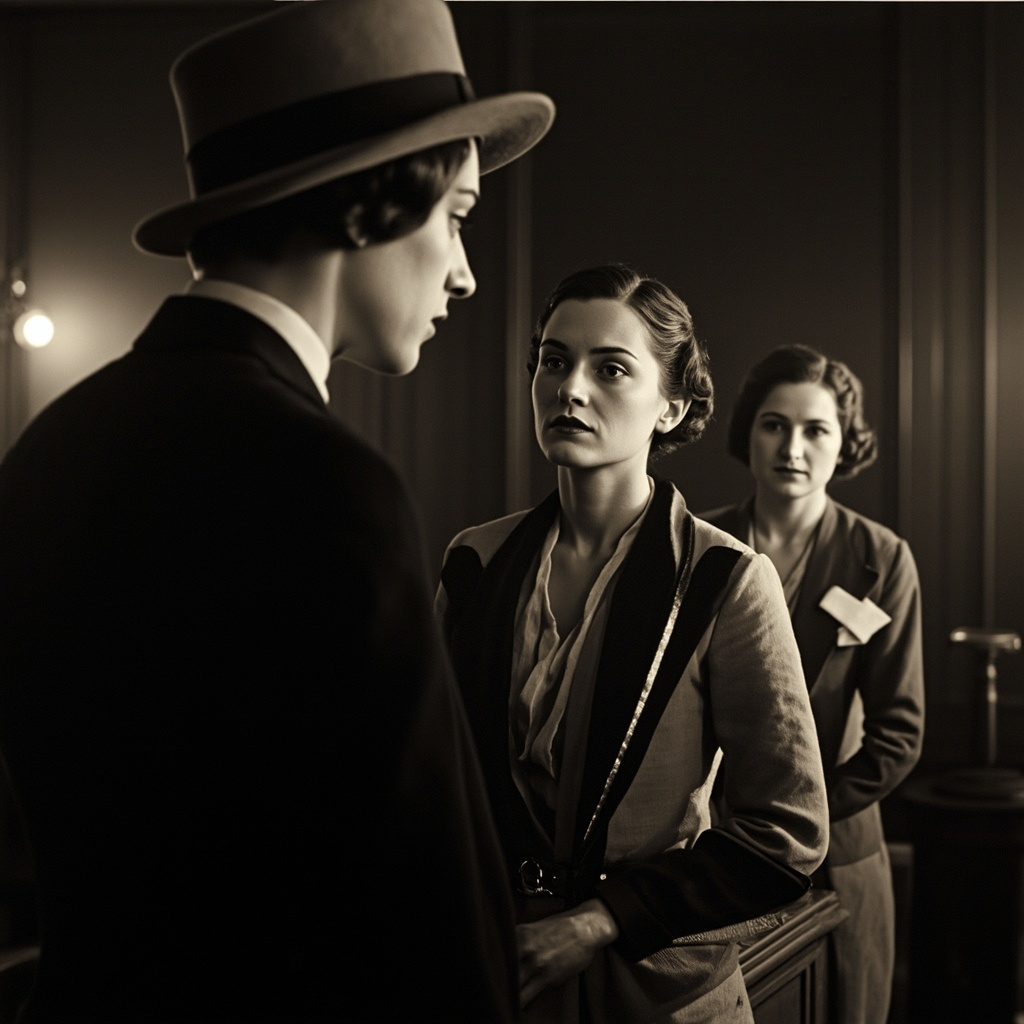
The historic courtroom scene where the Radium Girls fought for workers' rights against corporate America

Victory and Legacy

In June 1928, the New Jersey Radium Girls reached a settlement with U.S. Radium Corporation:

$10,000 lump sum for each woman (approximately $150,000 today)
$600 annual pension for life
Full medical expenses covered
Company admission that radium caused their illnesses

The Illinois women won their case in 1938, though many had died by then. Catherine Wolfe Donohue, the lead plaintiff, died just months after the victory.

Transforming Workers’ Rights

The Radium Girls’ legal victories established crucial precedents:

Right to Sue: Workers gained the legal right to sue employers for damages from occupational diseases.

Employer Responsibility: Companies became legally responsible for providing safe working conditions and informing workers of known hazards.

Statute of Limitations Reform: The “discovery rule” was established—the statute of limitations begins when the worker discovers their illness, not when exposure occurred.

Industrial Safety Standards: Federal oversight of workplace safety was strengthened, leading eventually to OSHA creation in 1970.

Scientific and Medical Advances

The Radium Girls’ cases contributed significantly to medical and scientific understanding:

Radiation Safety: Comprehensive safety protocols were developed for handling radioactive materials.

Occupational Medicine: The field of occupational health emerged, studying how workplace exposures affect human health.

Cancer Research: Long-term studies of radium workers provided crucial data about radiation-induced cancer.

Bone Metabolism: Research on radium poisoning advanced understanding of how bones absorb and process minerals.

The Human Cost

The exact number of radium poisoning victims remains unknown, but researchers estimate:

4,000+ dial painters worked at various facilities nationwide
Hundreds died from radium-related illnesses
Many more suffered chronic health problems
Some families experienced multiple generations of health issues

The women who survived long enough to see justice were permanently disabled. Grace Fryer lived until 1969 but suffered constant pain and required multiple surgeries. Most of “The Five” died in their 40s or 50s from radiation-related cancers.

Modern Recognition and Remembrance

Today, the Radium Girls are remembered as pioneers in workers’ rights and corporate accountability:

Historical Markers: Monuments in New Jersey and Illinois commemorate their struggle.

Academic Study: Their case is taught in law schools, medical schools, and public health programs worldwide.

Popular Culture: Books, documentaries, and even a Broadway musical have told their story to new generations.

Legal Precedent: Their cases continue to influence workplace safety litigation and corporate responsibility law.

Lessons for Today

The Radium Girls’ story remains relevant in our modern economy:

Corporate Accountability: Their battle established that companies cannot hide behind “trade secrets” when worker health is at stake.

Scientific Integrity: The importance of independent research and the dangers of industry-funded studies that prioritize profit over safety.

Worker Empowerment: The power of workers organizing to demand safe working conditions and holding employers accountable.

Regulatory Oversight: The need for strong government oversight of workplace safety and environmental health.

The Radium Girls didn’t choose to be heroes—they simply refused to accept that their lives were expendable for corporate profits. Their courage in fighting powerful companies while battling life-threatening illnesses transformed American workplace safety and established rights that protect workers to this day.

Their legacy reminds us that progress often comes at great personal cost, and that ordinary people can achieve extraordinary change when they refuse to remain silent in the face of injustice.


The Vatican Secret Archives: Hidden Treasures and Forbidden Knowledge That Changed History

Deep beneath the Vatican lies one of history’s most mysterious collections: the Vatican Secret Archives. For centuries, these sealed vaults have sparked conspiracy theories and captured imaginations. But the truth about what’s actually hidden in these archives is far more fascinating than any fiction.

In 2019, Pope Francis officially renamed them the “Vatican Apostolic Archives,” acknowledging that the word “secret” had fueled too much speculation. Yet even today, only a select few scholars gain access to documents that could reshape our understanding of history.

The Origins of Secrecy

The Vatican Archives began accumulating documents in the 4th century, but the modern secret archive system started in 1612 under Pope Paul V. The original purpose wasn’t conspiracy—it was preservation. In an era of political upheaval and wars, the Vatican needed to protect its most important diplomatic and administrative documents from destruction or theft.

The “secret” designation (from the Latin secretum, meaning “private”) indicated these were personal papal documents, separate from materials available in the Vatican Library. But this privacy created an aura of mystery that has persisted for over 400 years.

What’s Actually Inside

Ancient Vatican manuscripts and historical documents

Galileo’s Trial Documents: The complete records of Galileo’s 1633 heresy trial reveal surprising details. Contrary to popular belief, Galileo wasn’t tortured, and several cardinals actually supported his scientific work privately. The trial was more about papal authority than pure religious doctrine.

Letters from Michelangelo: The artist’s personal complaints about working on the Sistine Chapel, including his famous protests about painting the ceiling when he considered himself a sculptor, not a painter. One letter translates roughly as “I am not a painter” repeated multiple times in exasperation.

Henry VIII’s Marriage Petition: The original document shows 81 seals from English nobles supporting Henry’s request to annul his marriage to Catherine of Aragon. The elaborate presentation suggests Henry genuinely believed he could convince the Pope through political pressure.

Modern Access and Digital Revolution

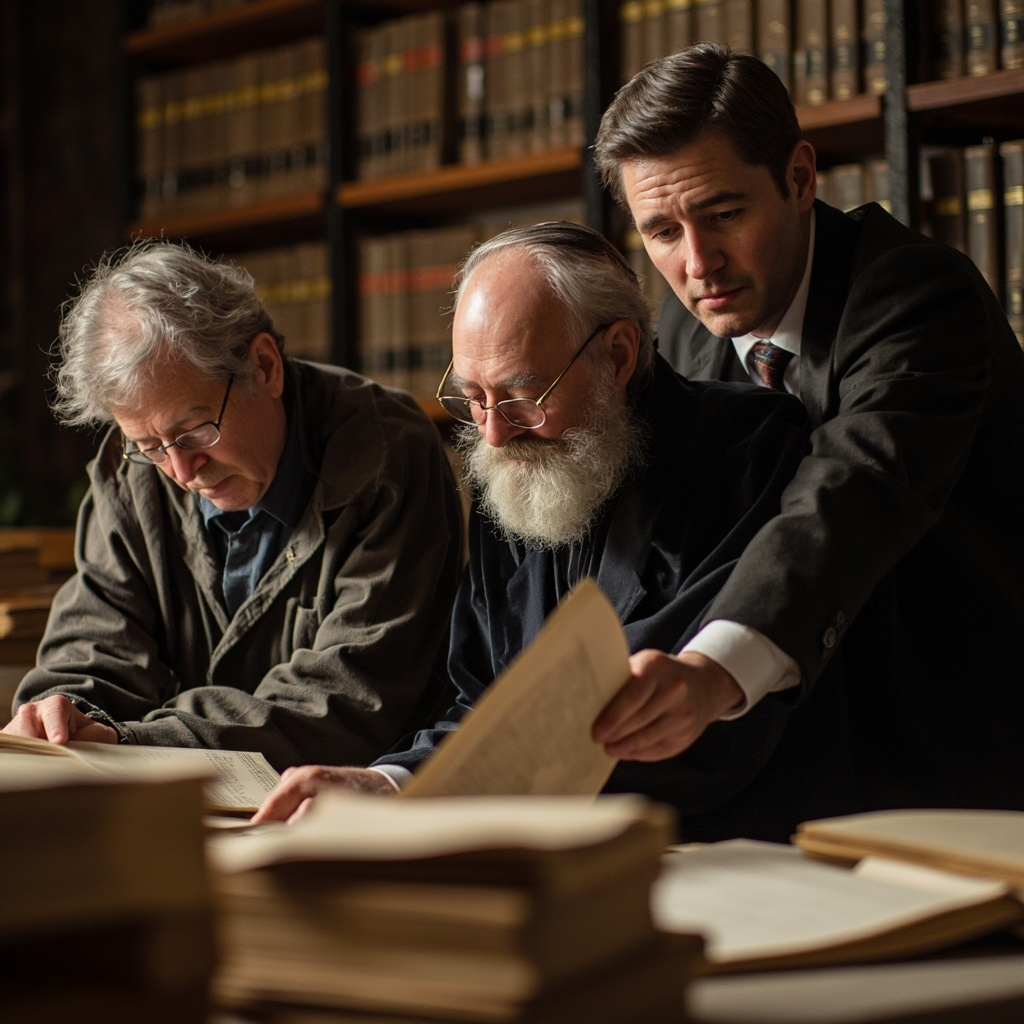
Modern scholars researching Vatican historical documents

Today, qualified researchers can access most pre-1958 documents, with some exceptions. The process requires academic credentials, specific research proposals, and Vatican approval. The Vatican has begun digitizing archives, making some documents available online.

The Vatican Secret Archives—now Apostolic Archives—represent one of humanity’s great historical repositories. While conspiracy theories persist, the reality is far more interesting: a massive collection of documents showing how religious, political, and scientific forces have shaped our world for over 1,500 years.

Related Reading

Double Vision: Famous Twins Who Shaped History

From the mythological founders of Rome to groundbreaking scientific subjects, twins have fascinated humanity for millennia. Their stories — sometimes triumphant, sometimes tragic — reveal deep truths about identity, connection, and what it means to share your life with someone who entered the world alongside you. Here are some of history’s most remarkable twin stories.

Romulus and Remus: The Twins Who Built an Empire

Perhaps no twins loom larger in Western civilization than Romulus and Remus, the legendary founders of Rome. According to myth, these twin brothers were born to Rhea Silvia, a Vestal Virgin, and Mars, the god of war. Their great-uncle, King Amulius, ordered them drowned in the Tiber River to eliminate any threat to his throne. But fate — or the gods — had other plans.

A she-wolf discovered the abandoned infants and nursed them in a cave called the Lupercal. Later, a shepherd named Faustulus found and raised them. When the brothers grew to manhood and learned their true origins, they overthrew Amulius and restored their grandfather to power. Then they set out to build their own city.

What happened next is one of history’s darkest twin stories. The brothers quarreled over where to build and how to rule. In a fit of rage, Romulus killed Remus and became the sole founder of Rome — a city that would grow to dominate the known world. The tale of Romulus and Remus isn’t just a founding myth; it’s a meditation on rivalry, ambition, and the terrible price of power, even between those who share the closest possible bond.

Chang and Eng Bunker: The Original “Siamese Twins”

Chang and Eng Bunker, the original Siamese twins

Born in 1811 in Siam (modern-day Thailand), Chang and Eng Bunker were conjoined twins connected at the chest by a band of cartilage. Their story would give the world the now-outdated term “Siamese twins” — but their lives were far more interesting than any label.

Discovered by a British merchant, the brothers were brought to the West as curiosities and toured with P.T. Barnum’s circus. But Chang and Eng were no passive spectacles. They were shrewd businessmen who eventually bought their freedom, became American citizens, purchased a plantation in North Carolina, and married two sisters — Adelaide and Sarah Yates.

Between them, the brothers fathered 21 children. They developed a rotating schedule, spending three days at Chang’s home and three at Eng’s. Despite being physically inseparable their entire lives, the twins had distinctly different personalities: Chang was more outgoing and drank heavily, while Eng was quieter and more reserved. When Chang died in his sleep on January 17, 1874, Eng reportedly said, “Then I am going too,” and passed away hours later. Modern doctors believe surgical separation would have been possible — and relatively simple — with today’s techniques.

The Dionne Quintuplets: Canada’s Famous Five

While not twins in the strict sense, the Dionne quintuplets — Yvonne, Annette, Cécile, Émilie, and Marie — were born near Callander, Ontario, in 1934 as the first quintuplets known to survive infancy. What makes their story relevant to twin history is that they were identical siblings, all developed from a single fertilized egg, making them essentially twins multiplied.

Their birth was a sensation, but what followed was exploitation on a staggering scale. The Ontario government removed the girls from their parents and placed them in a specially built facility called “Quintland,” where they became a tourist attraction. Up to 6,000 people a day watched them play behind one-way glass. They generated an estimated $500 million in tourism revenue during the Great Depression — money they never saw.

The quintuplets were eventually returned to their parents, but the damage was done. In later years, the surviving sisters revealed they had suffered abuse at home and carried deep psychological scars from their childhood as exhibits. Their story remains a powerful cautionary tale about the exploitation of multiple births and the dark side of public fascination with twins and multiples.

The “Silent Twins”: June and Jennifer Gibbons

The Silent Twins, June and Jennifer Gibbons

Of all the twin stories in history, few are as haunting as that of June and Jennifer Gibbons, known as the “Silent Twins.” Born in 1963 in Barbados and raised in Haverfordwest, Wales, the identical twins were the only Black children in their community and suffered severe bullying. They withdrew into each other completely, developing a secret language and refusing to communicate with anyone else.

Their bond was intense and suffocating. They made a pact: if one died, the other must begin to speak and live a normal life. They wrote novels — Jennifer authored The Pepsi-Cola Addict and June wrote The Pugilist — but their isolation eventually led to a crime spree of arson and theft that landed them in Broadmoor, Britain’s notorious high-security psychiatric hospital, where they spent 11 years.

The most chilling chapter came in 1993 when the twins were being transferred to a less restrictive facility. Jennifer suddenly became ill on the bus and died of acute myocarditis — inflammation of the heart — with no clear medical explanation. There were no drugs in her system, no obvious cause. June later told a reporter, “I’m free at last, liberated, and at last Jennifer has given up her life for me.” June has lived a quiet, independent life ever since, fulfilling their pact.

Twin Science: The Minnesota Twin Study

Beyond individual stories, twins have played a crucial role in advancing our understanding of human nature itself. The most famous scientific twin study — the Minnesota Study of Twins Reared Apart — began in 1979 under psychologist Thomas Bouchard. The study tracked identical twins who had been separated at birth and raised in different families, comparing their traits, behaviors, and life choices.

The results were astonishing. Jim Lewis and Jim Springer, separated at four weeks old and reunited at age 39, discovered they had both married women named Linda, divorced, and then married women named Betty. Both had sons named James. Both drove the same car, smoked the same cigarettes, and vacationed at the same Florida beach. Coincidence? The Minnesota study suggested that genetics played a far larger role in personality and behavior than scientists had previously believed — a finding that reshaped psychology, medicine, and our understanding of what makes us who we are.

Royal Twins and Political Power

Twins have also shaped political history. In 17th-century France, the birth of twin sons to Queen Anne of Austria in 1638 and 1640 (Louis XIV and Philippe, Duke of Orléans, who were not actually twins but were close in age) inspired Alexandre Dumas’s famous novel The Man in the Iron Mask, which imagined a secret twin imprisoned to prevent a succession crisis.

Real twin rulers have existed, too. Lech and Jarosław Kaczyński, identical twins from Poland, simultaneously held the positions of President and Prime Minister from 2006 to 2007 — one of the only times in modern history that twins controlled both the executive offices of a nation. Their political partnership and rivalry echoed, in democratic form, the ancient tensions of Romulus and Remus.

The Eternal Fascination

Why do twins captivate us so? Perhaps it’s because they challenge our deepest assumptions about individuality. In a world that prizes uniqueness, twins remind us that identity is more complicated than we think — that two people can share a face, a genome, even a womb, and still become entirely different people. Or, in some cases, remain so deeply connected that one cannot survive without the other.

From Roman myth to modern science, the stories of twins are really stories about all of us: about nature and nurture, love and rivalry, independence and connection. They are mirrors reflecting the fundamental question of what makes a person who they are — and whether any of us are truly alone in the world.

The Invisible Light: How X-rays Went from Accidental Discovery to World-Changing Technology

On a chilly November evening in 1895, a 50-year-old German physicist named Wilhelm Conrad Röntgen was working alone in his darkened laboratory at the University of Würzburg. He was experimenting with cathode ray tubes — the cutting-edge technology of his day — when something peculiar caught his eye. A fluorescent screen on the other side of the room was glowing. It shouldn’t have been. The tube was completely covered in thick black cardboard. Whatever was causing that glow was passing straight through the covering like it wasn’t even there.

Röntgen was baffled. He spent the next several weeks barely eating or sleeping, locked in his laboratory, obsessively investigating this mysterious new radiation. He didn’t know what it was, so he called it “X-rays” — X for unknown. It was a placeholder name that stuck forever. What he discovered in those feverish weeks would transform medicine, reshape warfare, revolutionize industry, and accidentally kill quite a few people along the way.

The Photograph That Stunned the World

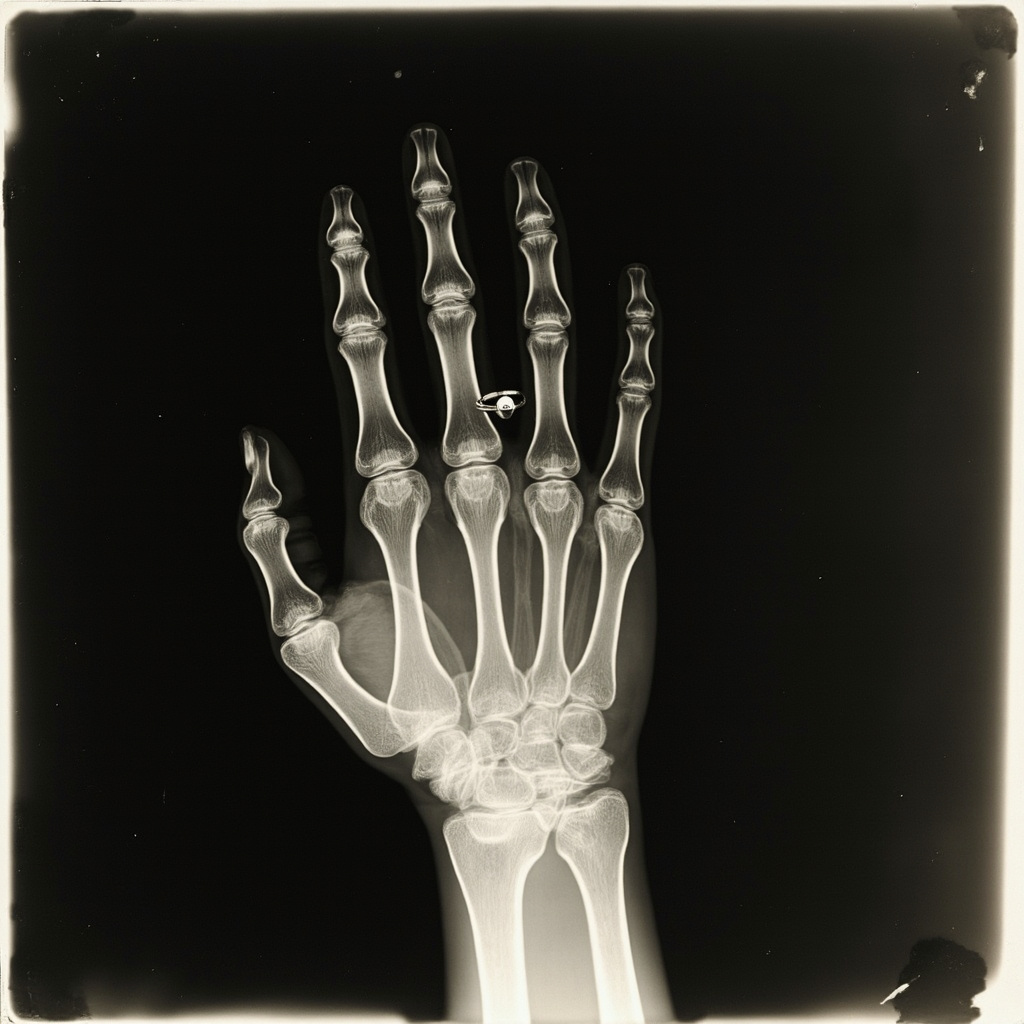
The famous first X-ray photograph of Anna Bertha Röntgen's hand, 1895

On December 22, 1895, Röntgen asked his wife Anna Bertha to place her hand on a photographic plate while he aimed his X-ray tube at it. The exposure took about 15 minutes — during which Anna Bertha had to hold perfectly still. The resulting image was haunting: the dark shadows of her bones clearly visible, her wedding ring floating ghostlike around her finger. When she saw the image, she reportedly gasped, “I have seen my death.”

Röntgen published his findings on December 28, 1895, and the news exploded across the globe with a speed that rivaled the telegraph itself. Within days, newspapers on every continent were breathlessly reporting on the “new photography” that could see through flesh to the bones beneath. The public was equal parts fascinated and terrified.

In 1901, Röntgen was awarded the very first Nobel Prize in Physics. True to his modest character, he donated the prize money to his university and refused to patent his discovery, believing it belonged to humanity. He died in relative obscurity in 1923, during the economic chaos of Weimar Germany, while the technology he unleashed was already changing the world in ways he never imagined.

X-ray Mania: When Seeing Bones Was Entertainment

Victorian-era X-ray parlor with people lining up to see their own skeletons

The years following Röntgen’s discovery saw an extraordinary craze sweep through Europe and America. “X-ray parlors” sprang up in cities, offering curious customers the chance to see their own skeletons for a small fee. It was the Victorian equivalent of a selfie — except instead of your face, you were showing off your metacarpals.

Department stores installed X-ray machines as novelty attractions. Shoe stores offered “fluoroscopes” that let customers wiggle their toes inside their shoes to check the fit — bombarding their feet with radiation in the name of retail satisfaction. These shoe-fitting fluoroscopes remained in widespread use from the 1920s through the 1950s before someone finally asked, “Wait, is this a good idea?”

The entertainment industry embraced X-rays with gusto. Thomas Edison, ever the showman, demonstrated a large fluoroscope at the 1896 Electrical Exhibition in New York City. His assistant, Clarence Dally, operated the device extensively. Dally would become one of the first known casualties of radiation exposure in America — he developed severe radiation burns, had both arms amputated, and died in 1904 at the age of 39. Edison, shaken by Dally’s fate, abandoned all X-ray research.

The early enthusiasm was dangerously naive. Without understanding radiation’s biological effects, people treated X-rays as harmless curiosities. Doctors would demonstrate X-ray machines at dinner parties. Inventors proposed X-ray opera glasses so theatergoers could peer through walls. A London company advertised “X-ray proof undergarments” for modest ladies who feared their privacy was at risk. The fear was absurd, but the entrepreneurial spirit was very real.

From Parlor Trick to Battlefield Savior

Marie Curie operating mobile X-ray equipment during World War I

While civilians were gawking at their bones in parlors, the medical community quickly recognized X-rays’ life-saving potential. During the Balkan Wars of 1897 and the Boer War (1899–1902), military surgeons used X-rays to locate bullets and shrapnel lodged in wounded soldiers — a task that had previously required agonizing exploratory surgery.

But it was World War I that truly proved X-rays’ value on a massive scale. Marie Curie — already famous for her research on radioactivity — threw herself into the war effort with characteristic determination. She equipped a fleet of vehicles with portable X-ray machines, creating the world’s first mobile radiological units. Soldiers affectionately called them “petites Curies” — little Curies.

Curie personally drove these vehicles to field hospitals near the front lines, training doctors and technicians to use the equipment. Her teenage daughter Irène joined her, operating X-ray machines in battlefield hospitals at the age of 17. Together, the Curies helped perform over a million X-ray examinations during the war, guiding surgeons to extract bullets and shrapnel that would have otherwise meant amputation or death.

The wartime experience transformed X-ray technology from a medical curiosity into an indispensable clinical tool. After the war, hospitals worldwide invested in permanent X-ray departments, and the specialty of radiology was born.

The Dark Side: Radiation’s Hidden Toll

The enthusiasm for X-rays came at a terrible price. In the early decades, no one understood the cumulative damage that radiation inflicted on human tissue. Radiologists routinely tested their equipment by X-raying their own hands. Many developed radiation dermatitis — chronic skin damage that progressed to ulceration and cancer.

By the 1930s, the toll was becoming undeniable. Hundreds of early radiologists and X-ray technicians had developed cancers, lost fingers and limbs, or died from radiation-related illnesses. A memorial erected in Hamburg, Germany, in 1936 listed 169 names of radiologists who died from radiation exposure. By 1960, the list had grown to 360 names.

The radium industry — a cousin of X-ray technology — was claiming victims too. The infamous “Radium Girls” of the 1920s, young women who painted luminous watch dials with radium-laced paint, developed devastating jaw necrosis and cancers after being told to lick their brushes to form a fine point. Their legal battle against the U.S. Radium Corporation became a landmark case in occupational health law.

These tragedies eventually forced the development of radiation safety standards. Lead shielding, exposure limits, dosimetry badges, and the principle of using the minimum radiation dose necessary all emerged from the painful lessons of the early X-ray era.

The Modern Age: From Film to Digital

Modern hospital radiology department with CT scanner

The second half of the 20th century brought revolutionary advances. In 1971, British engineer Godfrey Hounsfield introduced the CT (computed tomography) scanner, which used X-rays and computer processing to create detailed cross-sectional images of the body. It was like going from a shadow puppet show to a full 3D movie. Hounsfield shared the 1979 Nobel Prize in Physiology or Medicine for this invention.

CT scanning transformed diagnostic medicine. Doctors could now see tumors, blood clots, fractures, and internal bleeding with unprecedented clarity — without surgery. Emergency rooms became dependent on CT scanners for evaluating trauma patients. Oncologists used them to stage cancers and monitor treatment response.

The digital revolution of the 1980s and 1990s replaced photographic film with electronic sensors, bringing instant image display, computer enhancement, and electronic storage. Radiation doses plummeted as detector technology improved. Today’s digital X-ray systems deliver a fraction of the radiation that early machines produced.

The 21st century has brought further marvels: cone beam CT for three-dimensional imaging, AI algorithms that can detect diseases on X-rays with superhuman accuracy, and portable X-ray devices small enough to fit in a backpack for use in disaster zones and remote communities.

A Legacy of Light and Shadow

The story of X-rays is, in many ways, a perfect parable of human discovery. A curious scientist stumbles upon something extraordinary. Society embraces it with reckless enthusiasm. People suffer from the unintended consequences. And gradually, painfully, we learn to harness the discovery safely and effectively.

From Röntgen’s darkened laboratory to modern hospital radiology suites, from Victorian bone-gazing parlors to AI-powered diagnostic systems, the invisible light that one physicist discovered by accident has illuminated the hidden interior of the human body for 130 years. It has saved millions of lives, enabled entire medical specialties, and — in its darkest chapters — reminded us that every powerful technology demands respect.

Wilhelm Röntgen never sought fame or fortune from his discovery. He gave it freely to the world, asking nothing in return. The X stands for unknown — and in a sense, it still does. Even today, researchers are finding new applications for X-ray technology, from archaeology to art conservation to airport security. The unknown ray turned out to be one of the most versatile and consequential discoveries in human history.

Not bad for an accident on a November evening.

The War of the Bucket: When Italy Fought a Bloody Battle Over a Wooden Pail

In 1325, soldiers from the Italian city-states of Bologna and Modena fought a pitched battle involving thousands of troops, cavalry charges, and considerable bloodshed. The prize they were fighting over? A wooden bucket.

The War of the Bucket — or Guerra della Secchia Rapita — is one of the most absurd conflicts in military history. But beneath its comical surface lies a story about the deadly factional politics that tore medieval Italy apart for centuries.

Guelphs vs. Ghibellines: Italy’s Endless Civil War

To understand the War of the Bucket, you need to understand the conflict that dominated Italian politics for nearly three hundred years: the struggle between the Guelphs and the Ghibellines.

The Guelphs supported the Pope as the supreme authority in Italy. The Ghibellines backed the Holy Roman Emperor. Every Italian city was forced to choose a side, and the rivalry infected every aspect of civic life. Neighboring cities often chose opposite factions specifically to justify attacking each other.

Bologna was a Guelph city — prosperous, home to one of Europe’s oldest universities, and loyal to the papacy. Modena, just 25 miles to the northwest, was Ghibelline — smaller, scrappier, and perpetually in Bologna’s shadow. The two cities had been feuding for generations, and by the early fourteenth century, tensions were at a breaking point.

The Bucket Raid

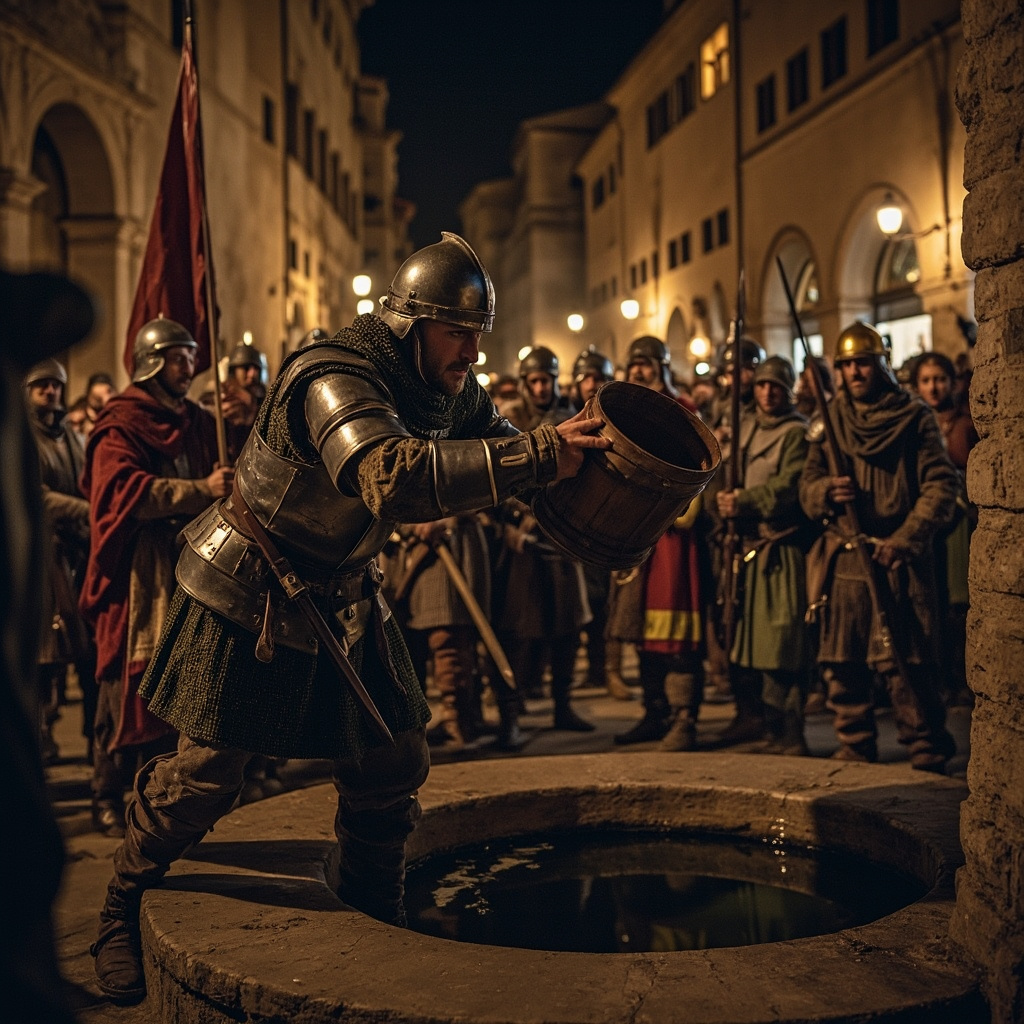
Modenese soldiers stealing the famous oak bucket from Bologna central well in 1325

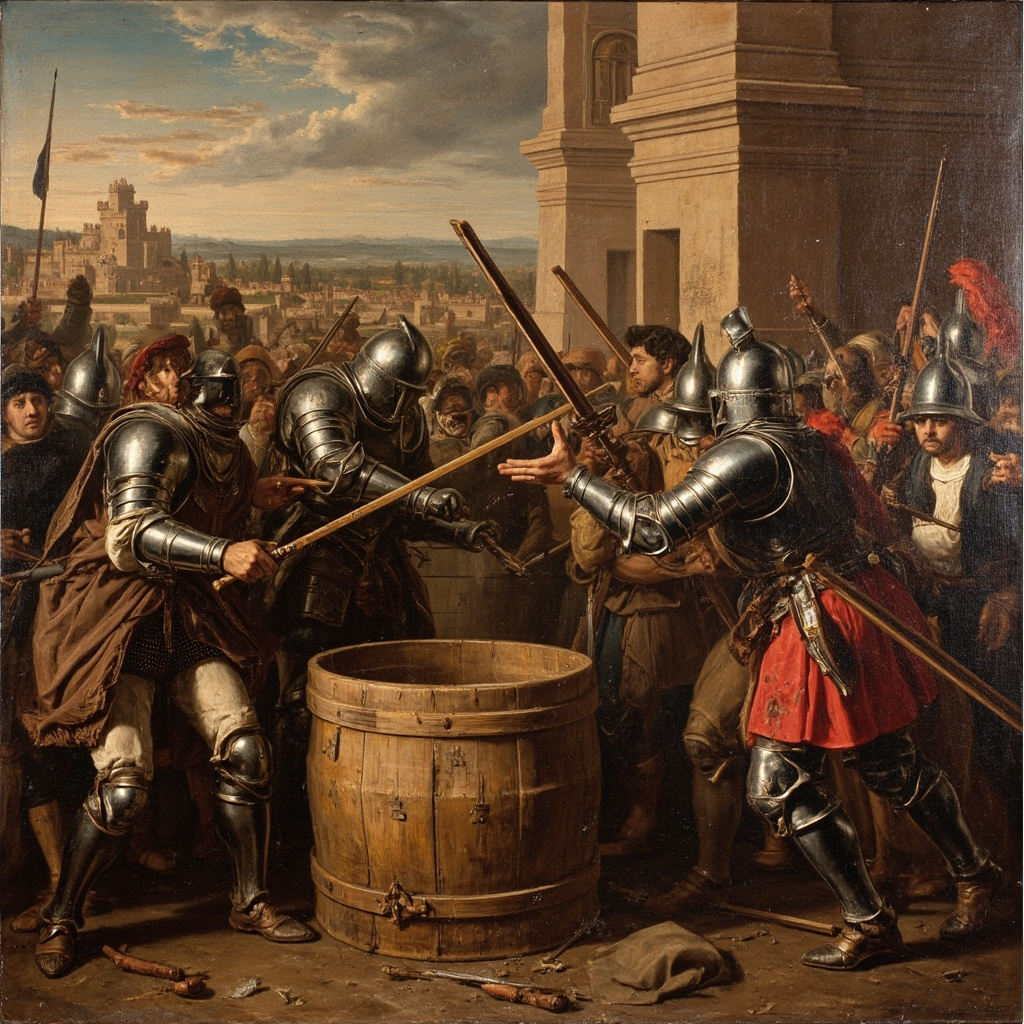
In 1325, a group of Modenese soldiers carried out a daring raid into the heart of Bologna. They fought their way into the city, and in an act of supreme provocation, stole an oak bucket from the main city well in the central square. The bucket — a secchia — was an ordinary wooden pail, worth almost nothing in monetary terms. But in symbolic terms, it was an intolerable insult.

Stealing from a city’s central well was a deliberate humiliation, equivalent to capturing an enemy’s flag. It announced to the world that Modena’s soldiers had penetrated Bologna’s defenses and taken a trophy from the very heart of the city. For proud, wealthy Bologna, this was an affront that demanded a military response.

The Battle of Zappolino

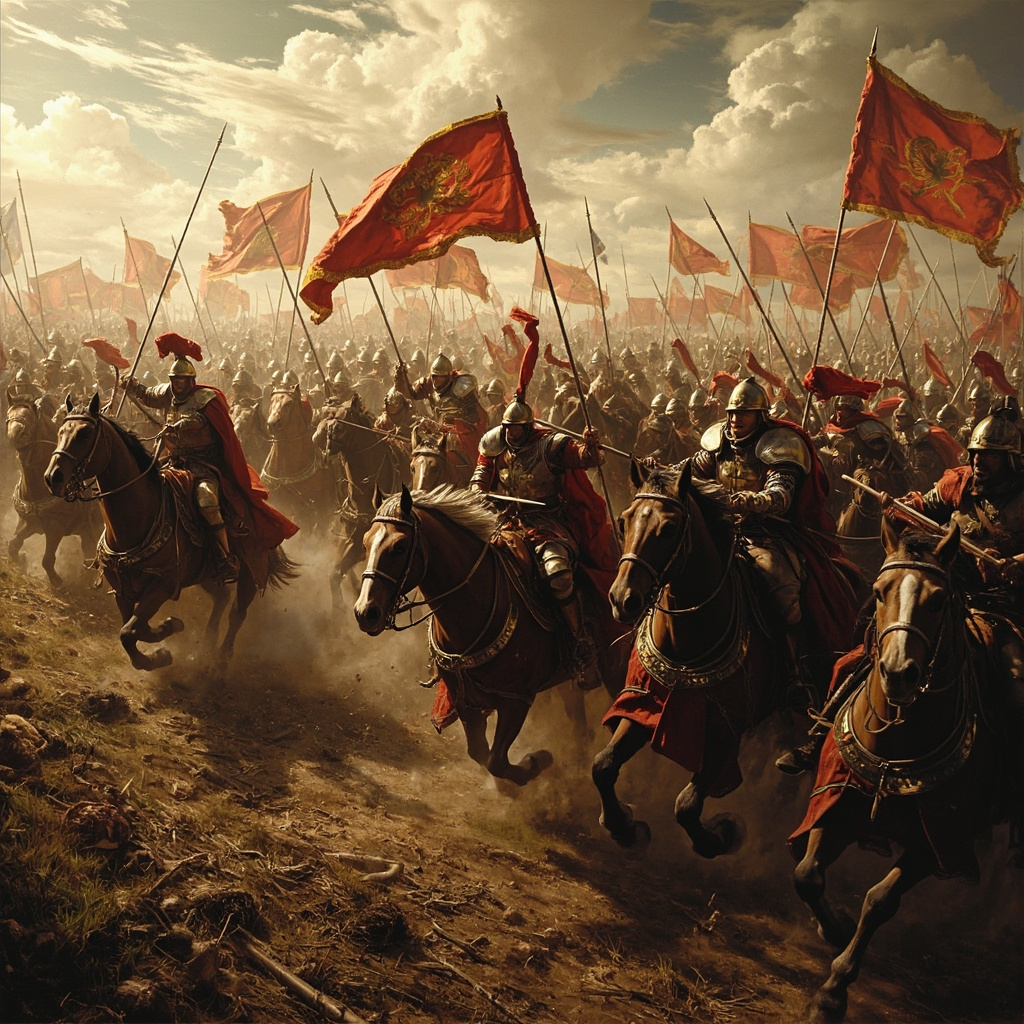
Medieval cavalry battle between Modena and Bologna armies at Zappolino in 1325

Bologna assembled a massive army. Historical accounts vary, but most sources suggest the Bolognese force numbered around 32,000 men — including 2,000 cavalry — making it one of the largest armies fielded by an Italian city-state in the medieval period. They also called upon allies from Florence, Romagna, and other Guelph cities. A papal legate accompanied the army, underscoring the involvement of the papacy itself.

Modena’s army was significantly smaller, perhaps 5,000 infantry and 2,000 cavalry, bolstered by Ghibelline allies including the fearsome warlord Passerino Bonacolsi, the lord of Mantua, who brought experienced troops hardened by years of factional warfare.

The two armies met on November 15, 1325, at the town of Zappolino, about nine miles south of Modena. What followed was a decisive and humiliating defeat for Bologna.

Despite their overwhelming numerical superiority, the Bolognese army was poorly coordinated and overconfident. The Modenese and their allies launched a devastating cavalry charge that broke the Bolognese lines. The rout was swift and total. The Bolognese army fled the field, abandoning equipment, supplies, and pride.

Modenese forces pursued the retreating Bolognese all the way back to the gates of Bologna, where, according to tradition, they carried out one final humiliation: they held a mock jousting tournament within sight of the city walls, taunting the defeated Bolognese from the safety of their own suburbs.

The Casualties and the Peace

The Battle of Zappolino was bloody by medieval Italian standards. Estimates of the dead range from several hundred to over 2,000, depending on the source. Thousands more were captured. For a conflict triggered by the theft of a bucket, the human cost was staggering.

Despite their crushing victory, the Modenese were unable to capture Bologna itself — the city’s walls were too strong and well-defended. A peace treaty was eventually negotiated, but the fundamental Guelph-Ghibelline tensions remained unresolved. The two cities would continue to skirmish for decades.

And the bucket? Modena kept it. It was never returned.

The Bucket Today

Nearly seven hundred years later, the stolen bucket still exists. It hangs in the bell tower of the Cathedral of Modena — the Torre della Ghirlandina — where it has been displayed as a trophy of victory for centuries. A replica can be seen in the town hall. Modenese citizens remain proud of their ancestors’ audacious theft and the military triumph that followed.

The War of the Bucket was immortalized in 1622 by the Italian poet Alessandro Tassoni, whose mock-heroic epic La Secchia Rapita (“The Stolen Bucket”) used the conflict as the basis for a satirical poem that mocked the absurdity of Italian factional warfare. The poem was a bestseller in its day and remains a classic of Italian literature.

More Than a Joke

It’s tempting to treat the War of the Bucket as a historical punchline — and it is genuinely funny that thousands of men fought and died over a wooden pail. But the conflict illuminates something important about how wars actually start.

The bucket wasn’t really the cause of the war. It was the spark. The underlying fuel was centuries of accumulated grievance, factional hatred, economic competition, and wounded civic pride. The theft of the bucket was simply the final provocation in a long chain of provocations, the insult that made war feel not just justified but necessary.

History is full of wars triggered by seemingly trivial incidents — a severed ear, a football match, a pig wandering across a border. In each case, the triviality of the trigger obscures the depth of the underlying tensions. The War of the Bucket reminds us that when communities are primed for conflict, even the most absurd catalyst can unleash devastating violence.

So the next time someone tells you that a particular dispute is “too silly to fight over,” remember Modena and Bologna. Remember the bucket that launched a war, killed hundreds, and still hangs in a cathedral tower as a proud trophy of victory. In politics, as in life, nothing is ever really about the bucket.

Related Reading

The Great Stink of 1858: How a Smell Saved Millions of Lives

In the summer of 1858, London — the capital of the most powerful empire on Earth, the richest city in the world, the beating heart of the Industrial Revolution — was brought to its knees by a smell. Not a plague, not an invasion, not a financial crisis. A smell. And that smell would ultimately save millions of lives.

The Great Stink of 1858 is the story of how the river Thames became so catastrophically polluted with human sewage that Parliament itself was forced to flee its chambers, and how the resulting crisis finally compelled the British government to build one of the greatest engineering achievements of the 19th century: Joseph Bazalgette’s London sewer system.

A River of Filth

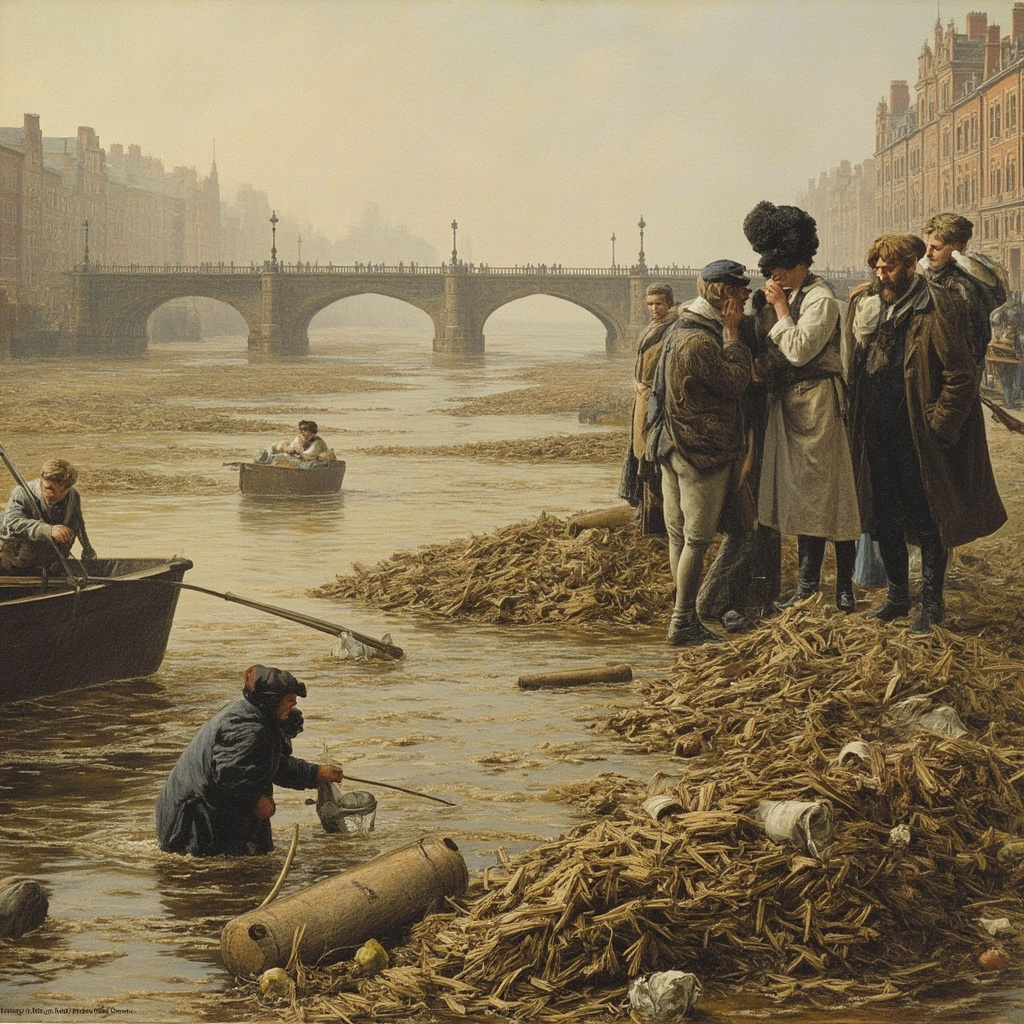
Polluted Thames river during the Great Stink of 1858 with people covering their noses

To understand the Great Stink, you need to understand what London had done to its river. By the mid-19th century, London’s population had exploded. In 1800, roughly one million people lived in the city. By 1850, that number had swollen to nearly 2.5 million. And every single one of them produced sewage.

For centuries, Londoners had relied on cesspits — underground chambers beneath homes and businesses that collected human waste. “Night soil men” would periodically empty these cesspits and cart the contents away to be used as fertilizer. The system was unpleasant but functional — as long as the population remained manageable.

Then came the flush toilet. The widespread adoption of water closets in the early 19th century was considered a triumph of modern hygiene. But it created an unforeseen catastrophe. Flush toilets used enormous quantities of water, which rapidly overwhelmed the old cesspits, causing them to overflow into street drains and ditches. These drains were never designed to handle sewage — they were meant for rainwater — and they all emptied into the same place: the River Thames.

By the 1850s, the Thames had become an open sewer. Raw, untreated human waste from millions of people poured directly into the river. The same river, it should be noted, from which many Londoners drew their drinking water.

Cholera and the Wrong Theory

The consequences were devastating. Cholera — a waterborne disease caused by bacteria in contaminated water — swept through London in terrifying epidemics in 1832, 1849, and 1854. Tens of thousands died. But the medical establishment of the time didn’t understand how cholera spread. The prevailing theory was miasma — the belief that diseases were caused by “bad air” arising from rotting organic matter. If it smelled bad, it could make you sick. The stench of the Thames, under this theory, was literally poisonous.

A brilliant physician named John Snow had demonstrated during the 1854 Broad Street outbreak that cholera was spread through contaminated water, not bad air. He famously traced cases to a single water pump and had its handle removed, stopping the outbreak. But Snow’s waterborne theory was largely rejected by the medical establishment. The miasma theory held firm.

Ironically, it was the wrong theory that would ultimately produce the right solution.

The Summer of 1858

The summer of 1858 was unusually hot. Week after week of blazing sunshine baked the Thames and its banks of accumulated sewage. The heat accelerated decomposition. The smell — already bad in normal years — became apocalyptic.

Contemporary accounts describe the stench as physically unbearable. It wasn’t merely unpleasant; it was a wall of foulness that made people retch, faint, and flee. The smell penetrated buildings, permeated clothing, and hung over the city like a toxic fog.

And nowhere was the smell worse than at the Houses of Parliament, which sat directly on the banks of the Thames. Members of Parliament attempted to continue their work with curtains soaked in chloride of lime hung over the windows. They tried every deodorizing agent available. Nothing worked. Committee rooms on the river side of the building were abandoned entirely. There was serious discussion of relocating Parliament to Oxford or St. Albans.

The Times thundered: “What a pity it is that the thermometer fell ten degrees yesterday. Parliament was all but compelled to legislate upon the great London nuisance by the force of sheer stench.”

Benjamin Disraeli, then Chancellor of the Exchequer, was seen fleeing a Commons committee room with a sheaf of papers in one hand and a handkerchief clutched to his nose with the other. The Great Stink had achieved what decades of cholera deaths, public health campaigns, and engineering proposals had failed to do: it had made the problem personal for the people in power.

Bazalgette’s Vision

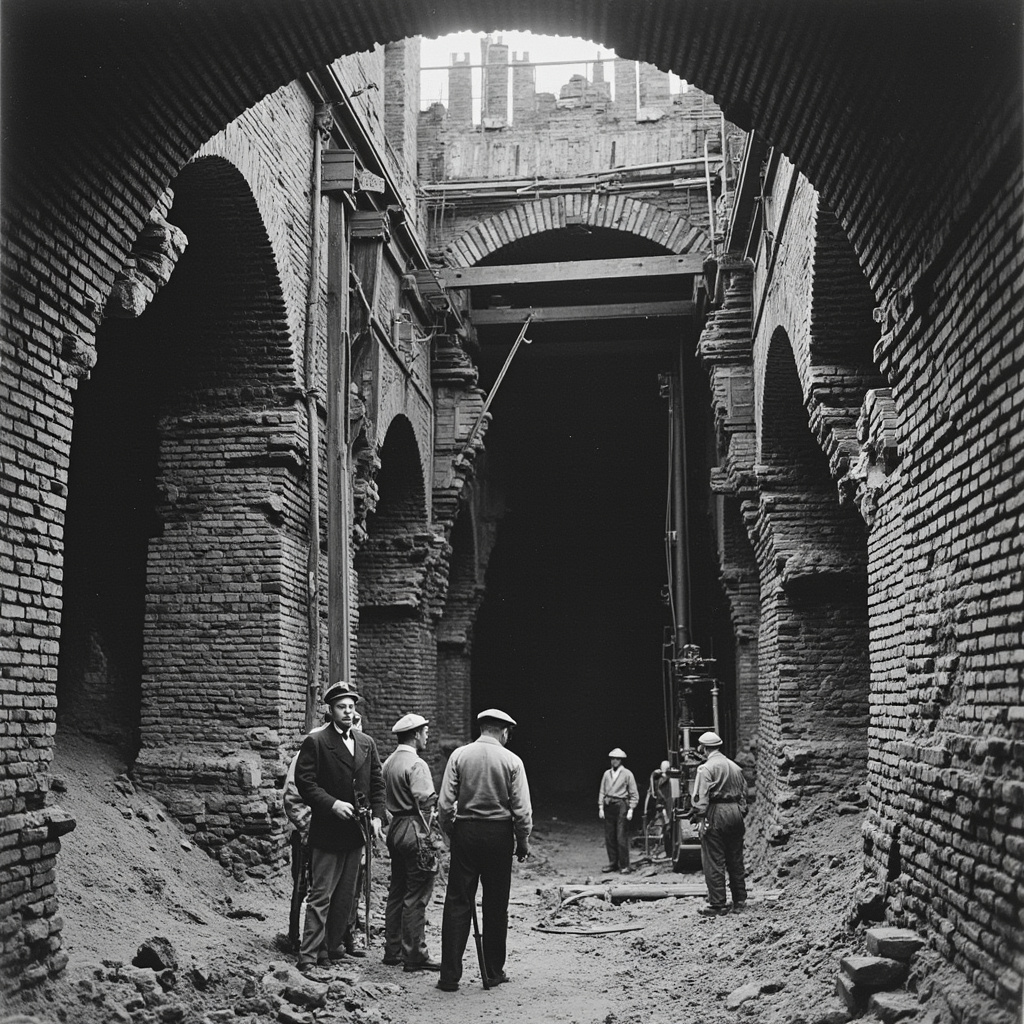
Victorian era workers constructing London underground sewer system under Joseph Bazalgette

Joseph Bazalgette was the Chief Engineer of the Metropolitan Board of Works, and he had been waiting for this moment. For years, he had championed an ambitious plan to solve London’s sewage crisis: a vast network of intercepting sewers that would catch the waste before it reached the Thames and carry it miles downstream to treatment works east of the city.

Previous proposals had been debated, revised, rejected, and shelved for years — victims of political infighting, cost concerns, and bureaucratic inertia. The Great Stink swept all of that away. Parliament passed the enabling legislation in just eighteen days — an almost unprecedented speed for Victorian government. Bazalgette was given his funding and told to get to work.

What he built was extraordinary. Over the next six years, Bazalgette oversaw the construction of 83 miles of brick-lined intercepting sewers, fed by 1,100 miles of street sewers. The system used gravity to channel sewage from across London into massive trunk sewers that ran parallel to the Thames, carrying waste eastward to pumping stations at Crossness and Abbey Mills, where it was lifted into holding reservoirs and released into the river on the outgoing tide, far downstream from the city.

The engineering was brilliant, but Bazalgette’s true genius was in his foresight. When calculating the diameter of the main sewers, he estimated the maximum capacity London would ever need — then doubled it. “We’re only going to do this once,” he reportedly said, “and there’s always the unforeseen.” That decision to overengineer the system is the reason Bazalgette’s sewers still form the backbone of London’s sewage infrastructure today, more than 160 years later.

The Result

The impact was transformative. Cholera, which had killed tens of thousands in London across multiple epidemics, essentially vanished from the city after the sewer system was completed. The Thames, while still far from pristine, was no longer an open cesspool. Life expectancy in London increased dramatically. The system became a model for cities around the world.

Bazalgette also used the construction project to reshape London’s riverfront. The massive trunk sewers running along the Thames were enclosed within new embankments — the Victoria Embankment, the Albert Embankment, and the Chelsea Embankment — which reclaimed land from the river, created new roads, and housed an underground railway line. These embankments remain some of London’s most recognizable landmarks.

The Lesson

The Great Stink is a story about the perverse mechanics of political will. London’s sewage crisis had been killing people for decades. John Snow had identified the mechanism. Engineers had proposed solutions. The evidence was overwhelming. But nothing happened — until the smell reached Parliament.

It took the personal discomfort of the ruling class to produce action that the deaths of thousands of ordinary Londoners could not. The cholera victims were mostly poor. The smell was democratic. And so, in one of history’s great ironies, a city was saved not by science or compassion, but by the simple, unavoidable reality that sewage stinks — and that even the most powerful men in the British Empire couldn’t legislate with a hand over their nose.