The Man Who Gave Away the X-Ray: Wilhelm Röntgen and the Discovery He Refused to Own

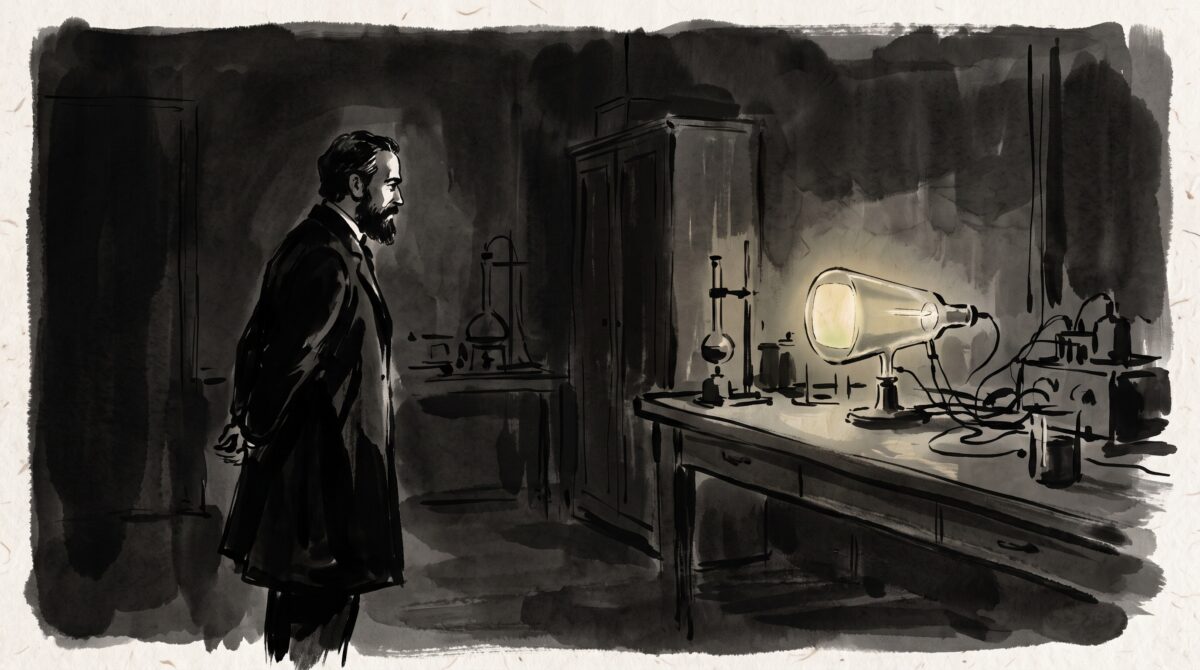
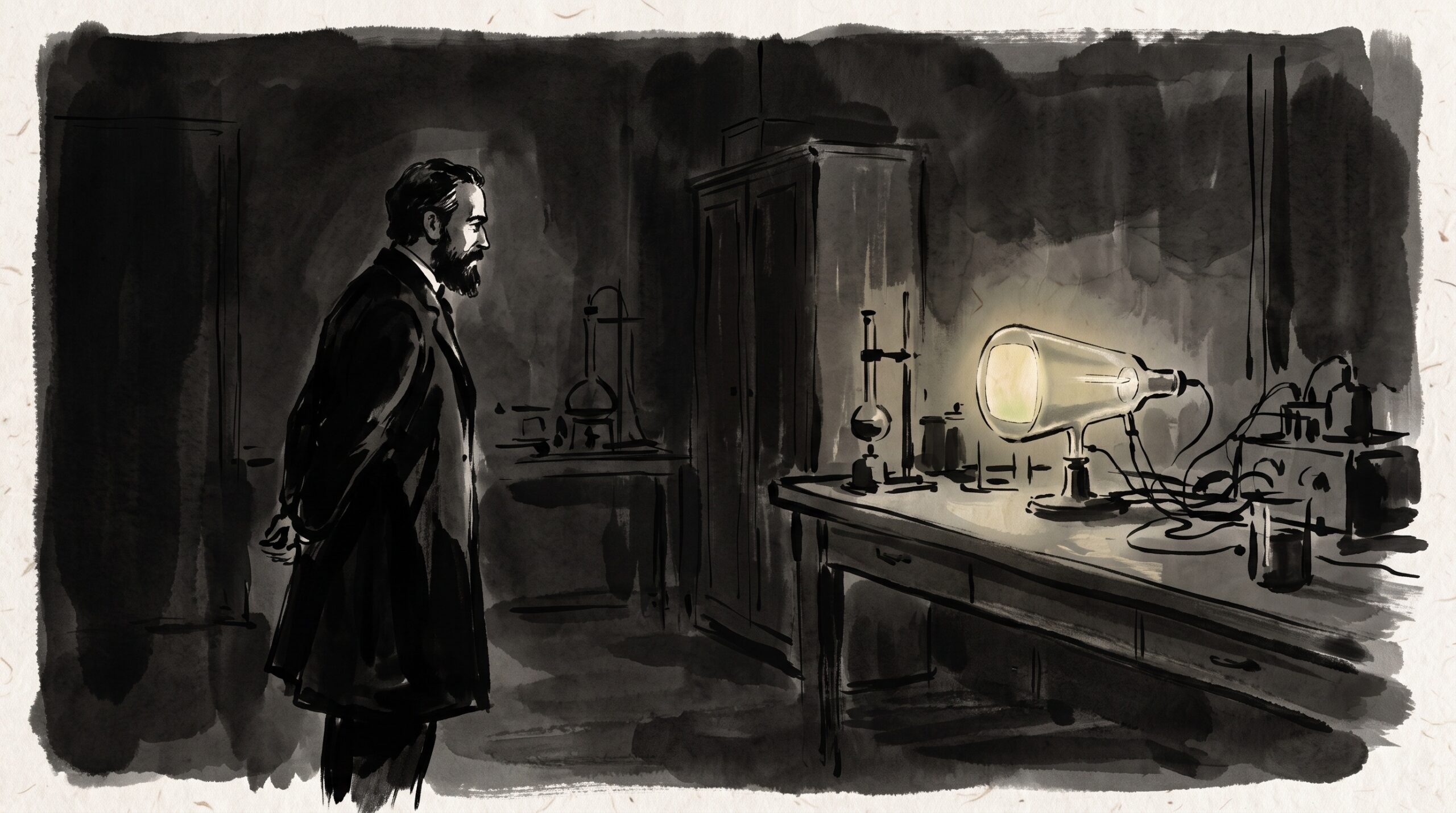
On the evening of 8 November 1895, a fifty-year-old professor of physics was working alone in his laboratory at the University of Würzburg, in Bavaria. He was a careful, unremarkable-seeming man, methodical to the point of dullness, the sort of scientist who checks a result twice and then checks it again. That night he was passing electricity through a glass vacuum tube, a piece of apparatus that dozens of other physicists across Europe had on their own benches. He had wrapped the tube in black cardboard and darkened the room to be sure no light escaped. And then, a short distance away, a small paper screen coated with a chemical began, impossibly, to glow.
There was no reason for it. The tube was sealed in cardboard; no visible light could be reaching that screen. Yet whenever the current flowed, the screen shimmered with a faint fluorescence, and when he switched the current off, the glow died. Something invisible was crossing the room and passing straight through solid matter. Wilhelm Conrad Röntgen had just stumbled onto one of the most consequential discoveries in the history of science, and, being who he was, his first instinct was not to celebrate but to shut himself away and make absolutely sure he was not fooling himself.
The Weeks He Told No One
For the next seven weeks, Röntgen practically lived in his laboratory. He ate there, he reportedly slept there, and he told almost no one what he was doing, not even, at first, his own wife. He was terrified of being wrong. A discovery this strange, announced carelessly, could end a serious man’s reputation, and Röntgen was nothing if not serious.
So he tested. He put objects between the tube and the screen and watched the mysterious rays pass through some and be stopped by others. Wood, cloth, thin metal, the pages of a book, all proved more or less transparent to the unknown radiation. Dense materials like lead cast dark shadows. He could not work out what the rays were, could not reflect or refract them like ordinary light, could not fit them neatly into any physics he knew. Unable to name a thing he did not understand, he borrowed the mathematician’s symbol for an unknown quantity and called them X-rays. The placeholder stuck, and more than a century later we still call them by the name of a man’s honest confusion.

The Hand That Saw Its Own Bones
Then came the moment that turned a laboratory curiosity into something the whole world would understand at a glance. Around 22 December 1895, Röntgen at last brought his wife, Anna Bertha Ludwig, into the darkened room. He asked her to place her hand on a photographic plate, and he let the rays do their work.
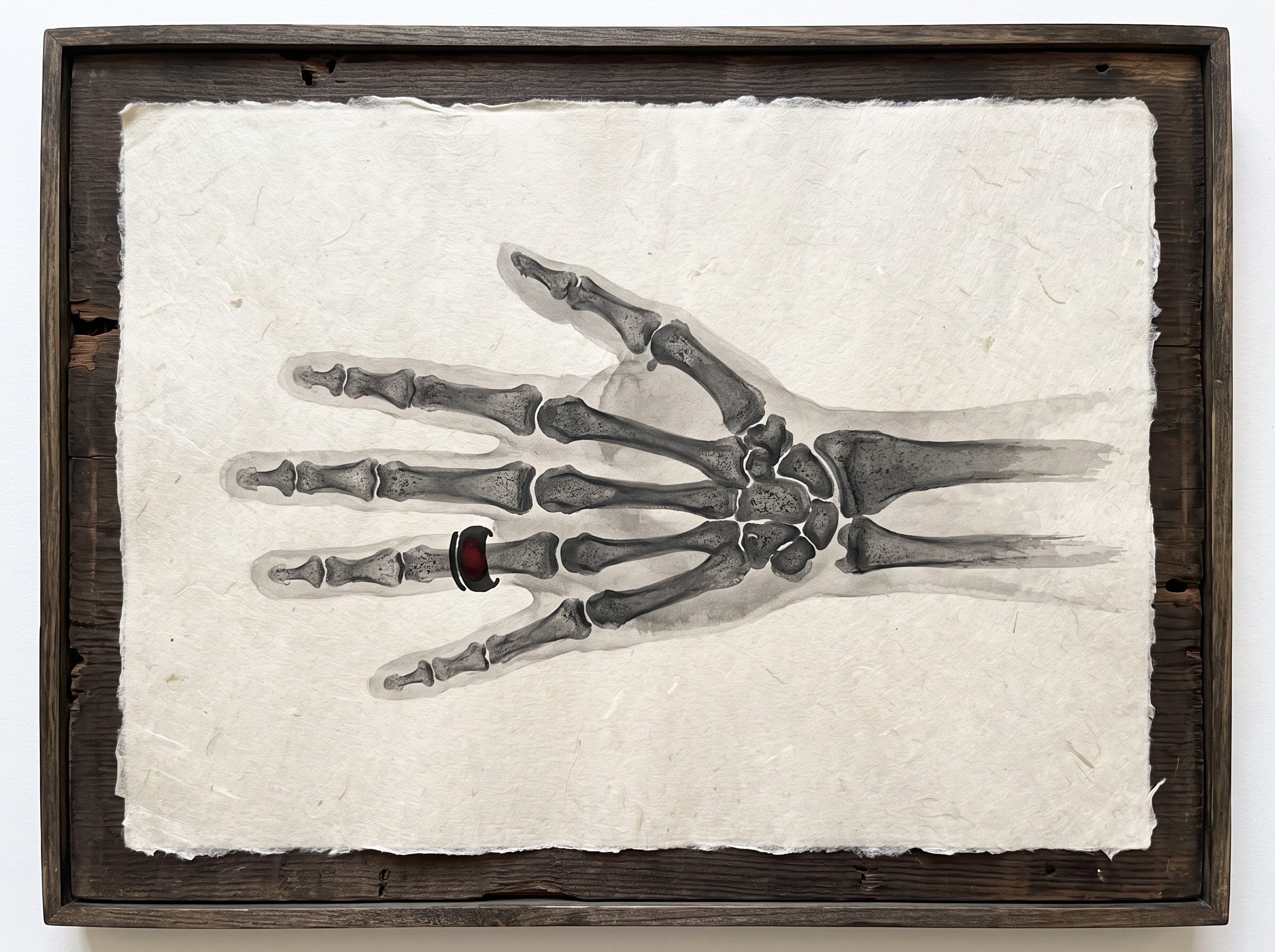
When the plate was developed, it showed something no human being had ever seen before: the living bones of her hand, dark and distinct, the flesh around them reduced to a faint translucent shadow, and the solid band of her wedding ring hovering around one finger. It is said that Anna Bertha looked at the image of her own skeleton and recoiled, murmuring, ‘I have seen my death.’ To her it was uncanny, even ghoulish, a glimpse into the grave. To the rest of the world it would soon look like a miracle.
That single photograph, the bones and the ring, is arguably the most famous scientific image of the nineteenth century. It required no education to grasp. A farmer, a duchess, a child could look at it and understand instantly that a machine could now see through human flesh. When Röntgen finally published his cautious paper, ‘On a New Kind of Rays,’ at the very end of December 1895, that picture carried the news around the globe faster than any argument could.
A Miracle, Overnight
The reaction was immediate and enormous. Within weeks, physicists everywhere were reproducing the effect, and within months, doctors were using X-rays to find bullets lodged in bodies and to set fractured bones they could finally see. A discovery made in November was saving limbs and lives by the following spring. Few breakthroughs in the whole of medicine have ever travelled from laboratory bench to hospital ward so quickly.
There was, of course, a shadow side that no one yet understood. The early experimenters bathed themselves and their patients in radiation with cheerful ignorance; burns, sores and, in time, cancers would teach a terrible lesson about the price of the invisible light. But in that first rush of 1896, the world saw only wonder, and at the centre of the wonder stood a shy Bavarian professor who wanted, more than anything, to be left alone to work.
The Fortune He Would Not Take
Here is where Wilhelm Röntgen becomes not merely an important scientist but a genuinely unusual human being. He had, in his hands, one of the most commercially valuable discoveries imaginable. Every hospital on earth would eventually want the technology. Companies were desperate to manufacture the equipment. A single well-drafted patent could have made him one of the richest men of his age, the Bavarian who owned the very idea of seeing inside the body.
He refused. Röntgen declined to patent the X-ray or any process connected with it, and he did so on principle. A discovery of nature, he held, was not a personal possession to be fenced off and rented out. It belonged to humanity, and to profit from it privately would be a kind of theft from the common good. He published his findings openly and freely, so that any physicist, any physician, any manufacturer could take up the work at once and put it to use. The extraordinary speed with which X-rays spread through the world’s hospitals is, in no small part, a direct consequence of the fact that one man chose not to lock the door behind him.

The First Nobel, Given Away Again
In 1901, when the Nobel Prizes were awarded for the very first time, the inaugural Nobel Prize in Physics went, fittingly, to Wilhelm Röntgen. It is a nice symmetry: the prize that would come to define scientific achievement began with the man who discovered the rays that still bear his name in much of the world.
Röntgen, characteristically, did not travel to give the grand lecture and accepted the honour with visible discomfort at the fuss. And then he did it again, the thing that defined him. He donated the substantial prize money to his university, to be used for scientific research. He also declined the offer of an ennobling title, the aristocratic ‘von’ before his name that would have marked him out as a nobleman of the empire. He had no interest in being Wilhelm von Röntgen. He simply wanted to be a physicist who did honest work.
The Quiet, Impoverished End
The final chapter of his life is a sober coda to all that generosity. Röntgen kept working and teaching, retiring in the years after the First World War into a Germany that was sliding toward economic catastrophe. The runaway inflation of the early 1920s devoured savings across the country, and Röntgen’s were not spared. The man who could have died a multimillionaire instead ended his days in relatively modest, even straitened, circumstances, his personal finances largely wiped out by forces far beyond his laboratory.
He died on 10 February 1923, of cancer of the intestine, a private man to the last. In keeping with his lifelong reserve, he had asked that his personal papers be destroyed after his death, and so much of his inner life went with him into the dark, unrecorded. He left behind no dynasty of patents, no vast estate, no monument he had built to himself. He left behind the X-ray.

Why the Story Still Matters
It is easy, in an age that measures discovery in market value and equity stakes, to find Röntgen almost incomprehensible. A man handed a fortune by chance and diligence, who looked at it and simply declined, is not the story our century usually tells about genius. And yet his choice is the reason a poor country’s hospital could adopt X-rays as readily as a rich one’s, the reason the technology became a shared inheritance of medicine rather than the guarded asset of a single firm.
There is a particular kind of greatness in refusing to own what could belong to everyone. Röntgen found the invisible light by accident, but giving it away was entirely deliberate, an act of character repeated at every turn: the unpatented discovery, the donated prize, the refused title, the destroyed papers of a man who never wanted to be a monument. He saw through the human hand and, in a sense, through the temptations that undo most people who touch that kind of power. The rays still carry his name across much of the world, and every time a clean image of a broken bone appears on a screen, it is worth remembering that the man who made it possible asked the world for nothing in return.
Related Reading
- The Invisible Light: How X-rays Went from Accidental Discovery to World-Changing Technology
- When X-Rays Were a Toy: The Shoe-Store Machines and the Long, Slow Dawn of Radiation Safety
- The Little Curies: How Marie Curie Built X-Ray Trucks and Drove Them Into the First World War