The Ship That the World Forgot: The MV Doña Paz and the Deadliest Peacetime Shipwreck in History

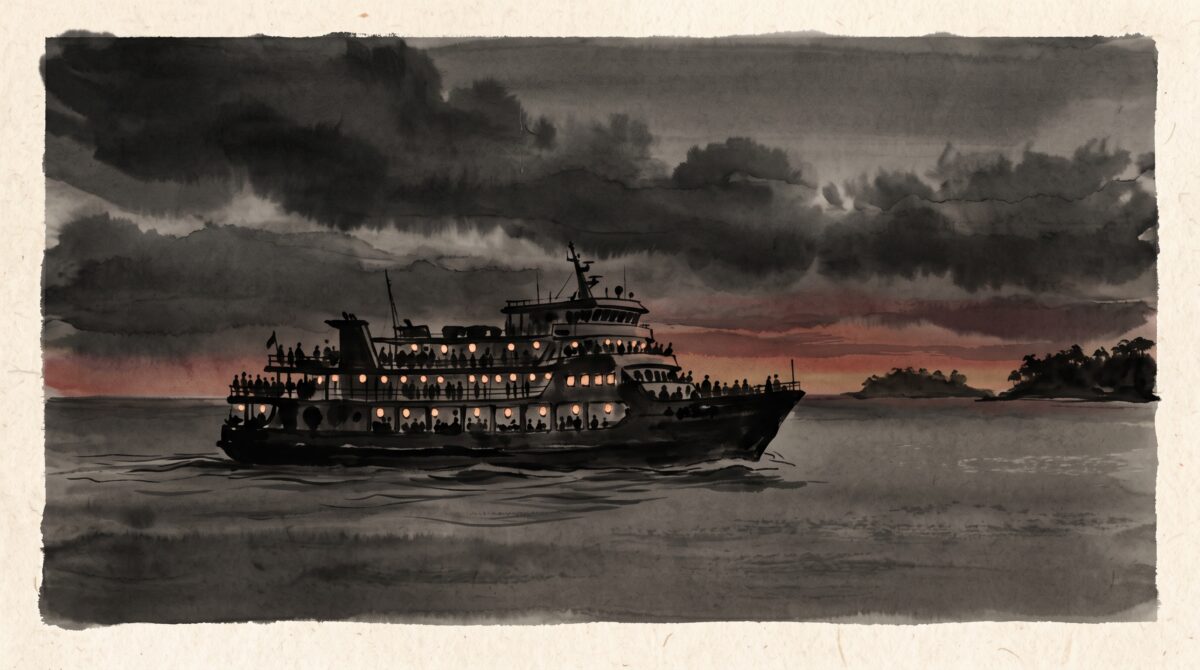
Ask almost anyone to name the worst peacetime disaster in the history of ships, and they will say the Titanic. The Titanic took roughly 1,500 lives, and more than a century later we still make films about it. Now consider a ship whose sinking killed, by the most credible estimates, well over four thousand people, more than the Titanic and the Lusitania combined, and whose name draws only a blank stare. It sank not in an age of iceberg-strewn ignorance but in December 1987, and it happened because nearly everything that could be done wrong had been done wrong at once. This is the story of the MV Doña Paz.
She was a Philippine passenger ferry running the long, ordinary route between the island of Leyte and the capital, Manila. On the night of 20 December 1987, she was crowded the way only a ferry the week before Christmas can be crowded, thick with families carrying gifts and children going home for the holidays. Her official papers listed around 1,500 souls aboard. The truth, everyone would later realise, was more than twice that.
A Floating Town, Off the Books
The Doña Paz was not a sleek liner. She was a workhorse, a bus of the sea, and like the buses of the sea she was routinely loaded past what any manifest admitted. Passengers slept in the aisles and on the stairs. Tickets were sold beyond the printed capacity; children often travelled uncounted on a parent’s lap. When investigators later tried to reconstruct how many people had actually been aboard, they could not, because no honest list had ever existed. The ship’s own manifest was a polite fiction.
That single fact, more than the fire that was coming, is why the death toll is still argued over today. The official count settled at 1,749. Survivors, relatives, and later analysts insisted the real number was closer to 4,000, with the most cited estimate reaching 4,386. The gap between those figures is not statistical noise. It is thousands of human beings who boarded a ship and were never on any record that they had lived at all.
Two Ships in the Dark
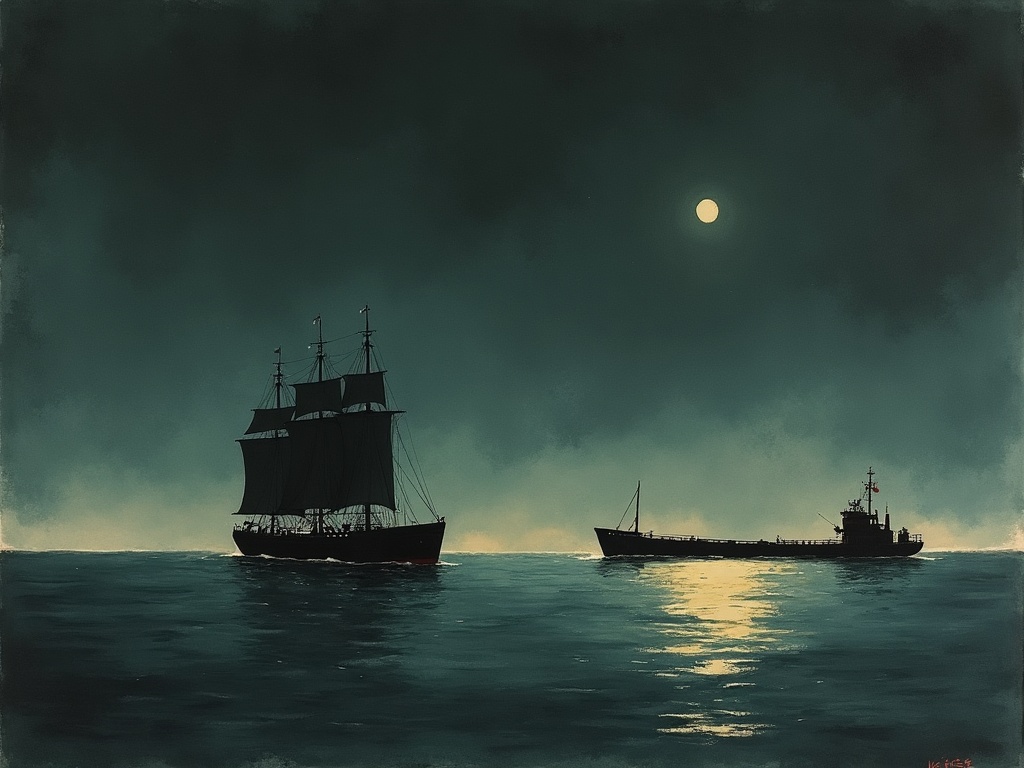
Somewhere in the Tablas Strait, the Doña Paz was moving through calm water on a clear night. Coming the other way was the MT Vector, a small coastal oil tanker laden with roughly 8,800 barrels of petroleum products bound for the island of Masbate. On paper this should have been an unremarkable passing, two vessels sliding by each other on a wide dark sea.
It was later established that the Vector was, in effect, a disaster looking for somewhere to happen. She was operating without a proper licence, was reportedly unseaworthy, and had no qualified lookout on watch at the critical moment. On the Doña Paz, accounts from the handful of survivors suggested only a single junior crewman was steering while the ship’s officers were elsewhere. Two vessels, and between them barely a competent set of eyes watching the water.
The Sea on Fire
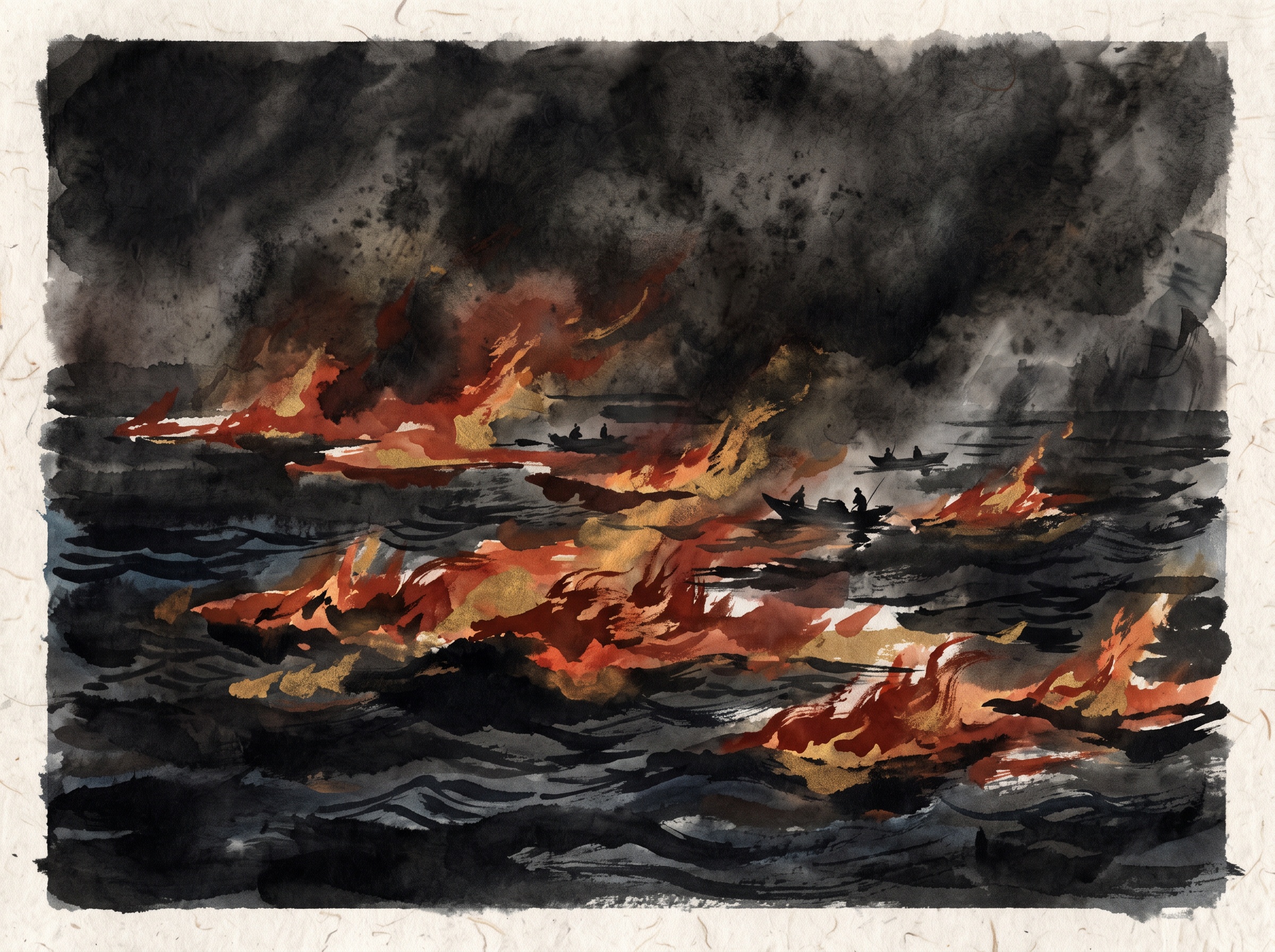
The two ships collided. Almost instantly, the Vector’s cargo of petroleum ignited, and the fire poured out across the water. This is the detail that separates the Doña Paz from an ordinary shipwreck and turns it into something closer to a vision of hell: the sea itself was burning. Flaming petroleum spread across the surface faster than a swimmer could move, so that to jump from the ship was to leap into fire, and to stay aboard was to burn with her.
The Doña Paz had no functioning radio to call for help. Survivors described life jackets locked away in cabinets, out of reach as the flames advanced. There was no orderly evacuation because there was no time and no means for one; there was only panic in the dark, a burning ship, and a burning sea. Some passengers who did make it into the water found that the strait’s other, older terror was waiting: the area was known for sharks.
Of the thousands aboard the Doña Paz, only a couple of dozen people survived. A small number of the Vector’s crew lived as well. The rest of both ships’ companies were simply gone. It had taken only a few hours, on a calm and cloudless night, in peacetime, a stone’s throw from a major shipping lane, for more people to die than in almost any single vessel loss in recorded history.
The Silence After
Rescue and recovery were slow and confused, in part because no one could agree on how many people were even missing. Bodies were pulled from an oil-slicked, scorched stretch of sea. Families in Manila and across Leyte waited for relatives who never arrived for Christmas, and many of them could not even prove their loved ones had been aboard, because the record said the ship had carried far fewer than it had.
The legal aftermath was as bleak as the night itself. Blame ricocheted between the ferry’s owner, Sulpicio Lines, and the operators of the unlicensed, unseaworthy Vector. Years of litigation followed over who should compensate the dead. For the survivors and the bereaved, justice arrived slowly, partially, and long after the world’s attention had drifted away.
Why We Forgot the Worst of All
Here is the uncomfortable question at the heart of the Doña Paz: how does the deadliest peacetime shipwreck in history become the one nobody remembers? Part of the answer is distance. It happened far from the wealthy media capitals of the world, to poor and working families in a developing nation, at a moment, days before Christmas, when the West was looking inward at its own festivities. The victims were not celebrities. There was no famous band playing on deck, no first-class staircase to immortalise. There was only an overloaded ferry and an unlicensed tanker, and a scale of loss so large it became abstract.
And perhaps that abstraction is its own kind of erasure. A single, named victim is a tragedy the mind can hold. Four thousand uncounted people, most of whose names were never written down, slide past comprehension. It is easier to remember 1,500 well-documented deaths on a legendary liner than four thousand undocumented ones on a ship most people never knew existed.

Counting the Uncounted
The Doña Paz matters precisely because she is so easy to forget. Every failure that killed those passengers was mundane and preventable: a manifest that lied, a ship loaded past sense, a tanker that should never have sailed, a watch nobody kept, life jackets behind locked doors, a radio that could not call for help. None of it required an iceberg or a war. It required only the ordinary, grinding negligence that treats some lives as too cheap to count carefully.
To remember the Doña Paz, then, is to do the one thing that was never done for the people aboard her: to insist that they be counted. Not as a statistic argued between 1,749 and 4,386, but as thousands of individual human beings, most of them heading home for Christmas, who trusted a ship to carry them and were failed by nearly everyone responsible for their safety. The sea gave the world its most famous shipwreck a lifetime ago, and we have never stopped talking about it. It also gave us its deadliest, and we have very nearly never started. That imbalance is worth sitting with, because it says less about the ships than it does about whose losses we choose to hold onto, and whose we allow the water to quietly take.
Related Reading
More from the archive
- The Batavia: Shipwreck, Mutiny, and the Bloodiest Massacre on Australia’s Shore
- The Dance of Death: The Sinking of the SS Mendi and the Men History Forgot