When Blue Didnt Exist: How Ancient Minds Saw Color and Why It Changed Everything


In 1858, British Prime Minister William Ewart Gladstone made a startling discovery that would challenge everything we thought we knew about human perception. While studying Homer’s epic poems as a classical scholar, Gladstone noticed something profoundly unsettling: the ancient Greeks seemed to live in a world without blue. Homer described the sea as “wine-dark” (oînops póntos), oxen as “wine-looking,” and sheep as violet. Most remarkably, in thousands of lines describing the heavens, seas, and natural world, the color blue appeared nowhere.
Gladstone’s observation wasn’t merely academic curiosity—it suggested that the very way humans perceive color might not be fixed and universal as we assume. His 1858 work “Studies on Homer and the Homeric Age” proposed that ancient Greeks categorized colors primarily by brightness and darkness rather than hue, lacking the sophisticated color vocabulary we take for granted today.

What Gladstone couldn’t have known was that he had stumbled upon one of the most profound questions in cognitive science: does language shape the way we literally see the world?
The Missing Blue Epidemic
A German philologist named Lazarus Geiger decided to test whether this “blue blindness” was unique to the Greeks. What he discovered was even more extraordinary. After analyzing ancient texts from across the world—Vedic hymns from India, Icelandic sagas, the Quran, ancient Chinese stories, and the original Hebrew Bible—Geiger found the same pattern everywhere.
Of the Hindu Vedic hymns, which contained more than ten thousand lines describing the heavens in elaborate detail, Geiger wrote that they were “brimming with descriptions of the heavens” yet contained not a single reference to blue. Ancient Chinese texts described everything from jade-green mountains to golden palaces, but the azure sky remained linguistically invisible. The pattern held across civilizations: humans seemed to develop words for black and white first, then red, then yellow and green, and finally—almost reluctantly—blue.
This wasn’t simply an oversight or poetic preference. These ancient cultures were describing the same physical world we see today, with the same blue skies and seas, yet somehow failing to linguistically capture what seems to us the most obvious color in nature.
The Universal Color Hierarchy
The mystery deepened in 1969 when anthropologists Brent Berlin and Paul Kay published their groundbreaking study “Basic Color Terms: Their Universality and Evolution.” After analyzing color vocabularies across 98 languages from around the world, they discovered something remarkable: colors don’t appear randomly in languages. Instead, they follow a strict, universal hierarchy.
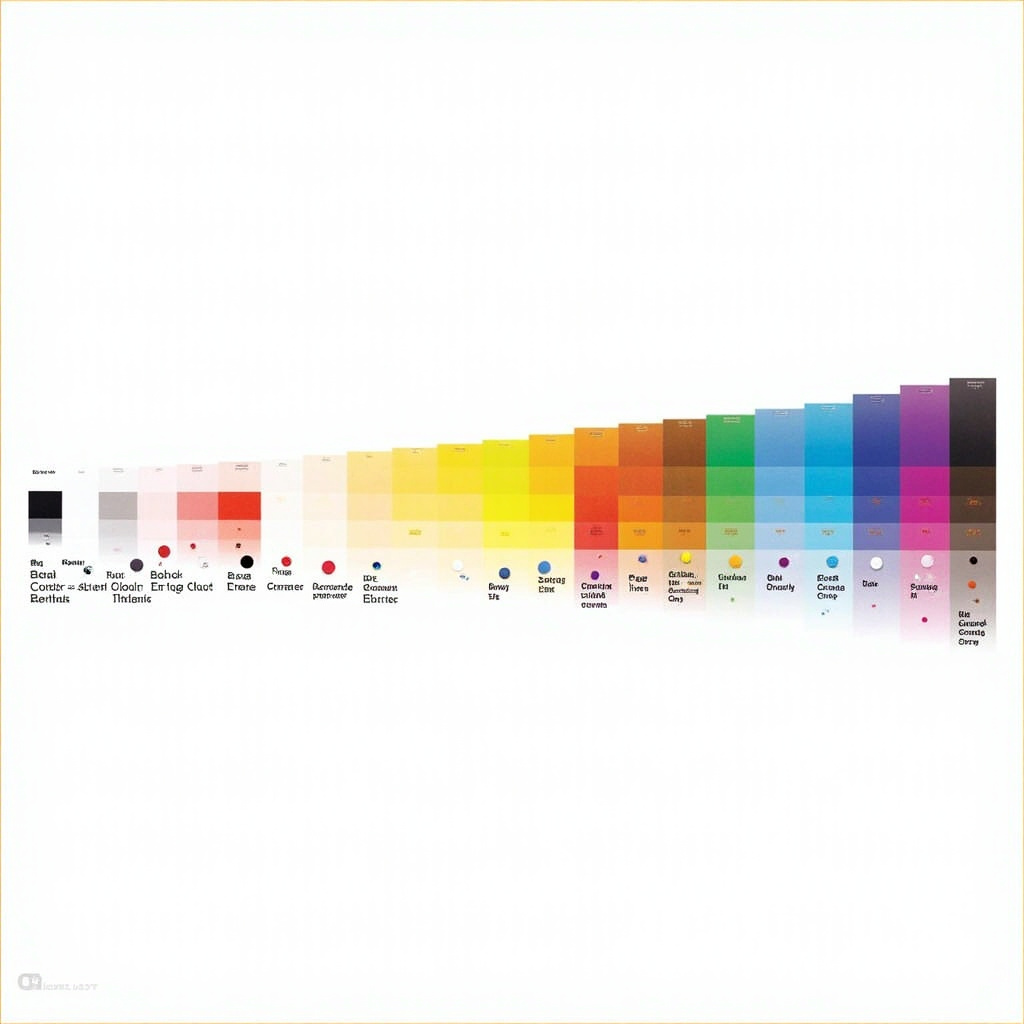
Every language starts with words for black/dark and white/bright. If a language has three color terms, the third is always red. Languages with four terms add either yellow or green. Those with five include both yellow and green. Six-term languages add blue. Seven-term languages include brown. Finally, languages with eight or more terms incorporate purple, pink, orange, and gray.
This wasn’t just correlation—it was a linguistic law as rigid as any in physics. No language Berlin and Kay studied had a word for blue without also having words for red, yellow, and green. The implications were staggering: human color perception seemed to unfold according to a universal script, with blue consistently arriving last to the linguistic party.
When Words Create Reality
The idea that language might shape thought wasn’t new. Linguists Edward Sapir and Benjamin Lee Whorf had proposed in the early 20th century that the structure and vocabulary of our language influences how we conceptualize and understand the world. The strong version of this hypothesis suggested that language determines thought entirely, while the weaker version proposed that language merely influences thinking.
For decades, this “linguistic relativity” remained largely theoretical. Then came the experiments that would prove language doesn’t just describe reality—it helps create it.
The Russian Blues Breakthrough
In 2007, researchers led by Lera Boroditsky conducted a landmark experiment with Russian speakers that would provide the first concrete evidence of language shaping color perception. Russian, unlike English, has two distinct words for what English speakers call “blue”: “goluboy” for light blue and “siniy” for dark blue. These aren’t merely shades—they’re as linguistically distinct as red and green are in English.
The experiment was elegantly simple. Researchers showed Russian and English speakers blue squares on a computer screen and asked them to identify which square was different from the others. When the odd square fell across the goluboy/siniy boundary, Russian speakers were 10% faster at spotting it than when all squares fell within the same Russian color category. English speakers showed no such advantage.
This wasn’t just about vocabulary—it was about perception itself. The Russian language had literally trained its speakers brains to see distinctions that were invisible to English speakers. Language wasn’t just describing color; it was creating perceptual boundaries.
The Himba Color Revolution
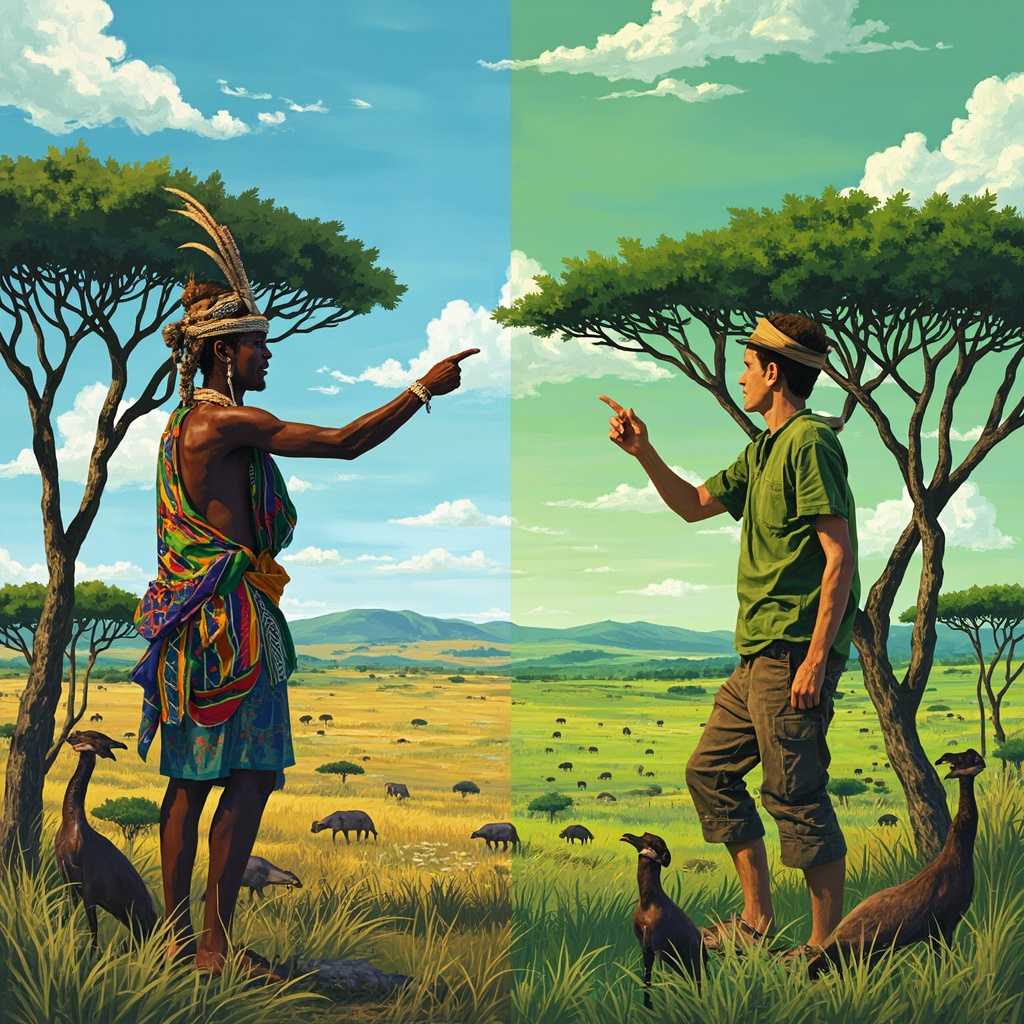
Even more dramatic evidence came from studying the Himba people of Namibia. Psychologist Jules Davidoff and his colleagues discovered that the Himba language divides the color spectrum very differently from English. Where English speakers see distinct blues and greens, Himba speakers use a single term. But where English speakers see uniform green, the Himba language distinguishes several categories.
In carefully controlled experiments, Himba speakers could easily identify subtle green distinctions that English speakers struggled with, but they had difficulty distinguishing between blues and greens that seemed obviously different to Western observers. Even more remarkably, Himba children who hadn’t yet learned color terms behaved exactly like English children who didn’t know their colors—they showed no cross-category advantage for any color distinctions.
The implications were profound: color categories aren’t hardwired into human perception. They’re learned, cultural constructs that literally reshape how we see the world.
Beyond Color: The Spatial Mind
The influence of language on perception extends far beyond color. The Guugu Yimithirr people of Australia speak a language with no words for “left” or “right”—instead, they use absolute cardinal directions. A Guugu Yimithirr speaker doesn’t say “move your right hand” but “move your north hand” or “the cup is southeast of the plate.”
Remarkably, Guugu Yimithirr speakers maintain perfect spatial orientation at all times. They can point accurately north even in unfamiliar environments, having developed a kind of internal compass that most humans lack. Their language has quite literally given them a superpower—perfect directional sense—that the rest of us can barely imagine.
Japanese Blue-Green and Traffic Light Diplomacy
The power of linguistic color categories plays out in unexpected ways in modern life. Japanese traditionally used the word “ao” (青) to describe both blue and green. When Japan adopted international traffic signals, they faced a linguistic crisis: how do you tell people to “go on green” when green is called “blue”?
Rather than change their language, Japan changed their traffic lights. A 1973 cabinet order mandated that traffic lights be “the bluest shade of green possible”—green enough to satisfy international standards, yet blue enough to still be called “ao.” To this day, Japanese traffic lights remain noticeably bluer than those in other countries, a permanent testament to the power of linguistic categories over technological standards.
The Rarity of Blue
Why does blue consistently appear last in human color vocabulary? The answer lies in the natural world around us. Blue is remarkably rare in nature—aside from the sky and deep water, there are few naturally occurring blue objects that early humans would have needed to distinguish and name.
Throughout most of human history, creating blue pigments was extraordinarily difficult and expensive. The ancient Egyptians developed the first synthetic blue pigment around 3300 BCE, but it required complex chemical processes and high-temperature kilns. For millennia afterward, the only sources of blue pigment were rare minerals like lapis lazuli, which had to be imported from remote mines in Afghanistan at costs that often exceeded gold.
This scarcity explains why medieval European paintings often depicted golden skies rather than blue ones—artists simply couldn’t afford blue paint. When Vermeer used costly ultramarine blue in his paintings, he was often painting with pigments worth more than the subjects entire wardrobe. The phrase “true blue” comes from this era, referring to expensive blue dyes that wouldn’t fade, unlike cheaper alternatives.
The Neuroscience of Color Categories
Modern neuroscience has revealed exactly how language creates perceptual boundaries in the brain. When we categorize colors linguistically, we literally strengthen neural connections that enhance our ability to distinguish between different categories while reducing our sensitivity to differences within categories.
Brain imaging studies show that color discrimination activates language regions in the left hemisphere, but only when colors cross linguistic boundaries. When Russian speakers distinguish between goluboy and siniy blues, their language centers light up. When they distinguish between two different shades of goluboy, those same regions remain quiet.
This “categorical perception” isn’t limited to color—it’s how the brain handles all kinds of sensory input. By creating discrete categories out of continuous spectra, language helps us navigate a world of infinite variation by focusing our attention on differences that matter.
The Gladstone Legacy
Guy Deutscher, in his 2010 book “Through the Language Glass,” synthesized decades of research to argue that Gladstone’s original observation was more prescient than anyone realized. Language doesn’t determine what we can see, but it profoundly influences what we choose to notice and remember.
The ancient Greeks weren’t colorblind—they could see blue as clearly as we can. But without a word for blue, they had no reason to treat it as a distinct category worthy of attention. Their “wine-dark sea” wasn’t a failure of perception but a different way of organizing visual experience, one that prioritized darkness and luminosity over hue.
Colors in the Digital Age
Today’s debates over whether a viral dress is “blue and black” or “white and gold” reveal that Gladstone’s questions remain surprisingly relevant. Our digital age has created new color experiences—RGB displays, CMYK printing, Pantone color matching—that require ever more precise color vocabularies.
Meanwhile, languages continue to evolve their color systems. English has gained new terms like “cyan” and “magenta” from printing technology, while fashion and design industries constantly coin new color names. Each new term potentially creates new perceptual boundaries, subtly reshaping how we see the world.
The story of blues emergence in human language isn’t just historical curiosity—it’s a window into how our minds construct reality from raw sensation. Every time we name a color, were participating in the same process that led ancient humans to distinguish red before yellow, yellow before blue, and blue before all the subtle variations we now take for granted.
In the end, Gladstone’s “wine-dark sea” reminds us that the world we see isn’t just shaped by our eyes—its sculpted by our words, one color term at a time. The next time you look at a blue sky or green forest, remember: somewhere in your brain, language is quietly deciding what you notice, what you remember, and what youll describe to others. The colors you see are not just physics—they’re the accumulated vocabulary of thousands of years of human experience, crystallized into categories that shape perception itself.
More from the archive
- When Vesuvius Turned a Human Brain Into Glass: The Strangest Archaeological Discovery of 2025
- The Invisible Light: How X-rays Went from Accidental Discovery to World-Changing Technology
- The Man Who Survived a Metal Rod Through His Brain: How Phineas Gage Changed Neuroscience Forever