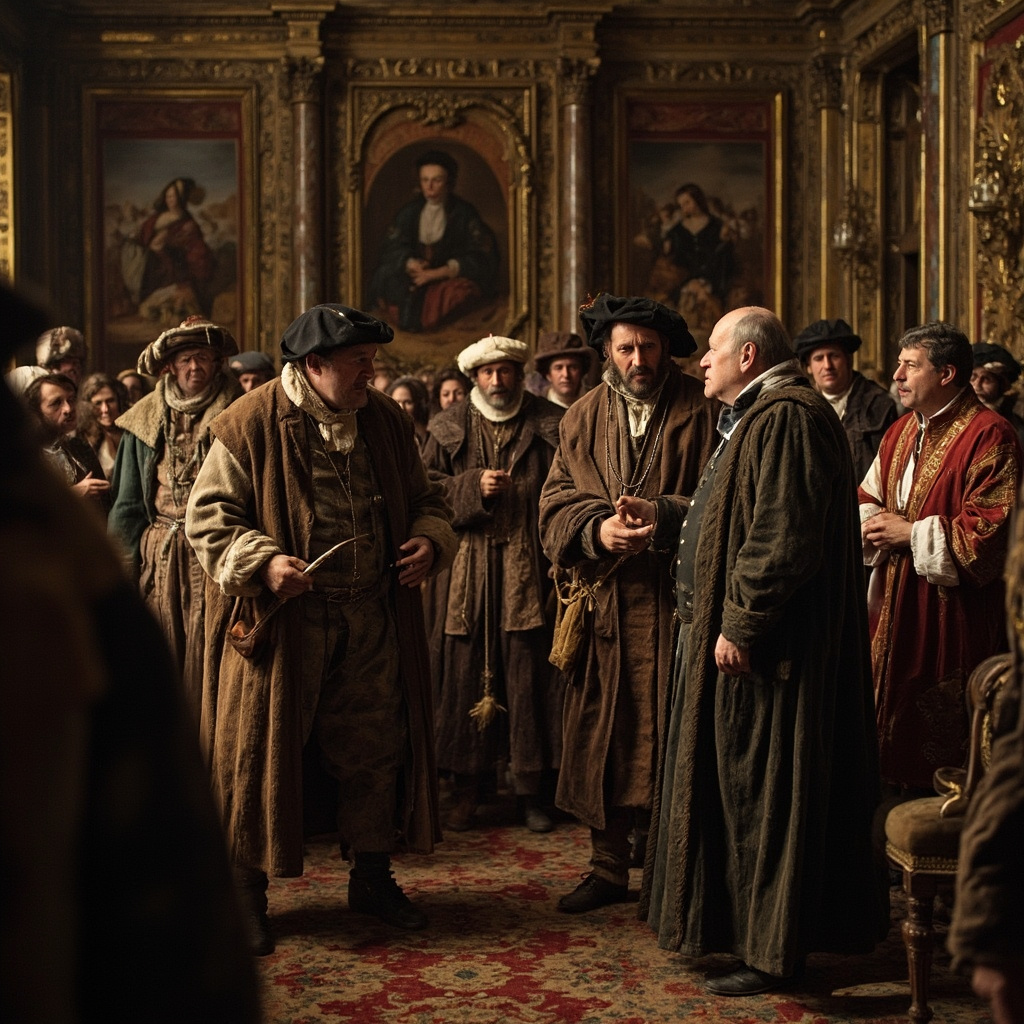
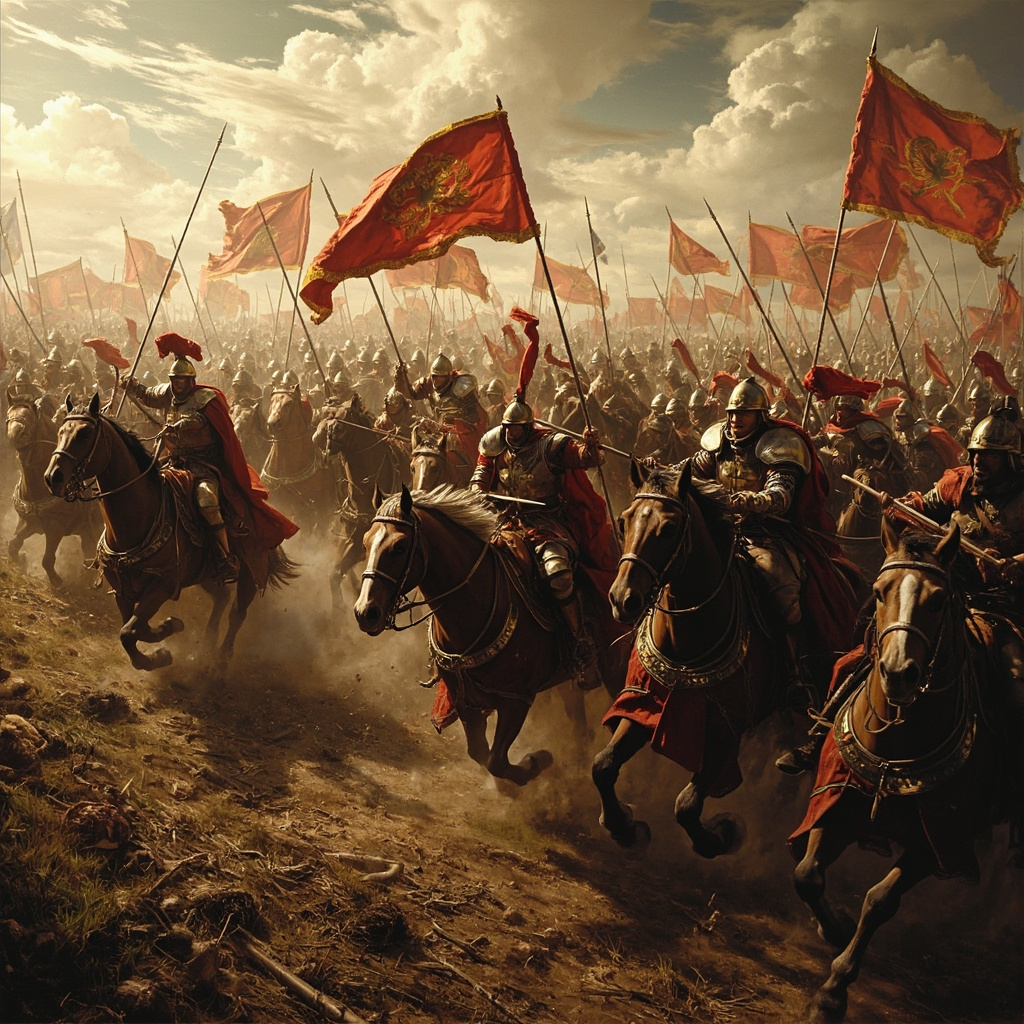
In January 532, a cheer from the chariot races became a battle cry. For five days a mob burned Constantinople to the ground and crowned a rival emperor, until the empress Theodora refused to run and the streets ran red with thirty thousand dead.
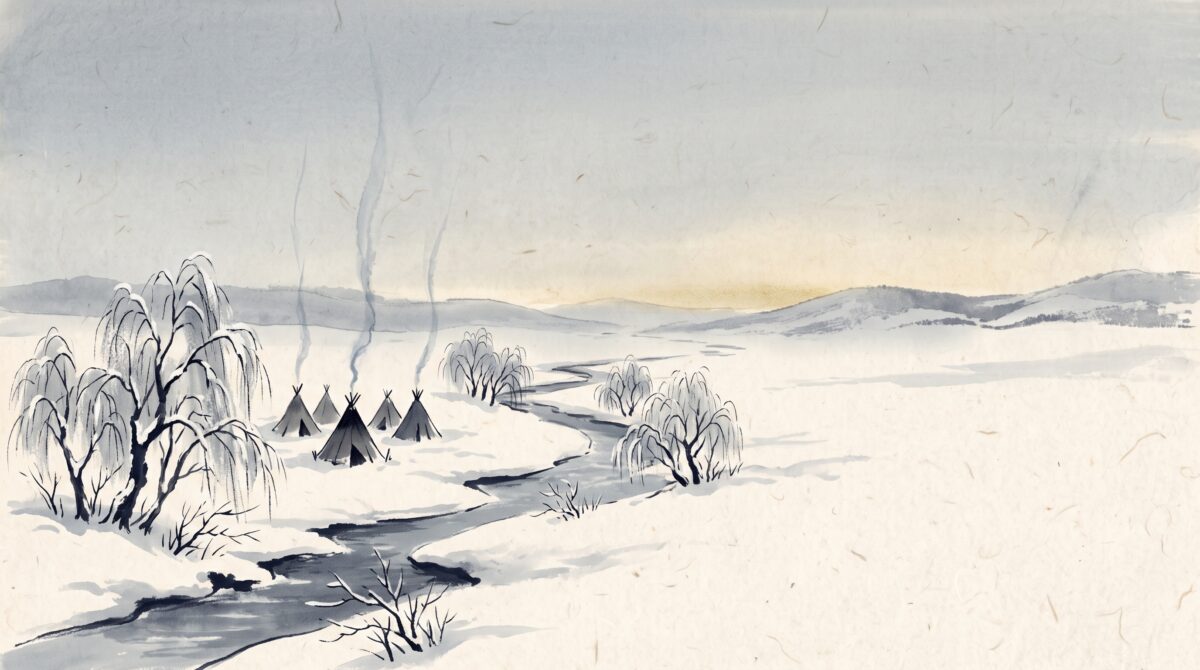
On a frozen January dawn in 1863, U.S. soldiers surrounded a sleeping Shoshone village on the Bear River and killed more people than fell at Wounded Knee. It was the deadliest single slaughter of Native Americans in United States history — and for more than a century, almost no one remembered it.
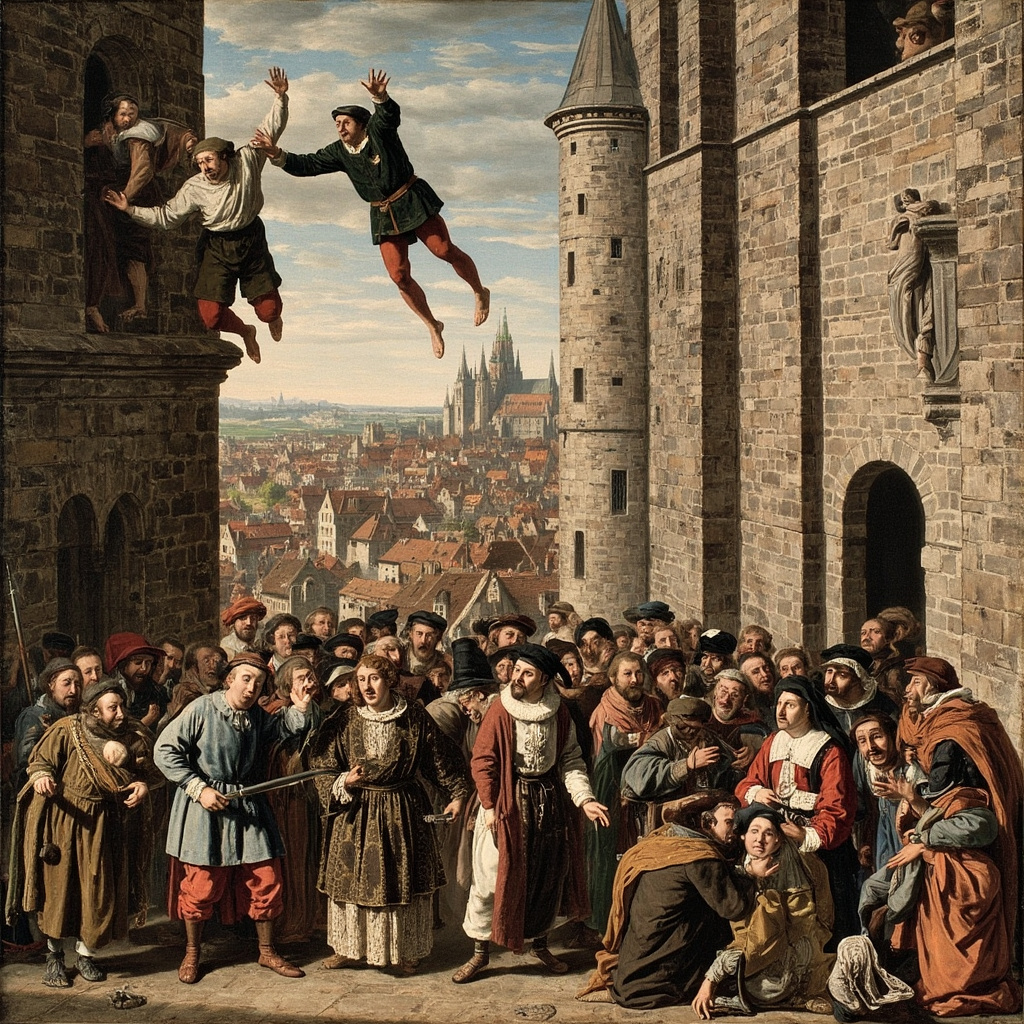
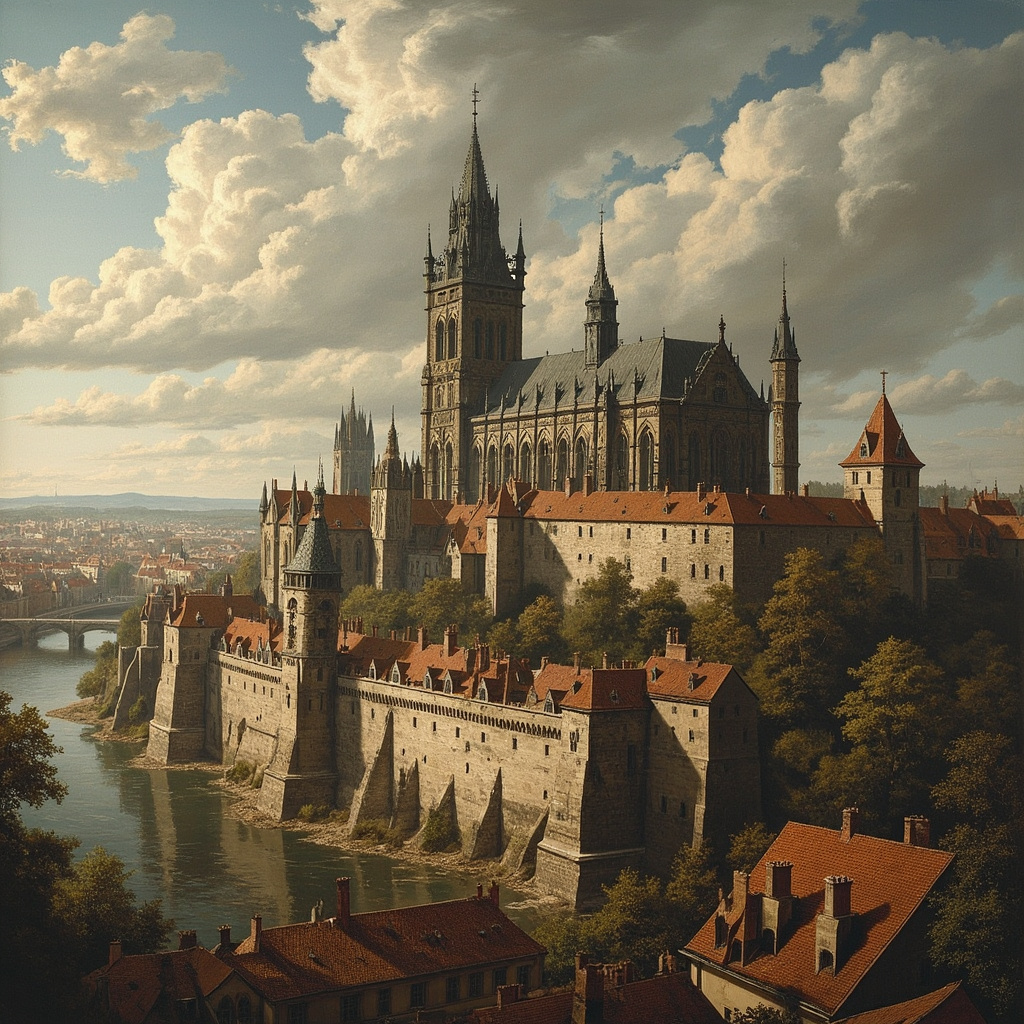
On May 23, 1618, a group of angry Protestant nobles did something so dramatic it would plunge Europe into three decades of devastating warfare. They threw three Catholic officials out of a third-story window at Prague Castle—an act that became known as the Defenestration of Prague and sparked the Thirty Years’ War, one of the most destructive conflicts in European history.
The Religious Powder Keg
The Kingdom of Bohemia in the early 17th century was a religious and political tinderbox. The Holy Roman Emperor Ferdinand II, a devout Catholic, was systematically rolling back Protestant rights that had been granted under the previous emperor. In Bohemia, where Protestantism had deep roots dating back to the reformer Jan Hus, tensions were reaching a breaking point.
The immediate crisis began when Ferdinand’s Catholic regents in Prague began restricting Protestant church construction and religious practices. This violated the Letter of Majesty, a 1609 agreement that had guaranteed religious freedom to Bohemian Protestants. The Protestant nobles, led by Count Heinrich Matthias von Thurn, decided they had endured enough.
The Fateful Meeting
On that spring morning in 1618, the Protestant nobles stormed into the meeting room at Prague Castle where the Catholic regents were holding session. They singled out two particular targets: Jaroslav Bořita von Martinicz and Wilhelm Slavata, both staunch Catholics whom they accused of orchestrating the religious persecution.
The confrontation was brief but explosive. The Protestants accused the regents of plotting to subvert Bohemian religious liberty and of betraying their oaths. When the regents refused to back down, the nobles decided on a dramatic punishment that deliberately echoed Bohemian history.
Out the Window They Went
The defenestration wasn’t random violence—it was a calculated political statement. In 1419, Prague had witnessed its first famous defenestration when Hussite revolutionaries threw seven city councillors from the windows of Prague’s New Town Hall. By recreating this act, the Protestant nobles were invoking a powerful symbol of Bohemian resistance to foreign rule.
Along with the two regents, the Protestants also threw out their secretary, Philipp Fabricius. All three men plummeted from the third-story window—a fall of approximately 70 feet that should have been fatal.
The Miracle of Manure
Remarkably, all three men survived their dramatic flight. Catholic propagandists immediately claimed this was divine intervention—that angels had swooped down to save the righteous officials. The reality was more mundane but no less fortunate: the window opened directly above a large pile of manure and garbage that had accumulated below the castle walls.
This soft, if malodorous, landing cushioned their fall and saved their lives. Martinicz and Slavata were able to walk away with only minor injuries, though their dignity suffered considerably more damage than their bones.
Europe Goes to War
The defenestration was far more than a symbolic gesture—it was a declaration of rebellion. The Bohemian estates rejected Ferdinand II as their king and elected Frederick V, Elector Palatine, in his place. This act of defiance triggered a conflict that would rage across Europe for thirty years.
What began as a religious dispute in Bohemia soon drew in every major European power. Catholic Spain and the Holy Roman Empire faced off against Protestant powers including Sweden, Denmark, and France (which supported the Protestant cause despite being Catholic, purely to weaken Habsburg power). The war would ultimately kill millions and reshape the political map of Europe.
The Power of a Single Act
The Defenestration of Prague demonstrates how a single dramatic moment can change the course of history. The Protestant nobles couldn’t have imagined that their act of rebellion would lead to three decades of warfare, economic collapse, and social upheaval across central Europe. The Thirty Years’ War wouldn’t end until 1648 with the Peace of Westphalia, which established new principles of national sovereignty that still influence international relations today.
Ferdinand II eventually regained control of Bohemia and imposed harsh Catholic rule, but the broader war had shown that religious unity could no longer be imposed by force. The age of religious wars was ending, and the modern state system was being born—all because some angry nobles decided to throw their enemies out a window rather than negotiate.
On the morning of August 27, 1896, a single Thursday changed the record books forever. What began as a succession dispute in the Sultanate of Zanzibar would conclude just 38 minutes later, earning the dubious honor of being the shortest war in recorded history. The Anglo-Zanzibar War proved that sometimes the most dramatic conflicts are measured not in years or months, but in minutes.
The Spark That Lit the Fuse
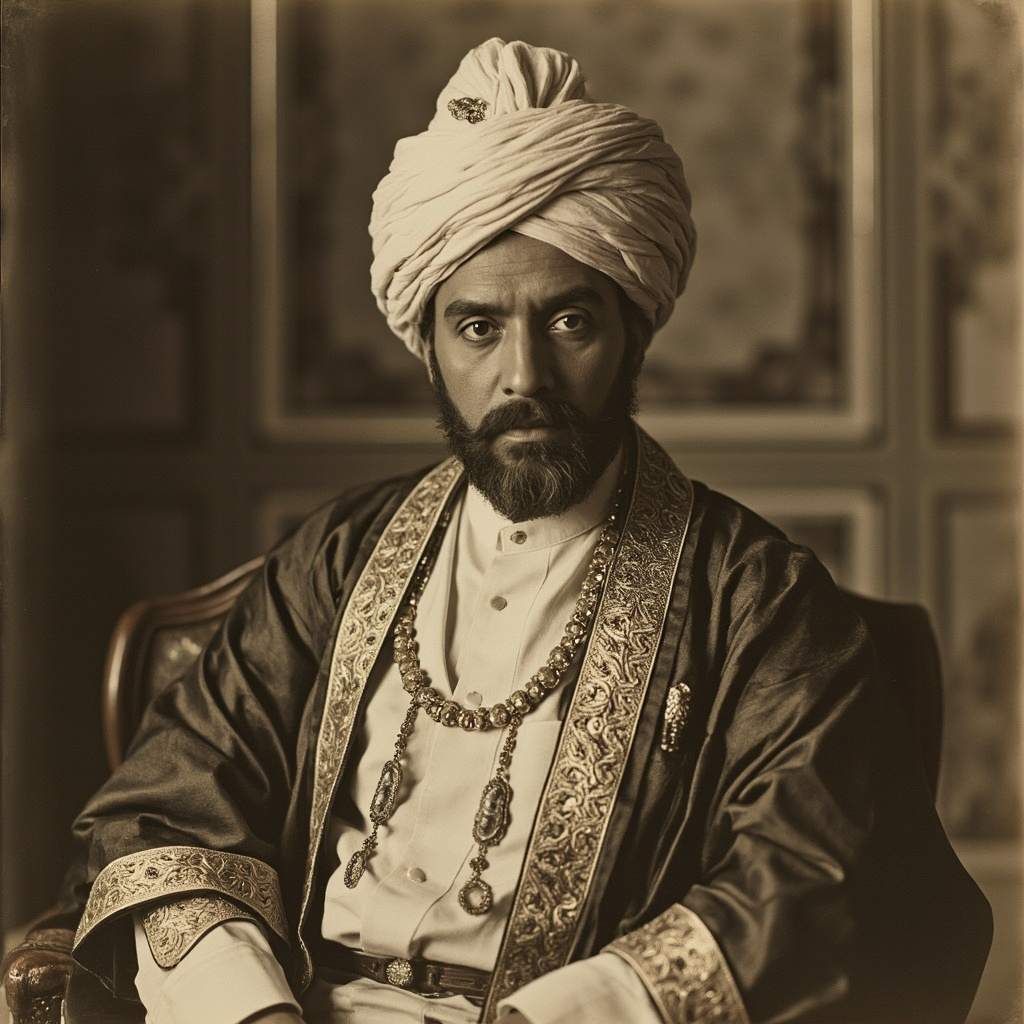
The crisis began two days earlier when Sultan Hamad bin Thuwaini, a British-friendly ruler, died suddenly at 11:40 AM on August 25, 1896. Within hours, his cousin Khalid bin Barghash had seized the palace and declared himself sultan, directly violating British expectations. The British had supported Hamad specifically because of his cooperative stance, and they weren’t about to let his replacement ignore their authority.
Khalid’s bold move put him on a collision course with the British Empire at its height. The British consul-general, Basil Cave, immediately demanded that Khalid step down and allow British-preferred candidate Hamoud bin Mohammed to take the throne. When Khalid refused and began fortifying the palace with his small army of about 2,800 men, armed with rifles, cannons, and one ancient cannon called “Glasgow,” the die was cast.
A Ticking Clock
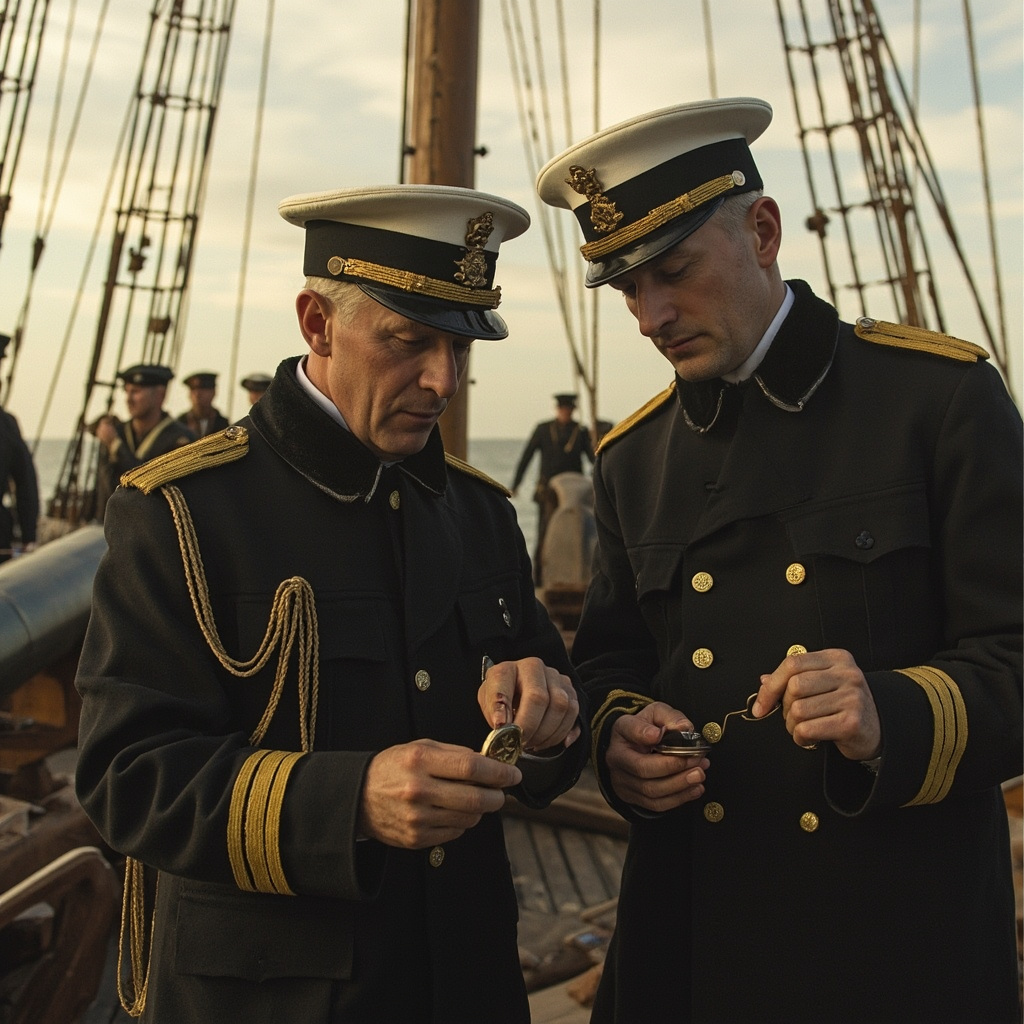
British Rear-Admiral Harry Rawson wasn’t playing games. He assembled a naval force of five warships and about 900 marines and sailors, then issued an ultimatum: Khalid had until 9:00 AM on August 27 to vacate the palace or face the consequences. The British were confident in their superior firepower, including modern naval guns that could reduce the wooden palace to rubble in minutes.
As the deadline approached, tensions mounted. Khalid had gathered his forces in and around the palace, hoping his show of strength might deter British action. Meanwhile, curious civilians gathered at a safe distance to witness what everyone sensed would be a historic confrontation.
38 Minutes of Destruction
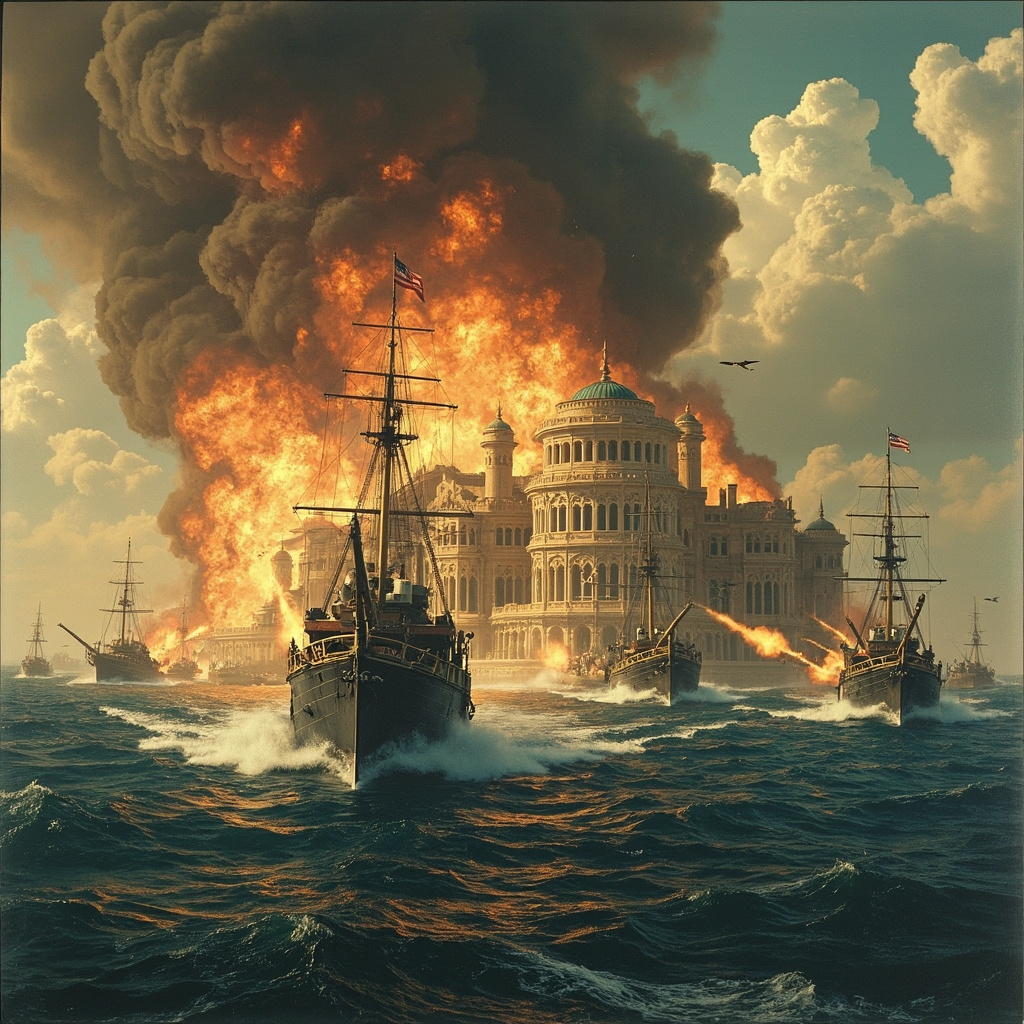
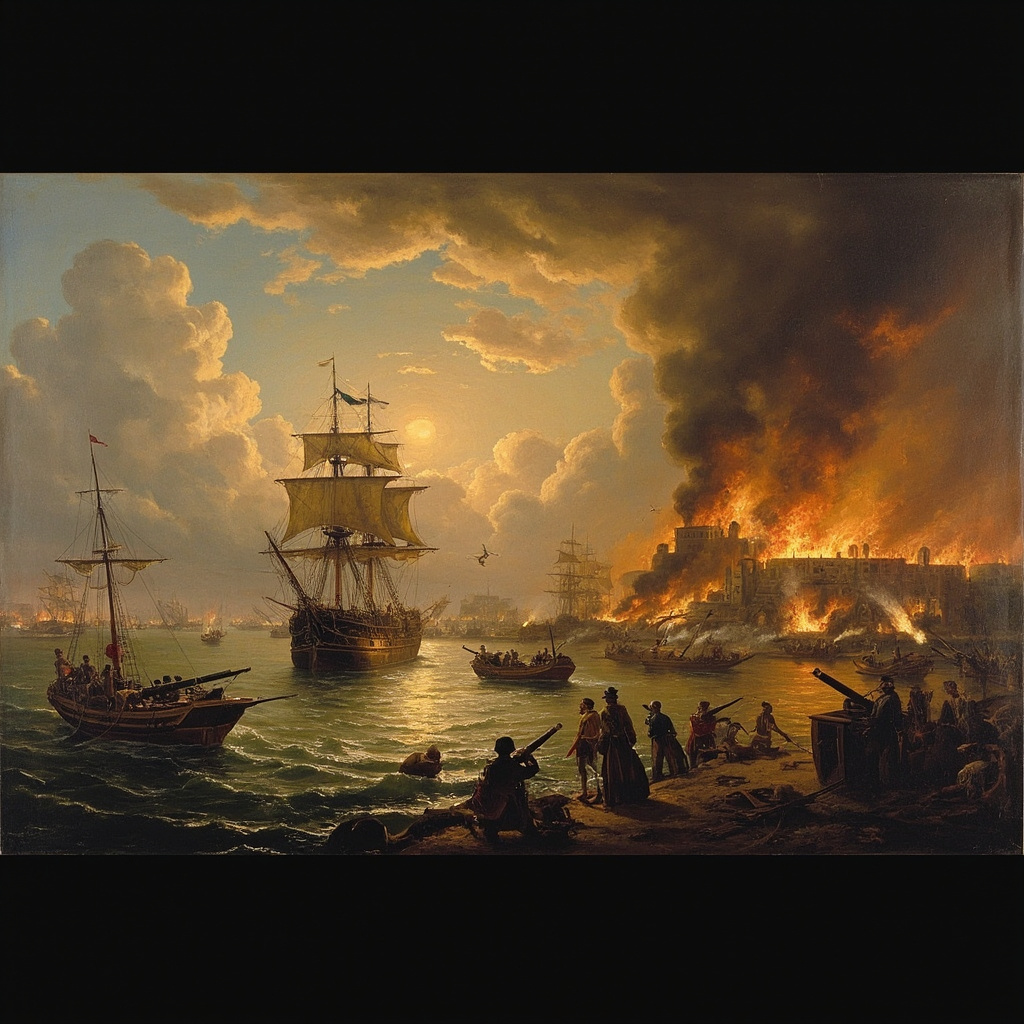
At exactly 9:02 AM, when Khalid failed to lower his flag and surrender, Admiral Rawson gave the order to commence firing. The British warships HMS St. George, HMS Philomel, and HMS Thrush opened fire on the palace with devastating effect. The wooden structure, despite being defended by stone walls, was no match for modern British naval artillery.
The palace burst into flames almost immediately. Khalid’s forces fought back bravely but hopelessly, their outdated weapons and single small gunboat proving utterly inadequate against British firepower. The royal yacht HHS Glasgow was sunk within the first few minutes, and the palace’s defenses crumbled under the relentless bombardment.
The Aftermath: Victory in Record Time
By 9:40 AM, exactly 38 minutes after the first shot was fired, the sultan’s flag was hauled down in surrender. Khalid himself had fled to the German consulate seeking asylum, leaving his forces to face the British alone. The shortest war in history was over, but the human cost was significant despite the brief duration.
British casualties were remarkably light—just one sailor wounded. The sultan’s forces, however, paid a much heavier price. Approximately 500 of Khalid’s men were killed or wounded in the brief but intense bombardment. The palace lay in ruins, and the sultan’s cause was utterly destroyed.
The New Sultan and British Control
With Khalid in exile, the British immediately installed their preferred candidate, Hamoud bin Mohammed, as the new sultan. Hamoud would rule under British protection and guidance, ensuring that Zanzibar remained firmly within Britain’s sphere of influence. The new sultan’s first official act was to outlaw slavery in Zanzibar, a move that aligned with British interests and humanitarian goals.
A War for the Record Books
The Anglo-Zanzibar War holds several distinctions beyond its brevity. It was one of the first conflicts to be recorded with precise timing, thanks to the British military’s attention to detail and the presence of war correspondents. It also demonstrated the overwhelming technological advantage that European powers held over local rulers in Africa during the colonial period.
Perhaps most remarkably, the war began and ended on a single Thursday morning, allowing British officers to return to their ships for lunch as if nothing extraordinary had happened. Yet in those 38 minutes, the political landscape of East Africa was permanently altered, and a place was secured in the history books for the most efficient military victory in human history.
The Anglo-Zanzibar War serves as a stark reminder that in the age of empire, superior technology and firepower could resolve conflicts with shocking speed. It also highlights how quickly political situations could escalate when colonial powers felt their interests were threatened. While lasting less than an hour, this “war” encapsulated the brutal efficiency of 19th-century imperial power and left an indelible mark on the history of both Britain and Zanzibar.
In the annals of bizarre military conflicts, few can match the sheer absurdity of the War of Jenkins’ Ear. This nine-year struggle between Britain and Spain (1739-1748) has the distinction of being named after a severed human ear—specifically, the ear of British sea captain Robert Jenkins, which was allegedly cut off by Spanish coast guards in 1731.
The story begins with Jenkins, a British merchant captain whose ship Rebecca was stopped and searched by Spanish customs officers in the Caribbean. According to Jenkins’ later testimony, the Spanish guards accused him of smuggling and, during the confrontation, one of them sliced off his ear while shouting “Take this to your King!” Jenkins claimed he picked up his severed ear and preserved it in a jar of brandy.
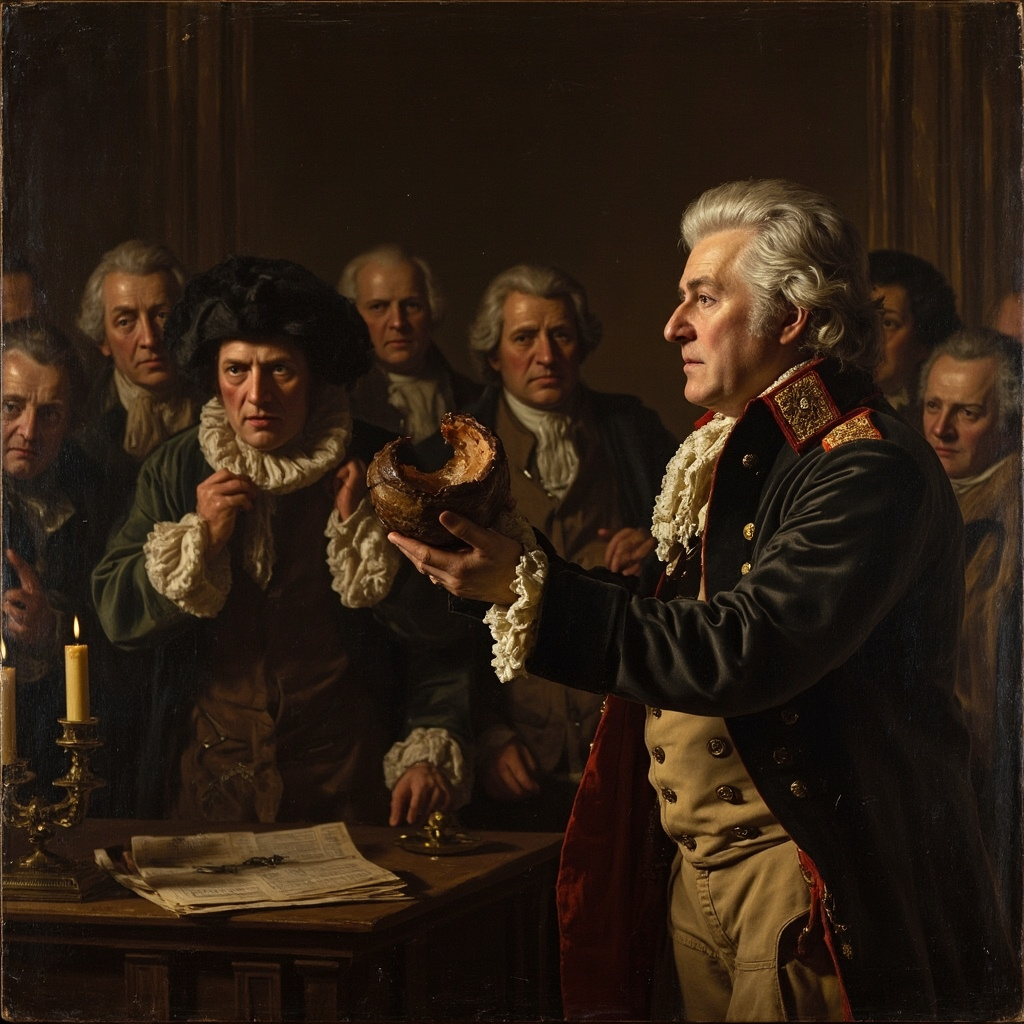
For seven years, this incident remained relatively obscure. However, in 1738, British opposition politicians—eager to undermine Prime Minister Robert Walpole’s peaceful foreign policy—dragged Jenkins before Parliament. In a dramatic performance, Jenkins allegedly produced his preserved ear from the jar and declared that when the Spanish guard cut it off, he had commended his soul to God and his cause to his country.
The Spark That Ignited War
The exhibition of Jenkins’ ear in Parliament was a masterful piece of political theater. The opposition Tories, who wanted war with Spain to expand British trade in the Americas, used the grisly artifact to whip up anti-Spanish sentiment. The incident became a symbol of Spanish arrogance and British humiliation, despite the fact that such searches were legal under the 1729 Treaty of Seville, which allowed Spanish officials to board British ships suspected of smuggling.
The reality was more complex than the propaganda suggested. British merchants had been systematically violating Spanish trade restrictions in the Caribbean, using legal trading licenses as cover for extensive smuggling operations. The Spanish, trying to protect their colonial monopoly, had stepped up enforcement—leading to numerous confrontations at sea.
Vernon’s Early Victories
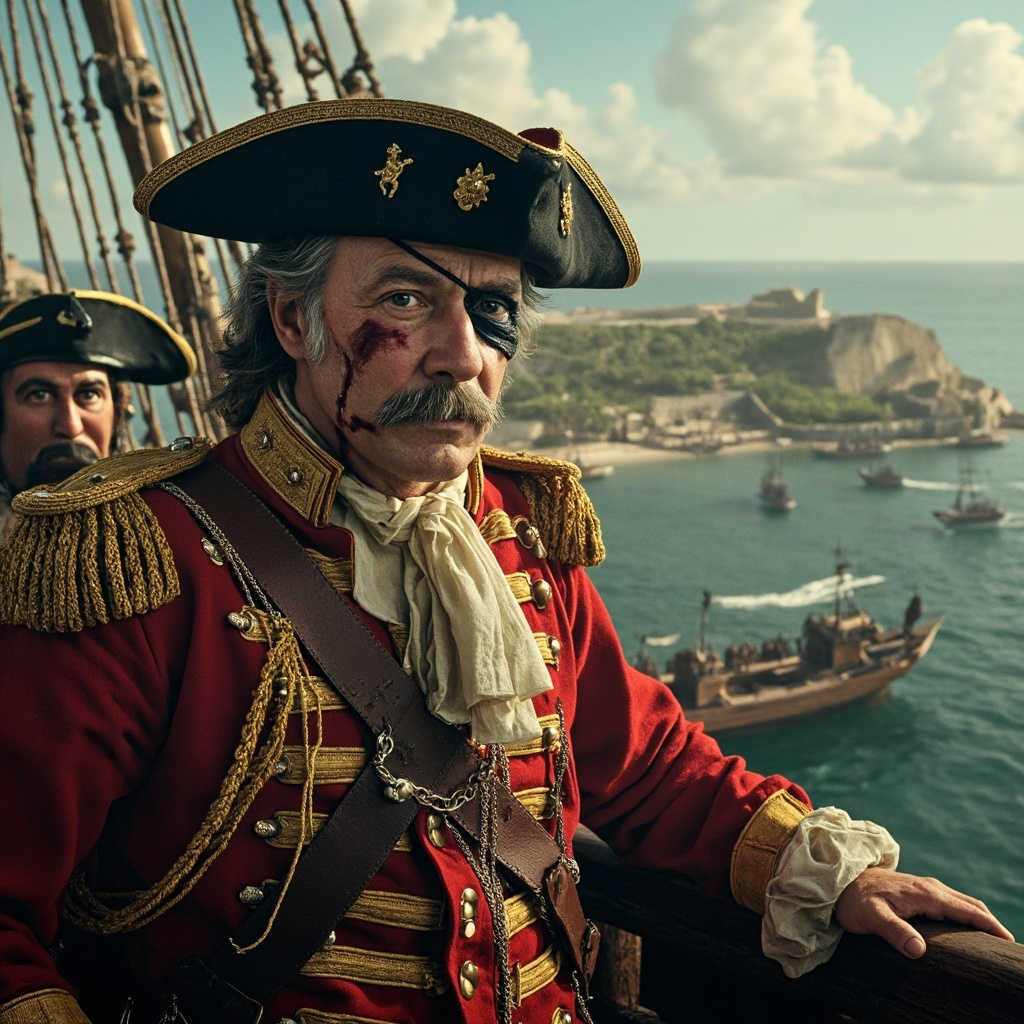
When war was declared in October 1739, the British public expected quick victories. Admiral Edward Vernon delivered exactly that, capturing the Spanish port of Portobelo (in present-day Panama) in November 1739 with remarkable ease. The victory was so celebrated that the famous song “Rule Britannia” was written to commemorate it, and numerous places in Britain were named after Portobelo.
Vernon’s success led to wild celebrations and the premature minting of commemorative medals showing Spanish defenders surrendering. The ease of the victory convinced British leaders that Spain’s American empire was ripe for conquest.
The Disaster at Cartagena
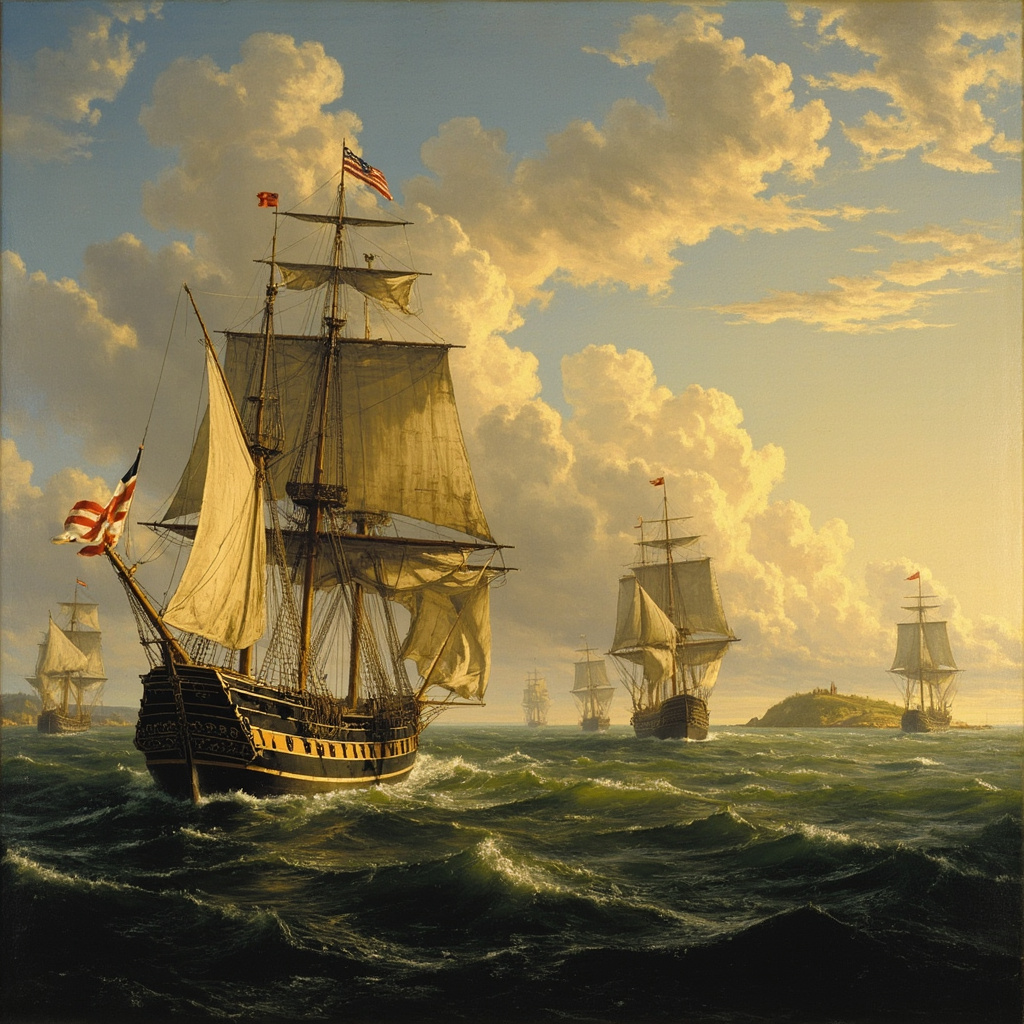
Emboldened by success, the British assembled one of the largest fleets ever sent to the Americas—186 ships carrying over 27,000 men, including soldiers, sailors, Jamaican slaves, and colonial volunteers from North America. Among these volunteers was Lawrence Washington, older half-brother of future U.S. President George Washington.
In March 1741, this massive armada attacked Cartagena de Indias (in modern-day Colombia), one of Spain’s most important ports in the Americas. Defending the city was Admiral Blas de Lezo, a remarkable Spanish officer who had lost an eye, a leg, and the use of one arm in previous battles—earning him the nickname “Mediohombre” (Half-man).
Despite being vastly outnumbered, Lezo’s brilliant defense turned the British siege into a catastrophe. The British forces, commanded jointly by Vernon and General Thomas Wentworth (who despised each other), suffered from poor coordination, inadequate supplies, and devastating tropical diseases. Yellow fever and other illnesses killed more British soldiers than Spanish bullets ever would.
After two months of futile attacks, Vernon was forced to withdraw. Of the 27,000 men who had arrived, only about 7,000 were still fit for duty. The Spanish defenders had lost fewer than 1,000 men. News of this disaster helped bring down Prime Minister Walpole’s government and shocked British confidence in their naval supremacy.
The War’s Strange Legacy
The War of Jenkins’ Ear eventually merged with the larger War of the Austrian Succession and formally ended with the Treaty of Aix-la-Chapelle in 1748. Despite nine years of conflict, the treaty restored the status quo—Britain had failed to achieve any of its territorial or trade objectives in Spanish America.
The war left several curious legacies. Lawrence Washington, who survived the yellow fever outbreak at Cartagena, named his Virginia estate Mount Vernon in honor of Admiral Vernon. This estate would later become famous as George Washington’s home. Meanwhile, the South Sea Company, which had held Britain’s trading privileges with Spanish America, quietly ceased operations.
Perhaps most remarkably, the war that began with a severed ear ultimately proved that Spain’s American empire was far more resilient than British politicians had assumed. The treasure fleets continued to sail, the colonies remained Spanish, and Britain’s dreams of Caribbean conquest would have to wait for another day.
The War of Jenkins’ Ear stands as a testament to how the most trivial incidents can escalate into major conflicts when political ambition and national pride are involved. In the end, a preserved ear in a jar of brandy had launched a thousand ships and cost tens of thousands of lives—all for remarkably little strategic gain.
Imagine living through the most defining war in American history, only to discover that fate had chosen your property as both the opening act and final curtain. This was the extraordinary reality for Wilmer McLean, a Virginia grocer who could rightfully claim, “The war began in my front yard and ended in my front parlor.”
McLean’s story represents one of history’s most remarkable coincidences, where a single man became an unwitting bookend to the American Civil War. His experience spans from the first major battle at Bull Run to the surrender at Appomattox Court House, making him perhaps the only civilian to witness both the war’s violent beginning and its peaceful conclusion on his own property.
When War Came to the Kitchen
In July 1861, Wilmer McLean was a prosperous wholesale grocer living at Yorkshire Plantation near Manassas Junction, Virginia. His two-story brick home sat peacefully in the Virginia countryside, complete with a well-maintained yard and outbuildings typical of a successful merchant’s estate.
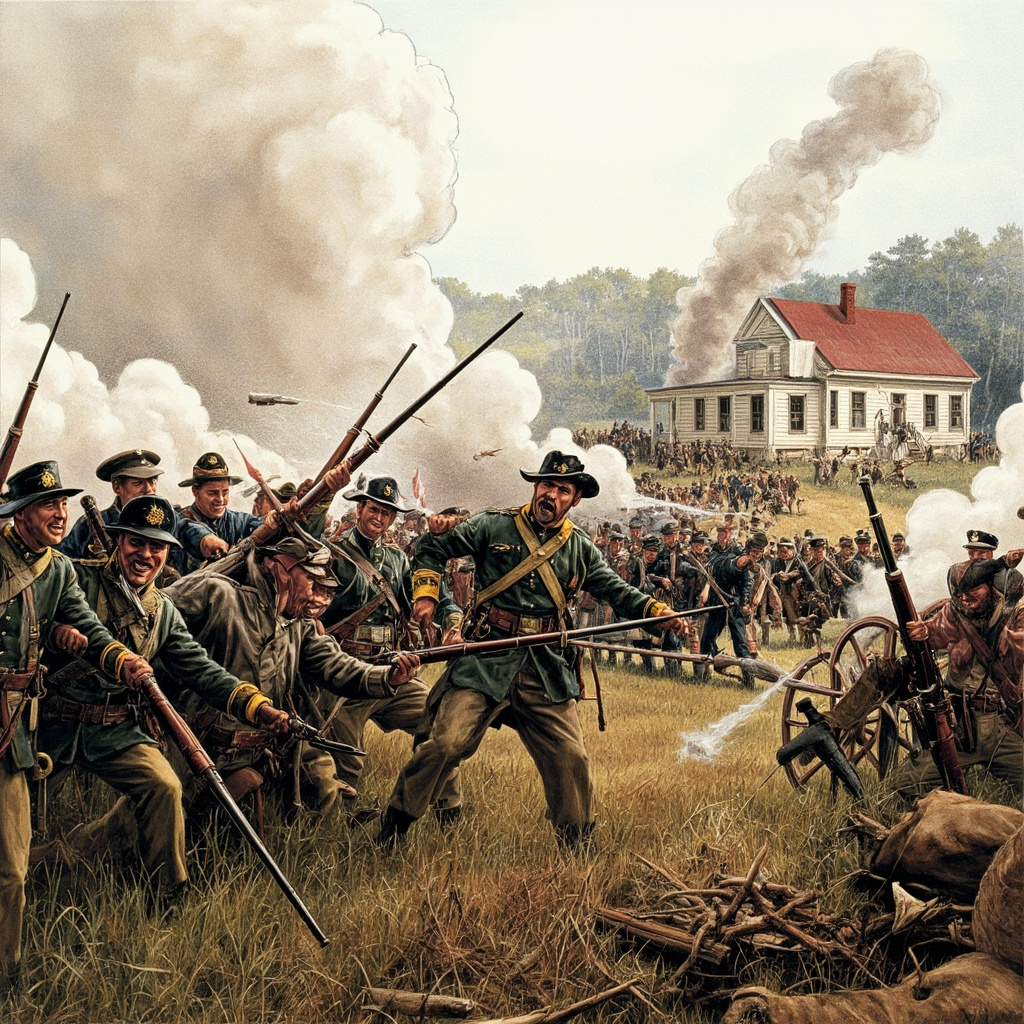
On July 18, 1861, McLean was enjoying breakfast in his kitchen when a cannonball from Union artillery crashed through his fireplace. This wasn’t just an unlucky shot—it marked the opening bombardment of what would become the First Battle of Bull Run, the Civil War’s first major engagement. Great wars often ignite from a single dramatic moment in one place — the Thirty Years’ War began when rebels hurled royal officials out of a Prague window — yet McLean’s land would host both a war’s opening shot and its final surrender.
For the next three days, McLean’s property became ground zero for the conflict that would define America’s future. Confederate General P.G.T. Beauregard established his headquarters in McLean’s house, using the dining room as his command center while coordinating the defense against advancing Union forces.
The battle raged across McLean’s fields and beyond, with soldiers trampling his crops and artillery positions dotting his landscape. When the smoke cleared on July 21, the Confederates had achieved a stunning victory, sending Union troops retreating in panic toward Washington D.C. But for McLean, the victory felt hollow as he surveyed the destruction of his peaceful home.
Seeking Peace in Appomattox
Understandably shaken by having his breakfast interrupted by cannonballs and his home commandeered as a military headquarters, McLean decided he’d had quite enough of war. In 1863, he made a decision that seemed perfectly logical: move his family far away from the fighting.
McLean sold his Manassas property and relocated 120 miles south to the small village of Appomattox Court House, Virginia. The tiny settlement seemed like the perfect refuge—isolated, rural, and far from any strategic military value. What could possibly happen in such an obscure backwater?
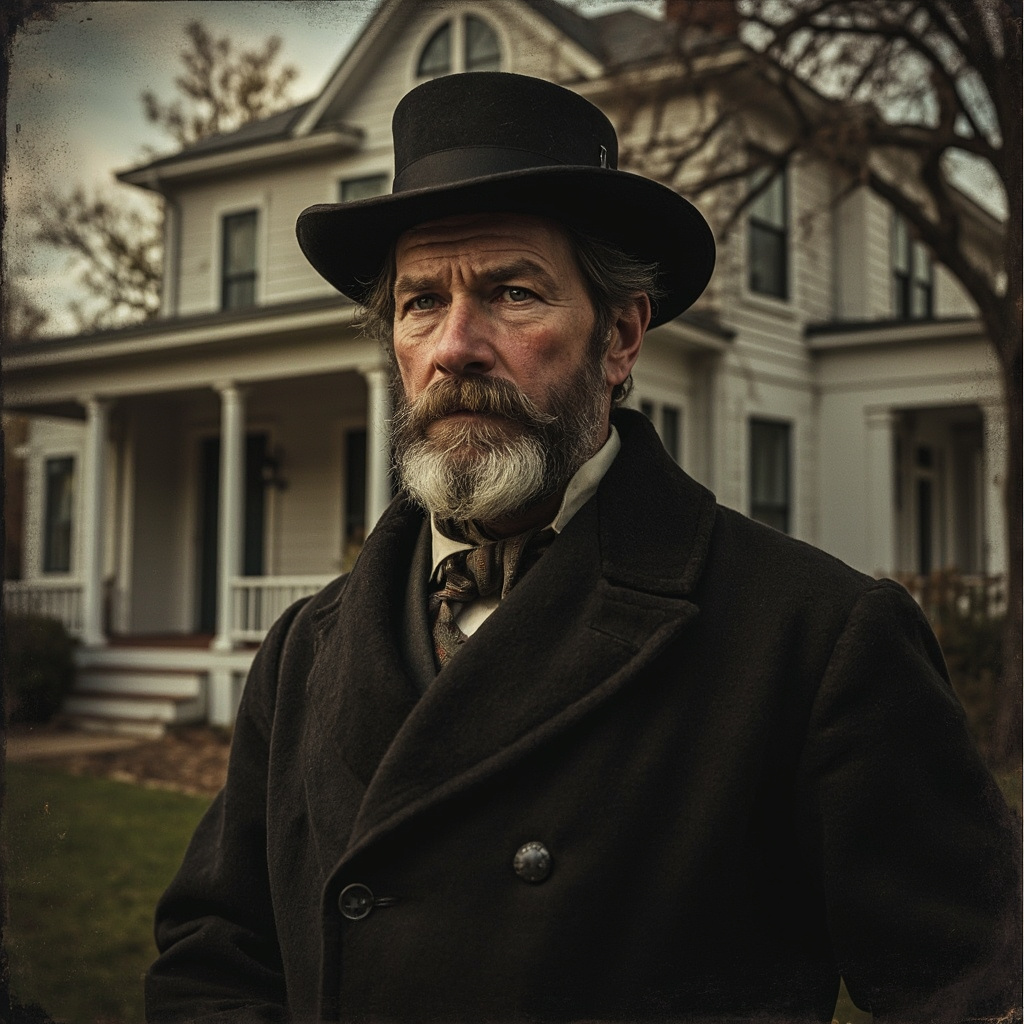
For nearly two years, McLean’s gamble paid off. He purchased a comfortable two-story brick home with white columns and established himself in the quiet community. The war seemed mercifully distant as he went about his business, surely convinced he’d made the right choice in seeking safety in this remote corner of Virginia.
April 9, 1865: History Knocks Again
On the morning of April 9, 1865, McLean thought he was facing just another routine day in peaceful Appomattox Court House. By that afternoon, his parlor would host the most consequential meeting in American history.
Confederate Colonel Charles Marshall approached McLean’s home around 1:00 PM, desperately seeking a suitable location where General Robert E. Lee could meet with Union commander Ulysses S. Grant. The Confederate Army of Northern Virginia was surrounded, supplies exhausted, and Lee had decided to surrender rather than see his men slaughtered in a hopeless final battle.
Marshall’s first choice was a dilapidated building, but McLean protested that it wasn’t suitable for such an important meeting. When pressed for an alternative, McLean reluctantly offered his own home. “Perhaps my house will do,” he said, having no idea he was about to host the end of the Civil War.
At approximately 1:30 PM, Lee entered McLean’s parlor, resplendent in his dress uniform with ceremonial sword. Grant arrived shortly after in his muddy field uniform, and the two generals spent about 25 minutes discussing terms. When Lee formally surrendered the Army of Northern Virginia, the Civil War effectively ended in the same modest room where McLean likely read his evening newspaper.
The Price of History
The meeting’s conclusion brought an unexpected consequence for McLean. Union officers, recognizing the historic significance of the moment, began purchasing his furniture as souvenirs. General Philip Sheridan bought McLean’s small wooden table for $20 in gold, intending to present it to General George Custer’s wife. Other officers purchased chairs, candlesticks, and various items, essentially stripping McLean’s parlor bare.
McLean found himself in the surreal position of watching Union officers dismantle his home’s contents while celebrating the war’s end. One can only imagine his thoughts as he witnessed both the beginning and conclusion of America’s bloodiest conflict from his own property.
A Singular Place in History
Wilmer McLean’s experience represents more than mere coincidence—it embodies the random way history touches individual lives. A successful merchant seeking nothing more than a peaceful existence found himself at the epicenter of his nation’s greatest crisis, not once but twice.
When McLean died in 1882, he carried with him memories no other American could claim. As one Union officer noted, McLean was “perhaps the only man who ever had the first major pitched battle of a war fought in his front yard and the surrender signed four years later in his parlor.”
His story serves as a reminder that history often unfolds in the most unexpected places, touching ordinary lives in extraordinary ways. McLean sought to escape war by moving to one of Virginia’s most isolated corners, only to discover that sometimes, you can’t run from destiny—it has a way of following you home.
Today, both of McLean’s homes are preserved as historical sites, bookends to the American Civil War. Visitors can stand in the same rooms where America’s bloodiest conflict began and ended, all thanks to one man’s remarkable—and remarkably unlucky—encounters with history.
In the annals of warfare, most conflicts are remembered for their devastating battles, heroic charges, and tragic casualties. But there exists one war that stands apart from all others—not for its violence, but for its complete absence of it. The Three Hundred and Thirty-Five Years War between the Netherlands and the Isles of Scilly lasted from 1651 to 1986, making it one of the longest wars in recorded history, yet not a single shot was fired, and no blood was shed.
The Forgotten Declaration
The origins of this peculiar conflict trace back to the turbulent period of the English Civil War. By 1651, Oliver Cromwell had successfully pushed the Royalist forces to the very edges of England, with Cornwall becoming their final mainland stronghold. When even Cornwall fell to the Parliamentarians, the Royalist navy retreated to the Isles of Scilly, a small archipelago off the Cornish coast under the command of Royalist John Granville.
The Dutch, who had allied themselves with the Parliamentarians during the English Civil War, found their merchant ships under constant attack from the Royalist fleet based in Scilly. These raids were causing significant losses to Dutch commerce, and patience was wearing thin in Amsterdam. On March 30, 1651, Lieutenant-Admiral Maarten Harpertszoon Tromp arrived at the islands with a simple demand: reparation for the Dutch ships and goods seized by the Royalist pirates.
When the Royalists refused to provide satisfactory compensation, Tromp made a fateful decision. According to historical records, specifically Bulstrode Whitelocke’s Memorials, Tromp declared war specifically upon the Isles of Scilly. This wasn’t a declaration against England as a whole—most of which was now under Parliamentarian control—but against this tiny collection of islands that had become a thorn in the side of Dutch maritime commerce.
The War That Wasn’t
As wars go, this one ended almost before it began. Just two months after Tromp’s declaration, in June 1651, the Parliamentarian Admiral Robert Blake arrived with a formidable fleet and forced the Royalist navy to surrender. With the threat eliminated, the Dutch fleet sailed away without firing a single shot. The immediate crisis was resolved, but here’s where the story becomes truly extraordinary: nobody remembered to officially declare peace.
When the Dutch Republic and the Commonwealth of England signed the Treaty of Westminster in 1654, ending the First Dutch War, this peculiar local conflict was simply overlooked. The treaty dealt with the major issues between the two nations but made no mention of the specific state of war that supposedly existed between the Netherlands and the tiny Isles of Scilly.
335 Years of Forgotten War
For over three centuries, this technicality remained buried in the annals of history. The Isles of Scilly continued their peaceful existence, their residents completely unaware that they were theoretically still at war with an entire European nation. The Netherlands, meanwhile, went through dramatic political transformations—from the Dutch Republic to the Batavian Republic, then the Kingdom of Holland, and finally the modern Kingdom of the Netherlands—all while technically maintaining a state of war with a cluster of small islands they had probably forgotten existed.
The war might have remained forgotten forever if not for Roy Duncan, a local historian and chairman of the Isles of Scilly Council. In 1985, while researching local history, Duncan stumbled upon the old legend that the islands were still technically at war with the Netherlands. Intrigued by this historical curiosity, he decided to investigate.
Peace at Last
Duncan wrote to the Embassy of the Netherlands in London, explaining the situation and asking whether there was any truth to the local legend. To everyone’s surprise, embassy staff confirmed that no peace treaty had ever been signed between the Netherlands and the Isles of Scilly. The war that everyone had forgotten was, technically speaking, still ongoing.
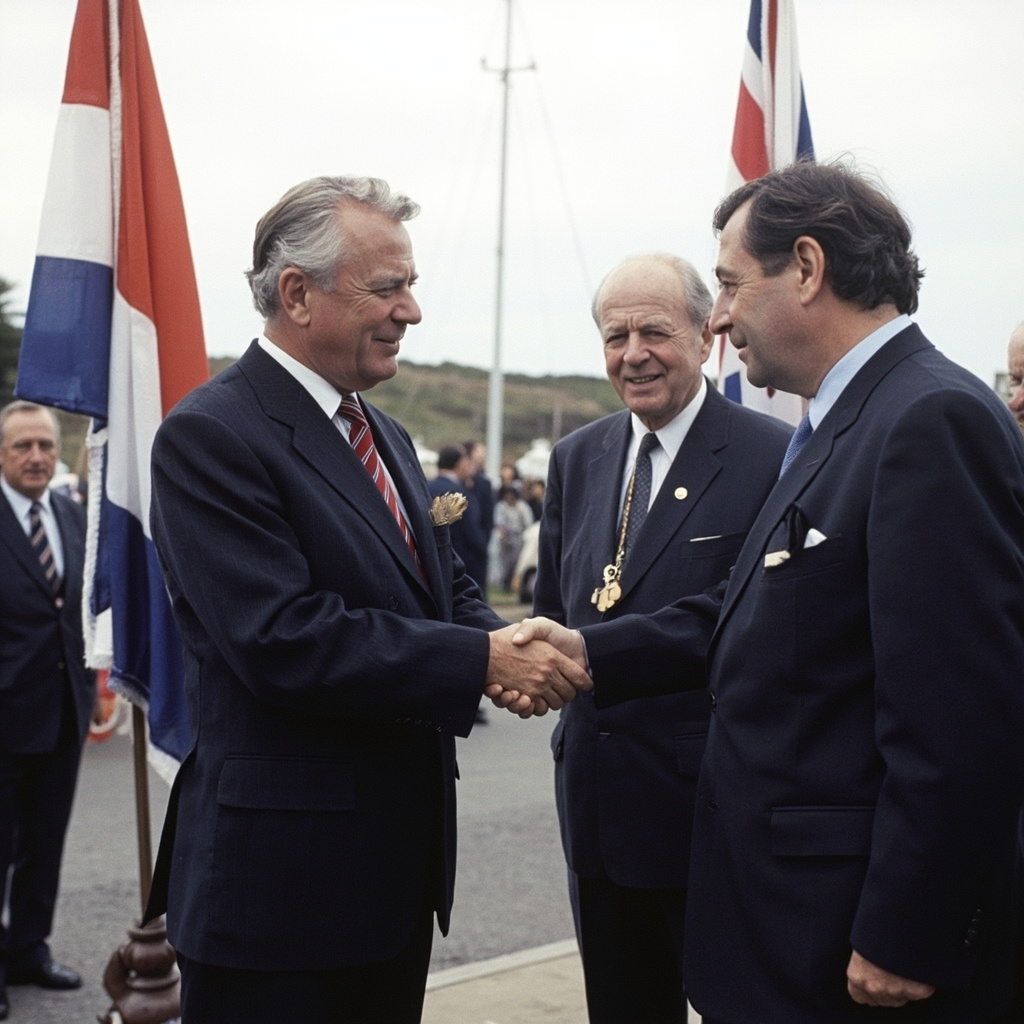
Seeing the humor in the situation, Duncan invited the Dutch Ambassador to Britain, Jonkheer Huydecoper, to visit the islands and officially end this marathon conflict. On April 17, 1986—exactly 335 years and 19 days after Tromp’s original declaration—peace was finally declared in a ceremonial signing on the Isles of Scilly.
Ambassador Huydecoper, clearly enjoying the absurdity of the situation, joked during the ceremony that it must have been “horrifying to the Scillonians to know we could have attacked at any moment.” The comment was made with a wink, of course—the Dutch had long since forgotten about the conflict, and the peaceful islands had certainly never lived in fear of an invasion that was never going to come.
The Debate Over Reality
While the story of the 335-year war makes for delightful historical trivia, scholars debate whether this “war” ever truly existed in any legal sense. Some historians argue that Tromp, as an admiral rather than a sovereign nation, lacked the authority to declare war on behalf of the Netherlands. Others point out that the Isles of Scilly, as part of England, couldn’t be considered an independent entity capable of being at war with another nation.
Author Graeme Donald has dismissed the entire affair as “a great PR coup for the island’s tourist board,” suggesting that the story was more legend than historical fact. However, the Dutch Embassy’s confirmation that no peace treaty existed lent enough credibility to the tale that both sides were willing to play along with the ceremonial ending.
A War Like No Other
Whether legally valid or not, the Three Hundred and Thirty-Five Years War stands as a unique chapter in military history. If we accept it as genuine, it represents the longest war in recorded history, the most peaceful conflict ever fought, and certainly the most forgotten. It’s a war with no battles, no casualties, no heroes, and no villains—just a bureaucratic oversight that lasted for over three centuries.
In an age when we’re constantly reminded of the devastating costs of warfare, there’s something wonderfully refreshing about a conflict that harmed absolutely no one. The “war” between the Netherlands and the Isles of Scilly serves as a charming reminder that sometimes the most interesting historical events are the ones where absolutely nothing happened at all.
Today, the Netherlands and the Isles of Scilly maintain the most peaceful of relationships, their “conflict” having been resolved with handshakes, smiles, and probably a fair amount of Dutch cheese shared among new friends. It’s perhaps the only war in history that ended with everyone having a good laugh.
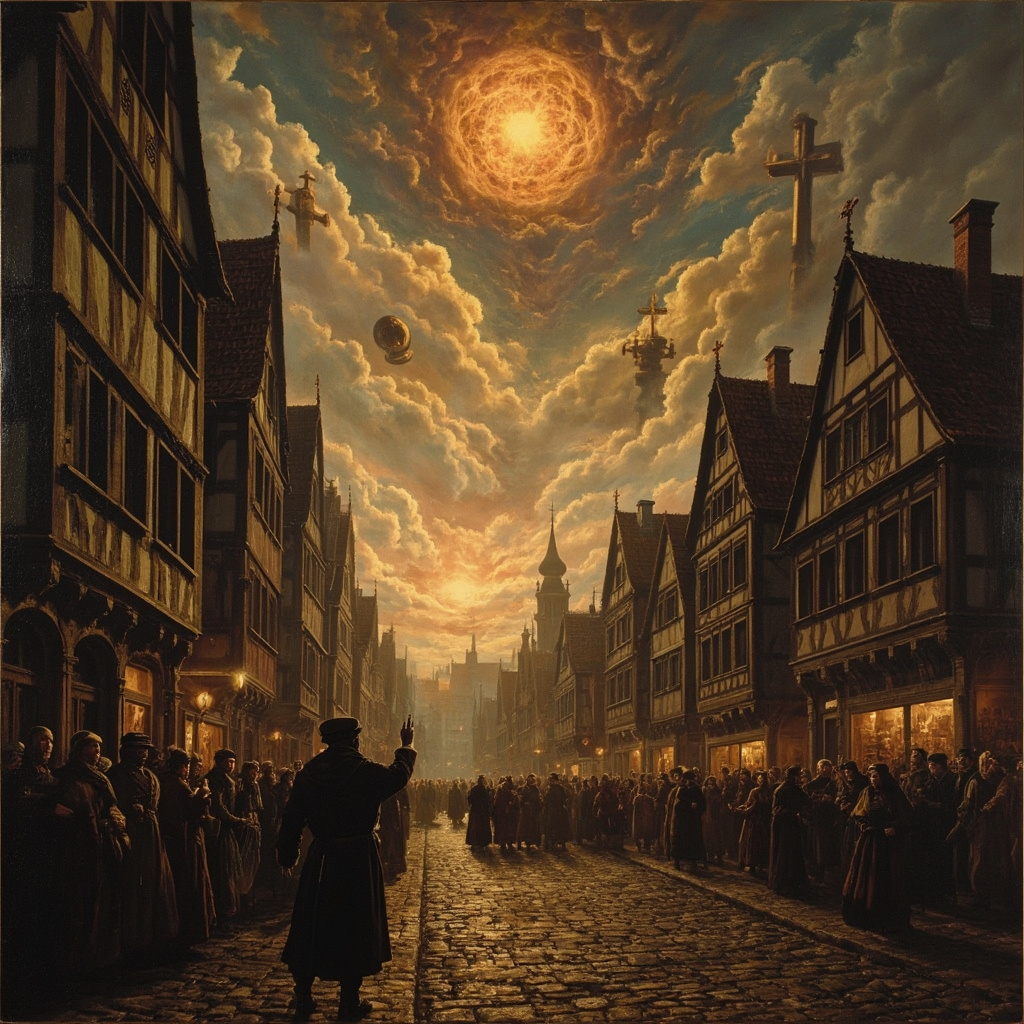
On the morning of April 14, 1561, the residents of Nuremberg, Germany, witnessed one of history’s most extraordinary and well-documented celestial phenomena. As dawn broke between 4 and 5 AM, the sky above this medieval city erupted into what appeared to be an aerial battle involving hundreds of mysterious flying objects.
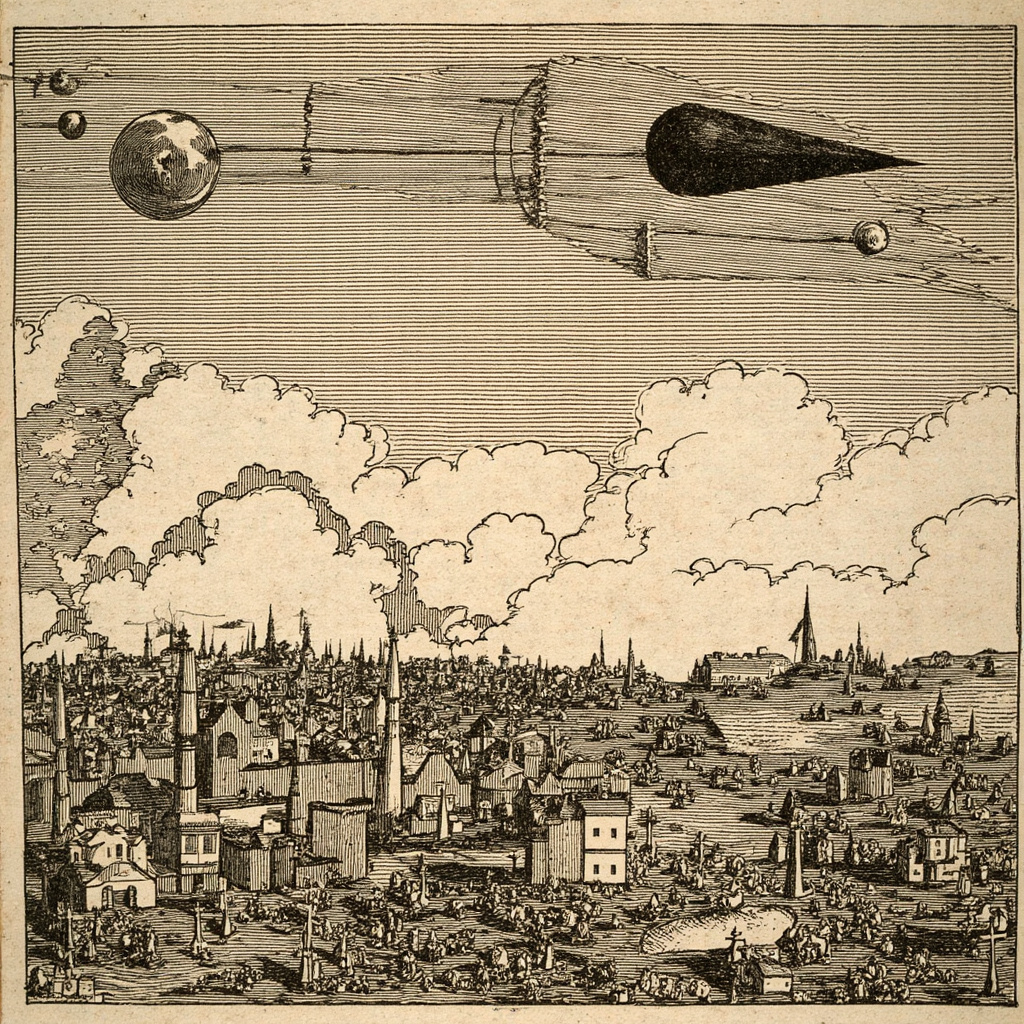
This remarkable event was so significant that it was immortalized in a detailed broadsheet—a printed news bulletin of the day—complete with woodcut illustrations depicting the strange objects that filled the sky. The incident has puzzled historians, astronomers, and researchers for over four centuries.
The Dawn of Terror
According to eyewitness accounts recorded in the famous broadsheet, the citizens of Nuremberg were confronted with “a dreadful apparition” as the sun rose. The sky filled with objects of various shapes and sizes: spheres, crosses, cylinders, crescents, and rod-like formations. Most remarkably, these objects appeared to be engaged in combat, darting around each other in seemingly organized patterns.
The broadsheet, printed and distributed throughout the region, described how “many men and women” witnessed cylinders from which “several small spheres emerged and darted around the sky.” Most ominously, witnesses reported seeing a large, black, spear-like or arrow-shaped object among the aerial combatants.
Contemporary Documentation
What makes the Nuremberg incident particularly compelling is its thorough documentation. The broadsheet was created by Hans Glaser, a prominent printer in Nuremberg, who was known for producing reliable news reports. The detailed text provides specific information about the timing, appearance, and behavior of the mysterious objects.
The account describes how the objects “fought among each other for over an hour.” After this aerial battle concluded, many of the objects allegedly fell to earth “as if they all burned,” though no physical remains were reportedly found. Most intriguingly, witnesses claimed that the large black arrow-shaped object crashed somewhere outside the city walls.
Theories and Explanations
Modern researchers have proposed various explanations for what the people of Nuremberg witnessed that April morning. Some meteorologists suggest the phenomenon could have been an unusual atmospheric display, possibly involving sun dogs (parhelia) or other optical illusions created by ice crystals in the atmosphere.
Others propose that the residents may have witnessed a meteor shower or multiple meteors breaking up in the atmosphere, which could explain the various shapes and the apparent “battle” as objects moved across the sky in different directions. The morning timing aligns with when certain meteor showers are most visible.
Religious and Cultural Context
The 16th century was a time of significant religious upheaval in Europe, with the Protestant Reformation in full swing. Many people interpreted unusual natural phenomena as divine omens or warnings. The Nuremberg broadsheet itself frames the event in religious terms, suggesting that citizens should “be warned” and “repent” in response to this celestial sign.
This religious interpretation was typical of the era, when astronomical events were often seen as messages from God about earthly affairs. The detailed documentation of such phenomena served both as news reporting and as religious commentary on contemporary events.
Historical Significance
The 1561 Nuremberg incident represents one of the earliest mass UFO sightings in recorded history, predating the modern UFO phenomenon by centuries. While the true nature of what occurred remains a mystery, the event demonstrates the human impulse to document and attempt to understand unusual phenomena.
The broadsheet itself has become an invaluable historical document, providing insight into both 16th-century printing practices and the way extraordinary events were communicated to the public. It serves as a fascinating example of early mass media responding to a breaking news story.
Legacy and Modern Interest
Today, the Nuremberg sky battle continues to captivate researchers and enthusiasts interested in unexplained historical phenomena. The incident has been referenced in numerous books about anomalous events and has found its way into discussions about historical UFO encounters.
Whether the citizens of Nuremberg witnessed an unusual atmospheric phenomenon, an astronomical event, or something else entirely, their detailed documentation has preserved one of history’s most intriguing mysteries. The 1561 sky battle remains a testament to the enduring human fascination with the unknown and our drive to record and share extraordinary experiences.
The Nuremberg broadsheet stands as a remarkable piece of historical evidence—a window into a world where the line between the natural and supernatural was far thinner than it is today, and where a single morning’s strange events could captivate an entire city and echo through the centuries.
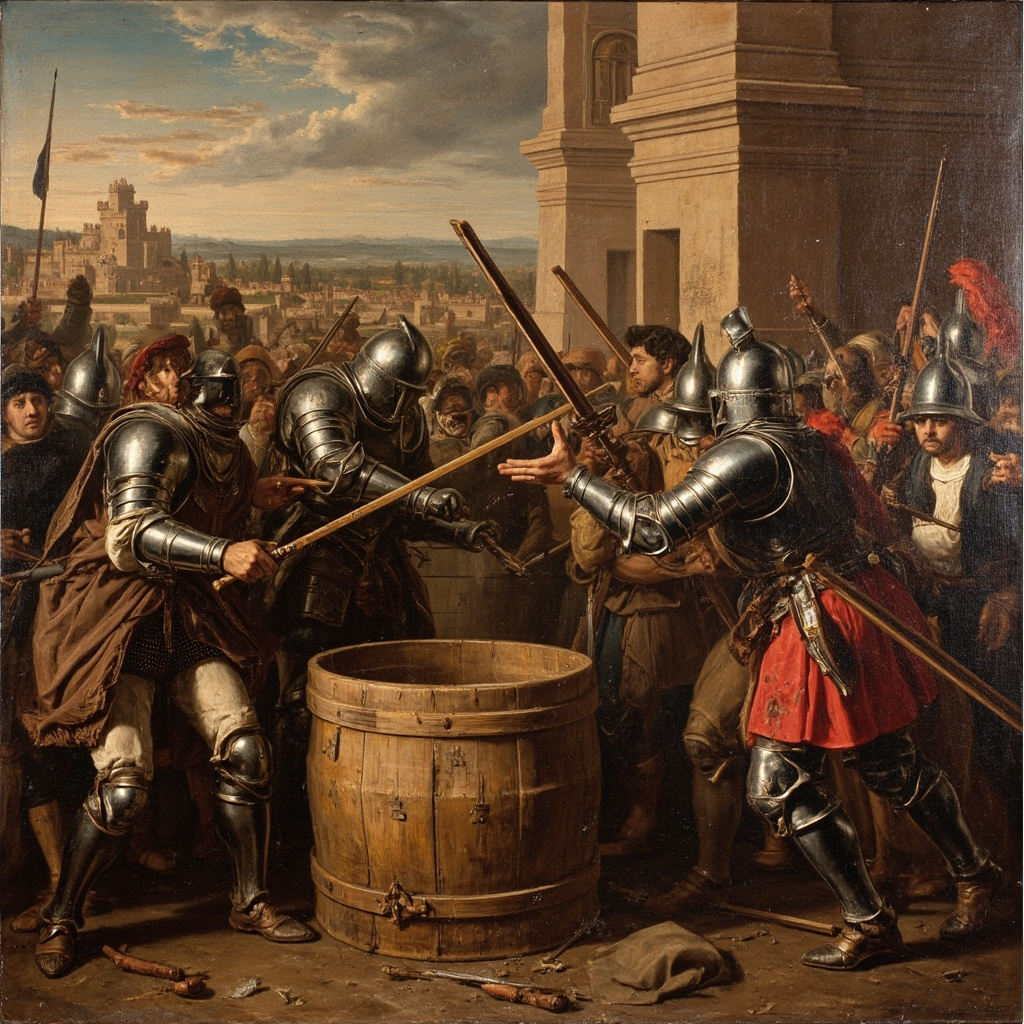
In 1325, soldiers from the Italian city-states of Bologna and Modena fought a pitched battle involving thousands of troops, cavalry charges, and considerable bloodshed. The prize they were fighting over? A wooden bucket.
The War of the Bucket — or Guerra della Secchia Rapita — is one of the most absurd conflicts in military history. But beneath its comical surface lies a story about the deadly factional politics that tore medieval Italy apart for centuries.
Guelphs vs. Ghibellines: Italy’s Endless Civil War
To understand the War of the Bucket, you need to understand the conflict that dominated Italian politics for nearly three hundred years: the struggle between the Guelphs and the Ghibellines.
The Guelphs supported the Pope as the supreme authority in Italy. The Ghibellines backed the Holy Roman Emperor. Every Italian city was forced to choose a side, and the rivalry infected every aspect of civic life. Neighboring cities often chose opposite factions specifically to justify attacking each other.
Bologna was a Guelph city — prosperous, home to one of Europe’s oldest universities, and loyal to the papacy. Modena, just 25 miles to the northwest, was Ghibelline — smaller, scrappier, and perpetually in Bologna’s shadow. The two cities had been feuding for generations, and by the early fourteenth century, tensions were at a breaking point.
The Bucket Raid
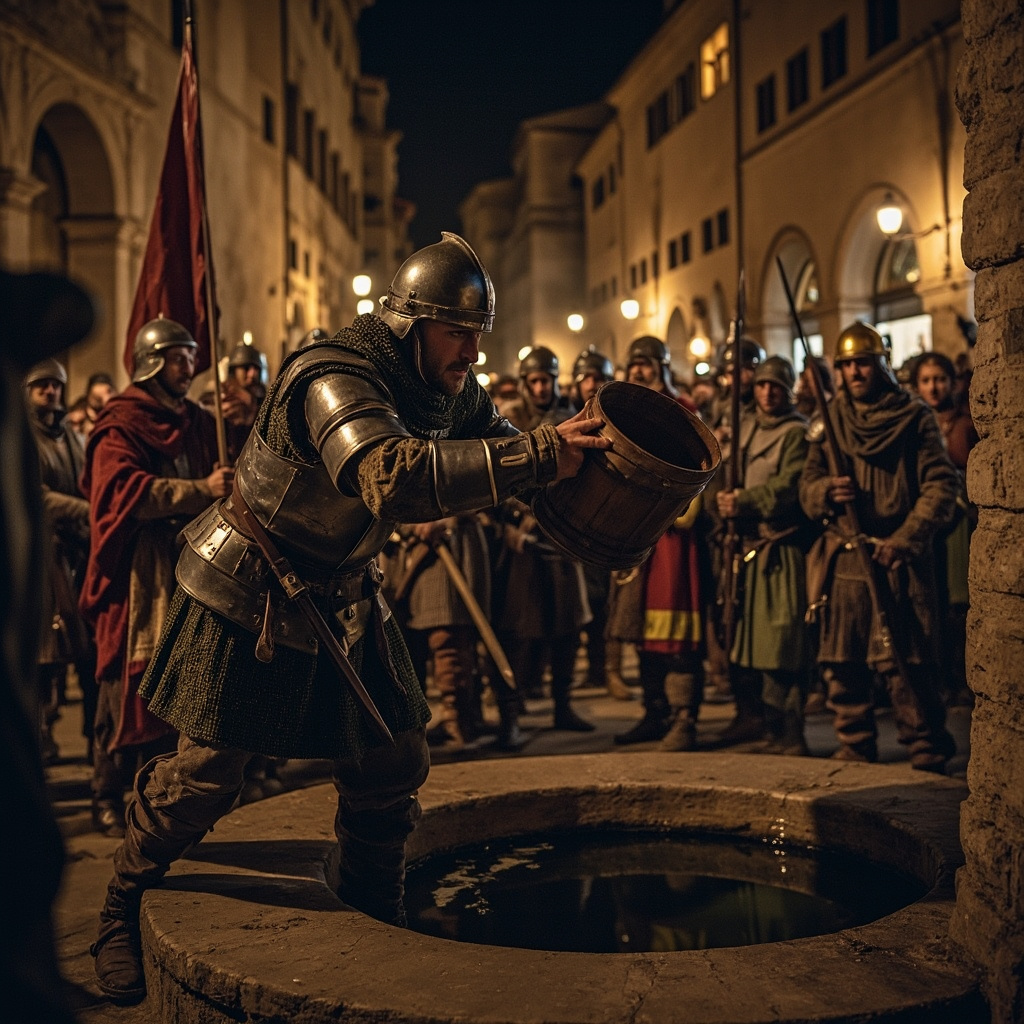
In 1325, a group of Modenese soldiers carried out a daring raid into the heart of Bologna. They fought their way into the city, and in an act of supreme provocation, stole an oak bucket from the main city well in the central square. The bucket — a secchia — was an ordinary wooden pail, worth almost nothing in monetary terms. But in symbolic terms, it was an intolerable insult.
Stealing from a city’s central well was a deliberate humiliation, equivalent to capturing an enemy’s flag. It announced to the world that Modena’s soldiers had penetrated Bologna’s defenses and taken a trophy from the very heart of the city. For proud, wealthy Bologna, this was an affront that demanded a military response.
The Battle of Zappolino
Bologna assembled a massive army. Historical accounts vary, but most sources suggest the Bolognese force numbered around 32,000 men — including 2,000 cavalry — making it one of the largest armies fielded by an Italian city-state in the medieval period. They also called upon allies from Florence, Romagna, and other Guelph cities. A papal legate accompanied the army, underscoring the involvement of the papacy itself.
Modena’s army was significantly smaller, perhaps 5,000 infantry and 2,000 cavalry, bolstered by Ghibelline allies including the fearsome warlord Passerino Bonacolsi, the lord of Mantua, who brought experienced troops hardened by years of factional warfare.
The two armies met on November 15, 1325, at the town of Zappolino, about nine miles south of Modena. What followed was a decisive and humiliating defeat for Bologna.
Despite their overwhelming numerical superiority, the Bolognese army was poorly coordinated and overconfident. The Modenese and their allies launched a devastating cavalry charge that broke the Bolognese lines. The rout was swift and total. The Bolognese army fled the field, abandoning equipment, supplies, and pride.
Modenese forces pursued the retreating Bolognese all the way back to the gates of Bologna, where, according to tradition, they carried out one final humiliation: they held a mock jousting tournament within sight of the city walls, taunting the defeated Bolognese from the safety of their own suburbs.
The Casualties and the Peace
The Battle of Zappolino was bloody by medieval Italian standards. Estimates of the dead range from several hundred to over 2,000, depending on the source. Thousands more were captured. For a conflict triggered by the theft of a bucket, the human cost was staggering.
Despite their crushing victory, the Modenese were unable to capture Bologna itself — the city’s walls were too strong and well-defended. A peace treaty was eventually negotiated, but the fundamental Guelph-Ghibelline tensions remained unresolved. The two cities would continue to skirmish for decades.
And the bucket? Modena kept it. It was never returned.
The Bucket Today
Nearly seven hundred years later, the stolen bucket still exists. It hangs in the bell tower of the Cathedral of Modena — the Torre della Ghirlandina — where it has been displayed as a trophy of victory for centuries. A replica can be seen in the town hall. Modenese citizens remain proud of their ancestors’ audacious theft and the military triumph that followed.
The War of the Bucket was immortalized in 1622 by the Italian poet Alessandro Tassoni, whose mock-heroic epic La Secchia Rapita (“The Stolen Bucket”) used the conflict as the basis for a satirical poem that mocked the absurdity of Italian factional warfare. The poem was a bestseller in its day and remains a classic of Italian literature.
More Than a Joke
It’s tempting to treat the War of the Bucket as a historical punchline — and it is genuinely funny that thousands of men fought and died over a wooden pail. But the conflict illuminates something important about how wars actually start.
The bucket wasn’t really the cause of the war. It was the spark. The underlying fuel was centuries of accumulated grievance, factional hatred, economic competition, and wounded civic pride. The theft of the bucket was simply the final provocation in a long chain of provocations, the insult that made war feel not just justified but necessary.
History is full of wars triggered by seemingly trivial incidents — a severed ear, a football match, a pig wandering across a border. In each case, the triviality of the trigger obscures the depth of the underlying tensions. The War of the Bucket reminds us that when communities are primed for conflict, even the most absurd catalyst can unleash devastating violence.
So the next time someone tells you that a particular dispute is “too silly to fight over,” remember Modena and Bologna. Remember the bucket that launched a war, killed hundreds, and still hangs in a cathedral tower as a proud trophy of victory. In politics, as in life, nothing is ever really about the bucket.