The Man in the Iron Lung: Paul Alexander and 70 Years Inside the Machine That Breathed for Him


In the summer of 1952, a six-year-old boy in Dallas came in from playing in the rain, feverish and aching. Within days Paul Alexander could no longer hold a crayon, then could no longer swallow, then could no longer breathe. A surgeon performed an emergency tracheotomy on a child already slipping away. When Paul woke, he could not move, could not speak, and could not feel his own body. He was sealed from the neck down inside a long steel cylinder that hissed and sighed around him, pulling the air in and out of his lungs on his behalf.
He would remain inside that machine, or one like it, for the next seventy-one years. In that time he would finish school, earn a law degree, stand before juries, fall in love, and write a book. This is the story of Paul Alexander, the man in the iron lung — and of the strange, life-giving machine that both imprisoned and saved him.

The disease that stole a summer generation
Poliomyelitis is an ancient virus, but the twentieth century was its cruellest stage. As modern sanitation delayed children’s first exposure, more of them met the virus later, when it struck harder. Every summer through the 1940s and early 1950s, parents in North America watched with dread as public pools emptied and cinemas closed. The disease seemed to fall from a clear sky, sparing one child and paralysing the one beside them.
The United States epidemic of 1952 was the worst the country ever recorded: roughly 58,000 cases, more than 3,000 deaths, and over 21,000 people left with some lasting paralysis. Most who caught polio recovered. But in its most dangerous form the virus attacked the nerves controlling the muscles of breathing, and a body that cannot breathe has hours, not days. For those children, survival depended entirely on a machine.
The machine that breathed
The iron lung was invented in 1928 by two Harvard researchers, Philip Drinker and Louis Agassiz Shaw. Its principle was elegant and simple. A patient lay inside a sealed metal cylinder with only their head protruding through a rubber collar. Bellows lowered the air pressure inside the drum, and the vacuum pulled the chest outward, drawing breath into the lungs; raise the pressure again, and the chest fell and exhaled. It did mechanically what paralysed muscles no longer could, mimicking the natural rhythm of breathing from the outside in.

The first device kept an eight-year-old girl alive at Boston Children’s Hospital, and within a few years iron lungs filled polio wards across the country. To lie inside one was to surrender almost everything. A patient could not sit up, scratch an itch, or turn to a visitor. A small mirror angled above the head let them see the room behind them, reversed. Nurses reached through portholes to tend the body hidden inside the drum. It was a coffin that kept you alive — and for a frightened child, the constant mechanical sigh of the bellows was the sound of being kept, second by second, on the right side of death.
Learning to breathe again
Doctors did not expect Paul to survive the night, then did not expect him to survive the week. He did both. But the prognosis was bleak: a life measured out inside the cylinder, dependent on the machine for every breath. Paul, stubborn even as a child, refused to accept it.
A physical therapist named Mrs. Sullivan made him an offer: if he could learn to breathe on his own, outside the lung, she would give him a puppy. The technique she taught him was called glossopharyngeal breathing, better known as “frog breathing” — using the muscles of the mouth and throat to gulp air down into the lungs, a swallow at a time, forcing the body to do consciously what it could no longer do automatically. It was exhausting, unnatural work. Paul practised for months. Eventually he could stay out of the iron lung for minutes, then hours, breathing by sheer act of will. He got the dog. The long, patient labour of relearning a broken body echoes the whole hard-won history of physiotherapy, the discipline built on the belief that function lost is not always function gone.
A life built from a steel cylinder
What Paul did with that hard-won freedom is the heart of his story. Determined to go to school, he learned to write and later to type by holding a stick in his mouth, tapping one key at a time. He graduated near the top of his high-school class. He talked his way into Southern Methodist University and then earned a law degree from the University of Texas at Austin, attending lectures and sitting exams in ways the institutions had never accommodated before.

Then he practised. Paul Alexander became a lawyer, appearing in court in a modified wheelchair that held him upright for a few hours at a time before he had to return to the lung. He represented clients for decades. In his later years he wrote a memoir, Three Minutes for a Dog: My Life in an Iron Lung — three minutes being how long he could breathe unaided when he began — composing it over eight years by tapping a pen strapped to a stick, or dictating to a friend who transcribed each line. Every page was an act of endurance most of us will never be asked to give.

The vanishing machines
While Paul was learning to live inside his cylinder, the war against the disease that put him there was being won. In 1955, Jonas Salk’s injectable vaccine was declared safe and effective, and church bells rang across America. Albert Sabin’s oral vaccine followed. Within a decade polio was collapsing across the developed world; today it survives in only a handful of places on earth, on the edge of eradication.
The iron lungs disappeared with the disease. Modern positive-pressure ventilators, which push air in through a tube rather than sucking the chest out from a drum, replaced them entirely. The great cylinders were scrapped by the thousand. But a tiny number of people, their childhood bodies shaped around the old machine, had grown too dependent to switch. Paul was among the last. As the manufacturers vanished, he relied on a shrinking supply of spare parts and a few devoted volunteers who taught themselves to repair the antique bellows and leather seals keeping him alive. The triumph of medicine had left a handful of survivors tethered to its obsolete first drafts — a reminder that even a cure leaves people behind, much as an earlier revolution in medicine came too late for those who suffered before doctors accepted the truths of Ignaz Semmelweis and clean hands.
Why the man in the iron lung still matters
Paul Alexander died in March 2024, at seventy-eight, having lived longer inside an iron lung than anyone in recorded history. He had spent more than seven decades flat on his back inside a steel tube, and in that confinement had done more than most people manage with the full run of a healthy body: earned degrees, argued law, written a book, and, late in life, found a new audience of millions who discovered his story online and were undone by his refusal to be pitied.
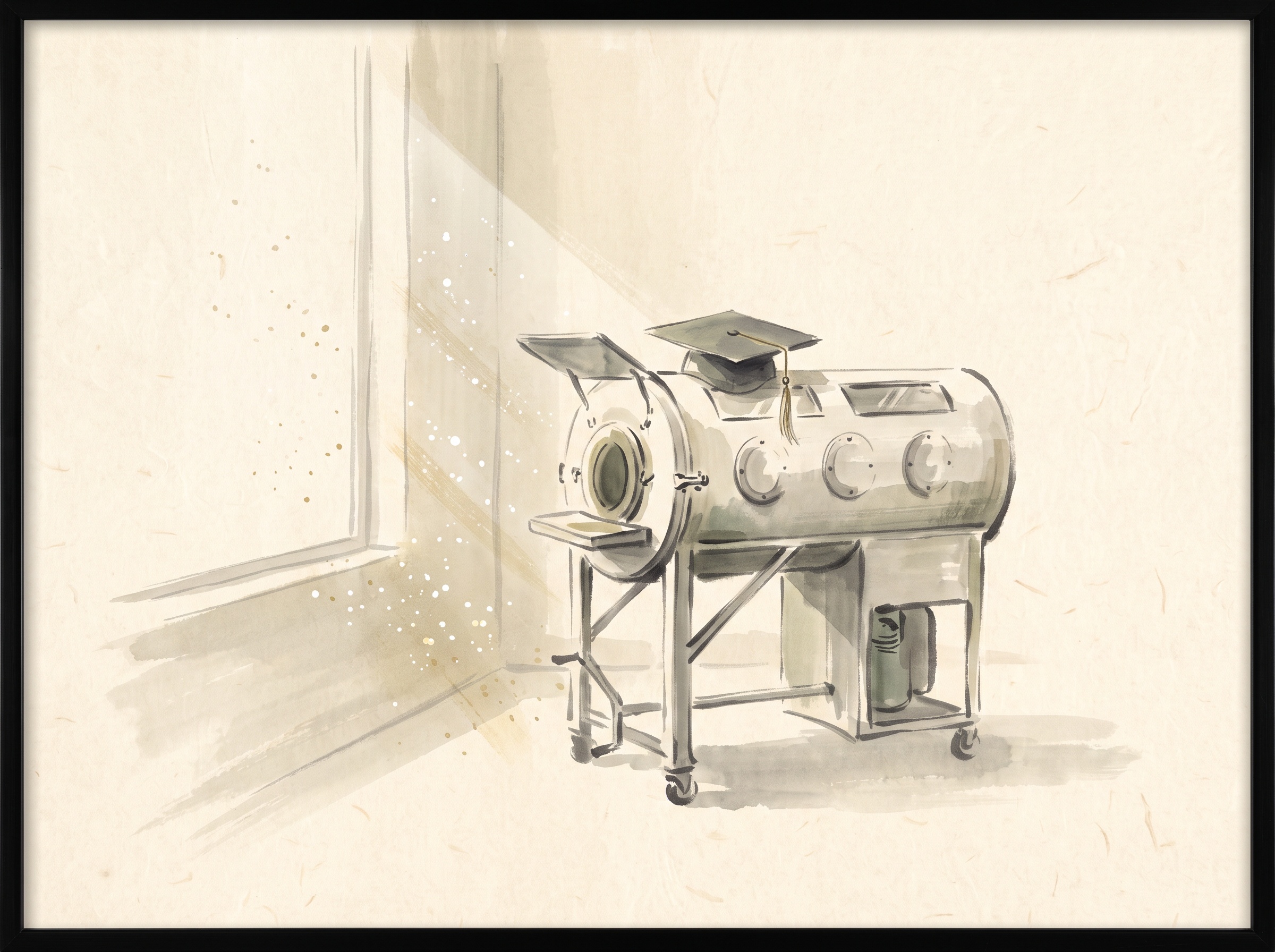
His life is a rebuke to easy despair. It is also a quiet argument for the things that made it possible: a machine dreamed up by two researchers, a therapist who bargained with a puppy, a vaccine that spared the generations who came after, and the volunteers who kept an obsolete relic breathing out of sheer human loyalty. Medicine gives us the tools; people decide what to do with the time those tools buy. Paul Alexander was handed a life almost no one would choose, sealed inside a cylinder the world had forgotten, and he chose to fill it — completely. The same stubborn faith that a machine could serve human dignity ran through the era’s other quiet heroes of medical technology, like the women who drove Marie Curie’s mobile X-ray trucks to the front. History remembers the cures. It should also remember the people who lived, magnificently, in the long shadow they cast.
Sources & further reading:
- Iron lung — the negative-pressure ventilator that kept polio patients alive
- Longest time living in an iron lung — Paul Alexander
More from the archive
- The Man Who Survived Two Atomic Bombs: Tsutomu Yamaguchi at Hiroshima and Nagasaki
- Mike the Headless Chicken: The Rooster Who Lived Eighteen Months After Losing His Head
- The Man Who Refused to Start World War III: Stanislav Petrov and the Night He Didn’t Press the Button