Simon Sudbury: The Archbishop the Rebels Beheaded on Tower Hill

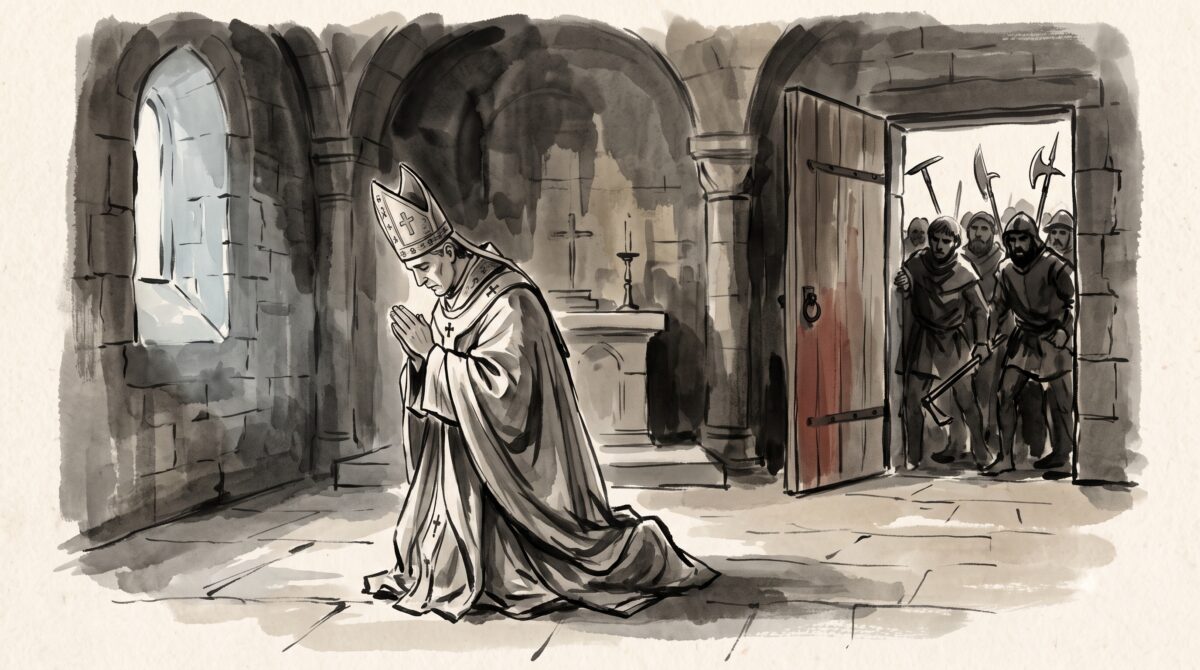
On the morning of 14 June 1381, the most powerful churchman in England knelt in prayer inside the Tower of London and waited to die. He was Simon Sudbury — Archbishop of Canterbury, the primate of all England, and until a few days earlier the King’s Chancellor, the man who signed the realm’s business into law. Within the hour a crowd of labourers, tilers and village men would walk into the strongest fortress in the kingdom, lay hands on him, drag him up to Tower Hill, and hack off his head. It would take them eight blows to finish the work. His crime, in the eyes of the mob, was written on every tax roll in England.
Of all the deaths in the 1381 Peasants’ Revolt, none said more about how far the world had turned upside down than this one. The rebels had not merely killed a great man. They had beheaded an archbishop — and felt they were doing justice.
From a Suffolk Merchant’s Son to Two Thrones
Simon Sudbury was not born to power. He came into the world as Simon Theobald, the son of a well-off merchant family in the wool town of Sudbury, Suffolk, and took the name of his birthplace as men of the church often did. What lifted him was ability and the long ladder of the medieval clergy. He studied law, served in the papal court at Avignon, and rose steadily: Bishop of London in 1361, and then, in 1375, the summit of the English church — Archbishop of Canterbury.
That alone would have made him one of the most important men in the realm. But in January 1380 the crown handed him a second crown of thorns: the office of Lord Chancellor, the head of the King’s government. Now Sudbury held the two greatest offices in England at once, spiritual and secular. He was the shepherd of every soul in the land and the chief administrator of a boy-king’s treasury. It was a dizzying height. It also meant that when the government did something the common people hated, his name was on it.
The Chancellor and the Tax That Lit the Fuse
The government of the young Richard II was broke, drained by the long, grinding war with France. Its answer was the third poll tax in four years — a flat charge on nearly every adult, rich and poor paying much the same, levied in 1380 while Sudbury sat as Chancellor. It was a fiscal disaster and a moral outrage: a duke and a ditch-digger taxed at nearly the same rate. When commissioners went out in the spring of 1381 to chase down the tens of thousands who had simply vanished from the rolls rather than pay, the resentment that had been building for a generation finally caught fire.
To the men marching out of Kent and Essex, the villains had names. There was John of Gaunt, the king’s uncle, whose Savoy Palace they would burn to ash. There was Sir Robert Hales, the Treasurer. And there was Simon Sudbury — Chancellor, archbishop, the face of a church that owned vast estates and a government that taxed the poor to the bone. In the rebels’ eyes he was not a holy man at all. He was a tax collector in a mitre.
Cornered in the Tower
As the rebel columns reached London in the second week of June, the court did the only thing it could: it retreated into the Tower of London, the great riverside fortress that had never fallen. Richard, his mother, Sudbury, Hales and a knot of terrified councillors sheltered behind its walls while the city burned and the crowds swelled outside. Sudbury, sensing which way the wind blew, is said to have resigned the chancellorship in those last days — but a resignation on parchment meant nothing to the men outside. To them he was still the archbishop who had taxed them.
On 14 June — the feast of Corpus Christi — the fourteen-year-old king rode out to Mile End to meet the rebels in person and hear their demands, drawing the main body of the crowd away east. It was a brave gamble, and in one sense it worked. But it left the Tower half-empty and its defenders leaderless. What happened next is one of the most extraordinary scenes of the whole revolt.
The Storming of the Impregnable Fortress
While the king parleyed at Mile End, a portion of the crowd surged to the Tower and found the impossible: the gates open, the drawbridge down, the garrison unwilling to raise a hand against them. Whether through treachery, terror or simple paralysis, the strongest castle in England was taken without a fight. Rough men in homespun poured through its royal chambers, sat on the beds, jostled the king’s mother, and hunted through the fortress for the men they had come to kill.
They found Simon Sudbury where a churchman facing death might be expected to be — in the chapel of St John, at prayer, some accounts say having just heard mass and made his confession. He knew exactly what was coming. There was no rescue, no reprieve, no royal guard. The rebels seized him, along with Treasurer Robert Hales, the friar William Appleton (John of Gaunt’s physician), and others marked for death, and hauled them out of the Tower and up the short rise to Tower Hill.
Eight Blows on Tower Hill
Tower Hill was the customary ground for the execution of traitors — but always by the crown’s order, under the law. On that morning the ceremony was inverted. It was the common people who had appointed themselves judge and headsman, and an archbishop of Canterbury who stood condemned. Sudbury is said to have faced the crowd and asked them to consider what they were doing — that to kill him would call down interdict and the wrath of the church. It did not move them.
The killing itself was ghastly, and the chroniclers dwell on it. The man wielding the blade was no practised executioner. The first stroke did not sever the neck but bit into it; Sudbury reportedly raised his hand to the wound, and the next blow struck his fingers. Blow after clumsy blow followed — the accounts give eight in all — before the archbishop’s head was finally hacked free. His mitre was said to have been nailed to his skull so it would stay in place, and the head was carried in a grim procession and set upon a pike above London Bridge, in the very spot where the heads of traitors were displayed. The primate of all England now looked out over the city as a criminal. Beside him went the heads of Hales and the rest.
The Skull That Outlived the Revolt
The revolt did not long survive its bloodiest morning. The very next day, at Smithfield, the king faced the rebels again and Wat Tyler was struck down before the crowd, and the rising began to collapse. Sudbury’s body was eventually recovered and buried with honour in Canterbury Cathedral, where — the story goes — a cannonball was placed in his tomb in the space where his head should have been.
But the head itself went home. It was carried back to Sudbury’s birthplace in Suffolk, and there, at St Gregory’s Church in the town of Sudbury, his mummified, leathery skull is preserved to this day, kept in a niche behind a small door and shown on rare occasion — one of the most remarkable relics of the medieval English state to survive into the modern age. Six and a half centuries later you can still, in a quiet Suffolk church, come face to face with a man the crowd of 1381 decided to unmake.
His death is the sharpest lesson the revolt teaches. The men who killed Simon Sudbury were not lawless in their own minds; they believed they were punishing a guilty official, and they had chosen their target with terrible precision — not a random victim, but the very hand they blamed for the tax. When Paul Greengrass’s 2026 film ‘The Uprising’ reaches the storming of the Tower, it is Sudbury’s fate that shows how completely, if only for a few June days, the ordinary people of England had stopped being afraid of the men who ruled them.
Source: this account draws on the Anonimalle Chronicle and the accounts summarised in the Encyclopaedia Britannica. For the full arc of the rising, see our complete guide to the 1381 Peasants’ Revolt.
Sources & further reading:
- The Anonimalle Chronicle (Peasants’ Revolt account, The National Archives)
- Simon Sudbury (Encyclopaedia Britannica)
- Peasants’ Revolt (Encyclopaedia Britannica)
Related Reading
- Richard II at 14: The Boy King Who Faced Down the Peasants’ Revolt
- The Aftermath: Richard II’s Broken Promises and the Bloody Reprisals
- John Ball and ‘When Adam Delved and Eve Span’: The Priest Who Preached Equality