The Poll Tax of 1381: The Tax That Sparked a Rebellion


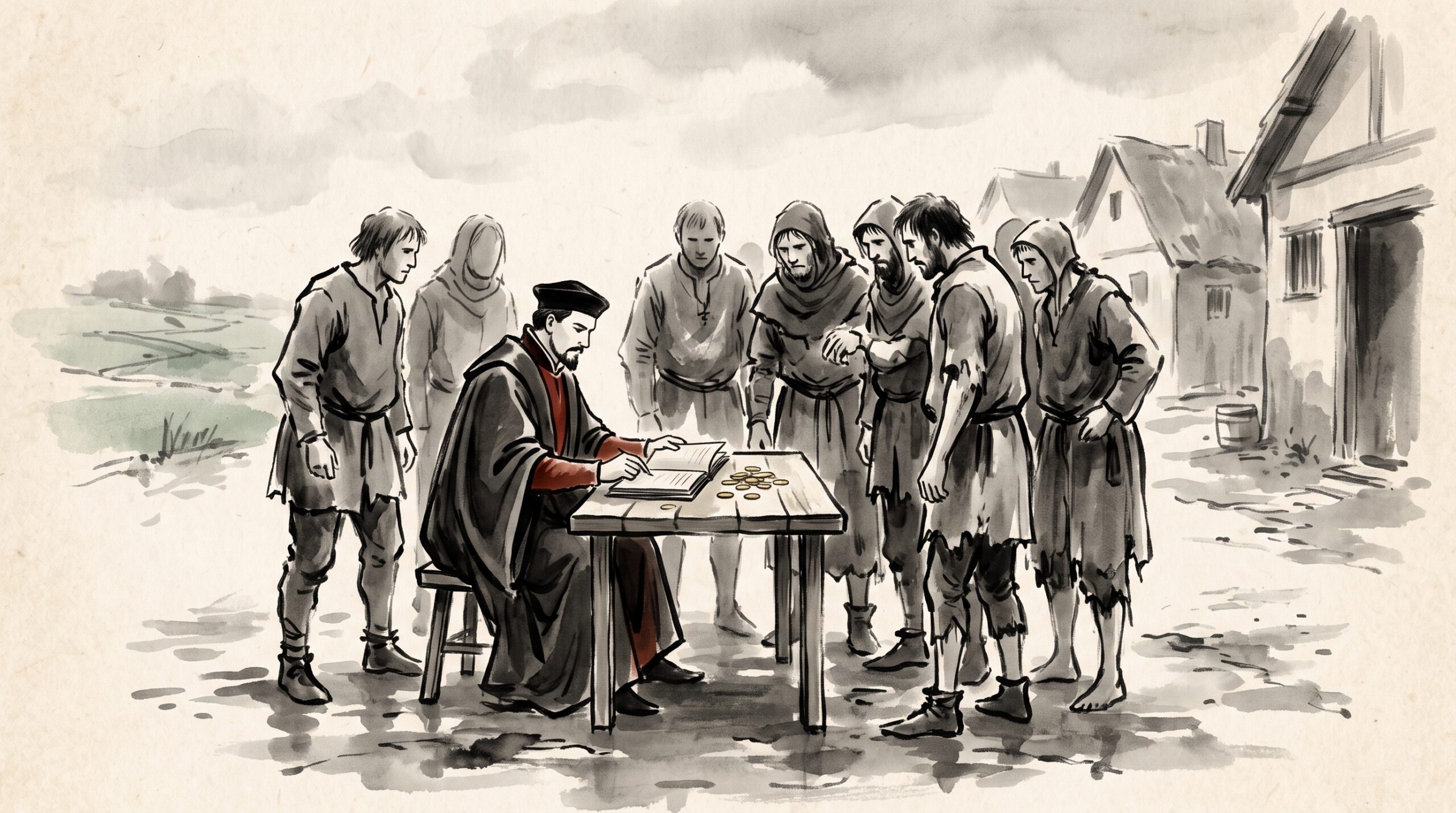
On the last day of May 1381, a royal official named Thomas Bampton rode into the Essex marsh village of Fobbing to ask a simple question: where was the King’s money? Weeks earlier the villagers had paid their poll tax, or so they believed. Now Bampton had come back to say the returns were short, the count was wrong, and they owed more. The men of Fobbing, led by a local baker named Thomas, gave him an answer no one in Westminster expected. They refused — and then they drove him out of the village. Within six weeks that act of defiance had swelled into tens of thousands of armed commoners marching on London, an archbishop beheaded, and a fourteen-year-old king riding out to save his crown. It all began with a tax.
A war that had to be paid for
England in 1381 was governed in the name of a boy. Richard II had come to the throne at ten, and real power lay with a council of nobles dominated by his uncle John of Gaunt, Duke of Lancaster. Gaunt’s government had inherited a ruinously expensive and increasingly unsuccessful war with France — the long conflict we now call the Hundred Years’ War. Campaigns had to be financed, garrisons paid, ships manned, and the old sources of royal revenue were no longer enough.
Parliament’s answer was a device that was cheap to administer and, on paper, wonderfully simple: a tax on every head. Instead of assessing land or goods, the Crown would levy a flat sum on each adult in the realm. It seemed a neat solution to a cash crisis. In practice it would prove to be one of the most politically catastrophic taxes in English history.
Three taxes in four years
The poll tax of 1381 was not a novelty. It was the third in just four years. The first, granted in 1377, charged a groat — fourpence — on every lay person over the age of fourteen. It was a modest, broadly borne levy, and though grumbled at, it was paid. The second, in 1379, tried to be fairer by grading the charge according to rank, so that a duke paid pounds while a poor labourer paid only a few pence. It raised disappointingly little.
So in November 1380, Parliament reached for a third grant — and this time abandoned any pretence of proportion. The rate was set at three groats, a full shilling, for every person over the age of fifteen. Twelve pence a head. For a prosperous merchant it was a nuisance. For a rural labourer whose entire cash income for a year might be measured in a handful of shillings, it was a hammer blow, and it landed on a population still angry about wage controls and the memory of the plague. The wider tinderbox of grievances — the Black Death, the labour laws, the resentment of lords — is traced in our complete guide to the 1381 Peasants’ Revolt.

A shilling a head: the tax that broke the camel’s back
What made the 1381 poll tax so incendiary was not merely its size but its shape. It was regressive to the point of cruelty. A married couple of little means owed the same two shillings as a couple of comfortable yeomen. There was a gesture toward mercy — communities were meant to spread the burden so the poor paid less and the rich a little more, averaging out at a shilling a head — but in the crowded, cash-poor villages of the south-east that mechanism largely failed. The full weight fell where it always did: on those least able to carry it.
To men and women who worked the land, the logic was intolerable. They were being asked to pour their scarce coin into a war that brought them nothing but higher prices, at the command of a government they blamed for corruption and misrule. The tax did not create their anger. It focused it, and gave it a single, hateful face: the collector at the door.
The great vanishing
Faced with a tax they could not afford and would not accept, ordinary people did the quietest thing they could: they disappeared. When the 1381 returns came in, the recorded taxpaying population of England had collapsed compared with the 1377 count. Something on the order of a third of the taxpayers had simply vanished from the rolls — well over four hundred thousand people gone on paper in the space of four years, far more than plague or hardship alone could explain.
They had not died. They had been hidden. Village constables and local jurors, sympathetic to their neighbours, under-reported households, left daughters and wives off the lists, and quietly rounded the numbers down. It was mass, low-level tax evasion — a whole society passively refusing to cooperate. The government in Westminster saw the shortfall in the receipts, concluded it was being cheated, and made the decision that turned resentment into revolt: it sent men to get the money.

The commissioners and the spark at Fobbing
In the spring of 1381 special commissioners were dispatched into the counties to reopen the returns, re-examine the rolls household by household, and extract the arrears. These were not gentle men. They arrived with royal authority to interrogate, to reassess, and to punish, and they treated whole communities as suspects. It was one of these commissioners, Thomas Bampton, who came to the Essex villages of Fobbing, Corringham and Stanford-le-Hope at the end of May and demanded that the shortfall be paid.
The men of Fobbing, led by Thomas Baker, told him flatly that they had already paid and would give no more. When Bampton tried to arrest the ringleaders, the villagers rose, armed themselves, and drove him and his clerks out. Days later the Crown sent Sir Robert Belknap, Chief Justice of the Common Pleas, to hold a court and punish the offenders. He too was chased off, and the jurors who had served the Crown found themselves in mortal danger. The spark had caught. Across the Thames in Kent, the rising exploded almost simultaneously, and it quickly found its leaders.
From a village quarrel to a national rising
What began as a tax dispute in a marsh village became, within days, an organised popular movement. In Kent the rebels seized the castle at Rochester, freed prisoners, and rallied behind a charismatic commander whose name would become inseparable from the whole revolt — Wat Tyler, the rebel leader who nearly toppled a king. They were fired, too, by the preaching of a radical priest who had long argued that God had made no man a serf — John Ball, whose sermon on Adam and Eve gave the rising its revolutionary edge.
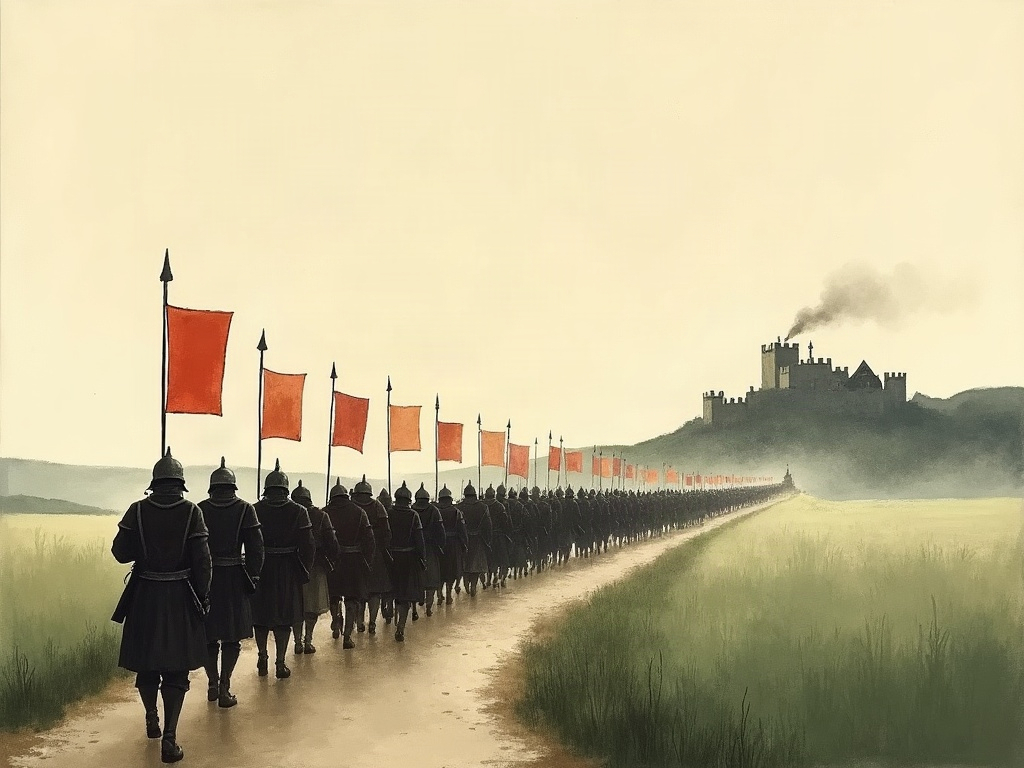
By the second week of June the rebels were marching on London itself, and the poll tax had done its work: it had united countryside and town, labourer and artisan, in a single furious demand for change. When the confrontation finally came, it fell to the boy at the centre of it all to face the storm his uncle’s government had raised — a drama we tell in full in our account of Richard II, the boy king who faced down the Peasants’ Revolt. The same collision of plague, taxation and a cornered young king is the true history dramatised in Paul Greengrass’s 2026 film, explored in our companion piece on the true story behind The Uprising.
Why the poll tax still matters
The rising was crushed within weeks, its leaders killed and its charters revoked. But the tax that started it left a lasting mark. No English government dared levy a general poll tax on the same lines for centuries; the memory of 1381 hung over the very idea of taxing every head at a flat rate. The lesson had been written in blood: a tax is never only a number. It is a statement about who a society thinks should carry its burdens.
That lesson has echoed down the centuries. When a modern British government revived a flat-rate “community charge” in 1990 — instantly nicknamed the poll tax — it too provoked mass refusal, riots and, ultimately, the fall of a prime minister. Six hundred years apart, the same principle produced the same fury. The men of Fobbing who turned on Thomas Bampton were not political theorists. They were ordinary people who had reached the end of what they could bear, and who discovered, to their own astonishment, that a kingdom’s patience has a limit — and that a single tax can find it.
Sources & further reading:
- The Peasants’ Revolt (The National Archives, UK)
- Poll tax (Encyclopaedia Britannica)
- Peasants’ Revolt (Encyclopaedia Britannica)
- The Anonimalle Chronicle account of the Peasants’ Revolt (British Library)
Related Reading
- The 1381 Peasants’ Revolt: The Complete Story of England’s Great Rising
- The Statute of Labourers: Wage Caps That Fuelled a Revolt
- How the Black Death Set the Stage for the Peasants’ Revolt