Yasuke: The African Warrior Who Became a Samurai Under the Warlord Who Unified Japan

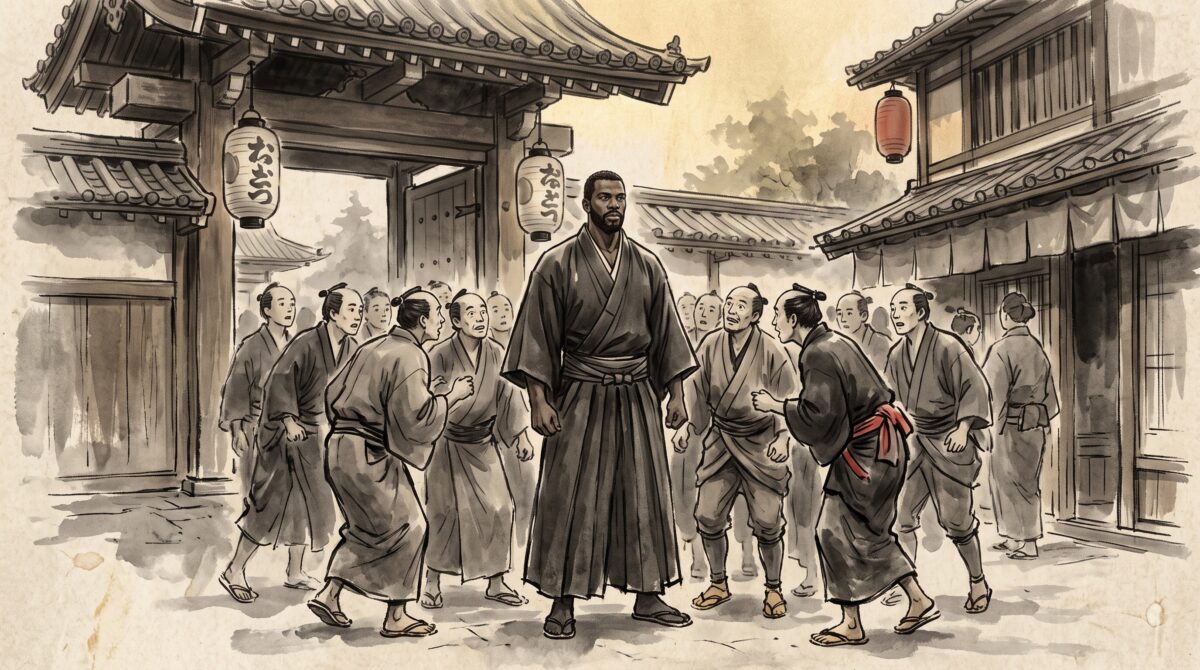
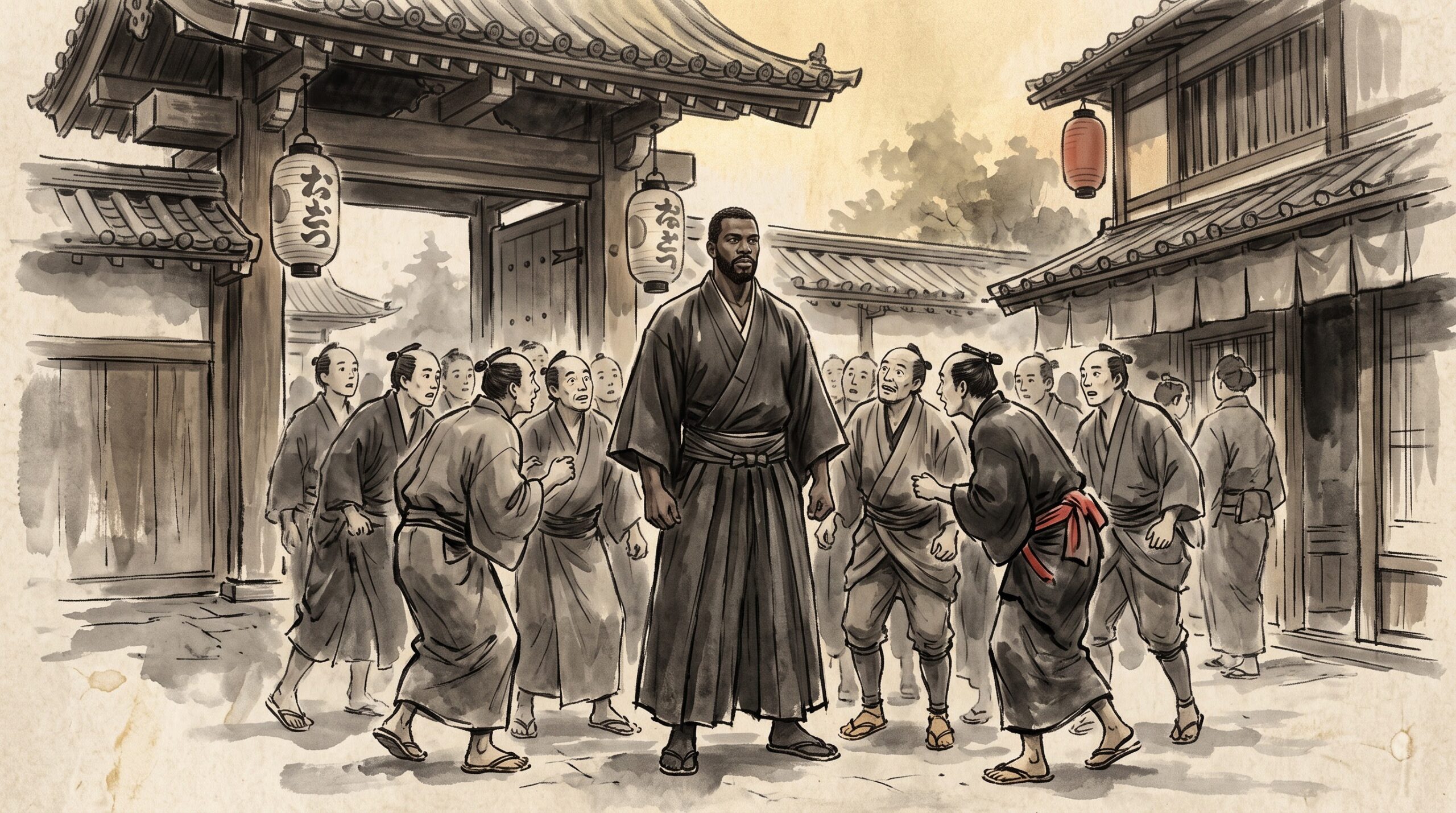
In the spring of 1581, a crowd gathered at a Jesuit church in Kyoto so eager to see a single man that, by one account, people were hurt in the crush and stones were thrown to force the doors. They had come to look at a visitor unlike anyone in the capital had ever seen: a tall African man, powerfully built, with dark brown skin, who had arrived in Japan in the service of the Catholic missionaries. Within weeks that stranger would be standing in the private chambers of the most powerful warlord in the country. Within a year he would be a samurai in all but birth — and then he would ride straight into one of the most famous betrayals in Japanese history, and vanish.
A gift the missionaries did not expect to lose
The man the Japanese would come to call Yasuke almost certainly came from Africa — Mozambique is the most common guess, though his true origins and birth name are lost. He arrived in Japan in 1579 as the attendant of Alessandro Valignano, an Italian Jesuit sent to inspect the mission in the Far East. For two years he travelled in the missionaries’ retinue, a bodyguard and servant, until business brought Valignano to Kyoto in 1581, into the orbit of the man then remaking Japan by fire and sword.
That man was Oda Nobunaga, the first of the three great unifiers who would drag Japan’s warring provinces into a single state. Nobunaga was ruthless, brilliant and endlessly curious about the wider world — he collected Western weapons, armour and maps the way other lords collected tea bowls. When he heard that the foreign priests had in their company a black-skinned giant, he demanded to see him for himself.
The man Nobunaga thought was painted
The meeting became legend almost immediately, because of what Nobunaga did next. According to the Jesuit chronicler Luís Fróis, the warlord simply did not believe the man’s colour was real. He assumed the skin had been stained with black ink as some kind of trick, and ordered the man stripped to the waist and scrubbed to make the colour run. It did not run, of course. The more they washed, the more astonished Nobunaga became.
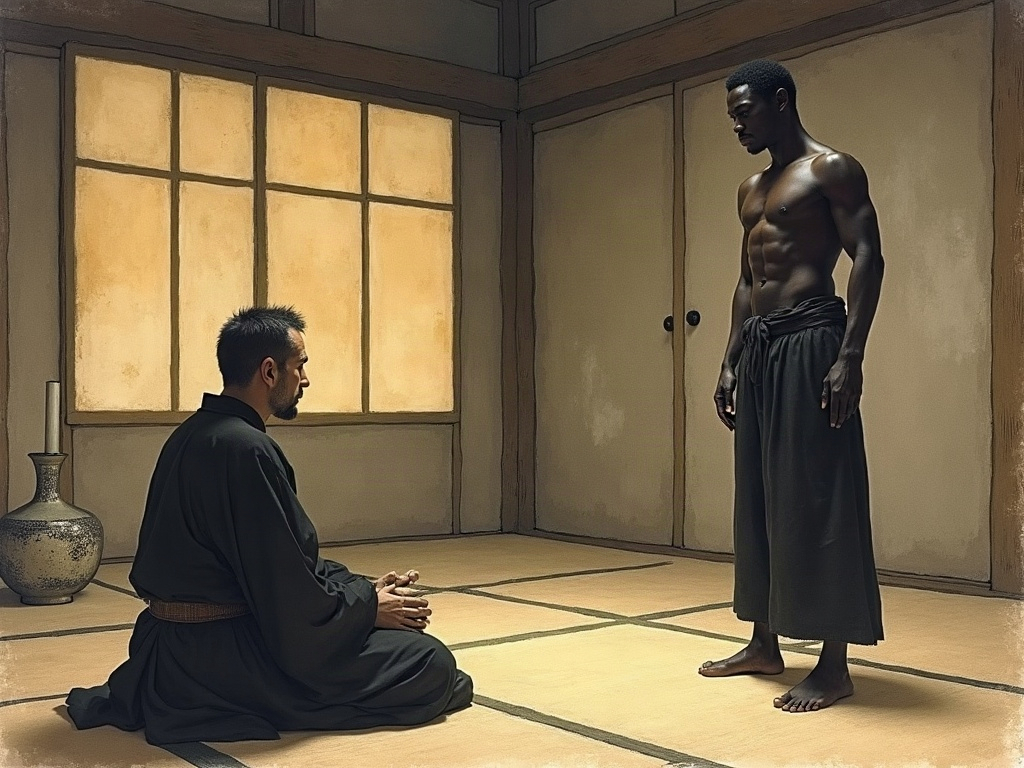
What might have been a humiliation turned into a fascination. Nobunaga questioned the man closely and was impressed by what he found: a visitor who already spoke some Japanese, who was, by the accounts, around twenty-six or twenty-seven years old, well over six feet tall, and said to have “the strength of ten men.” The warlord asked Valignano to leave the man in his service, and the Jesuits — who needed Nobunaga’s goodwill far more than they needed a single attendant — agreed.
From curiosity to retainer
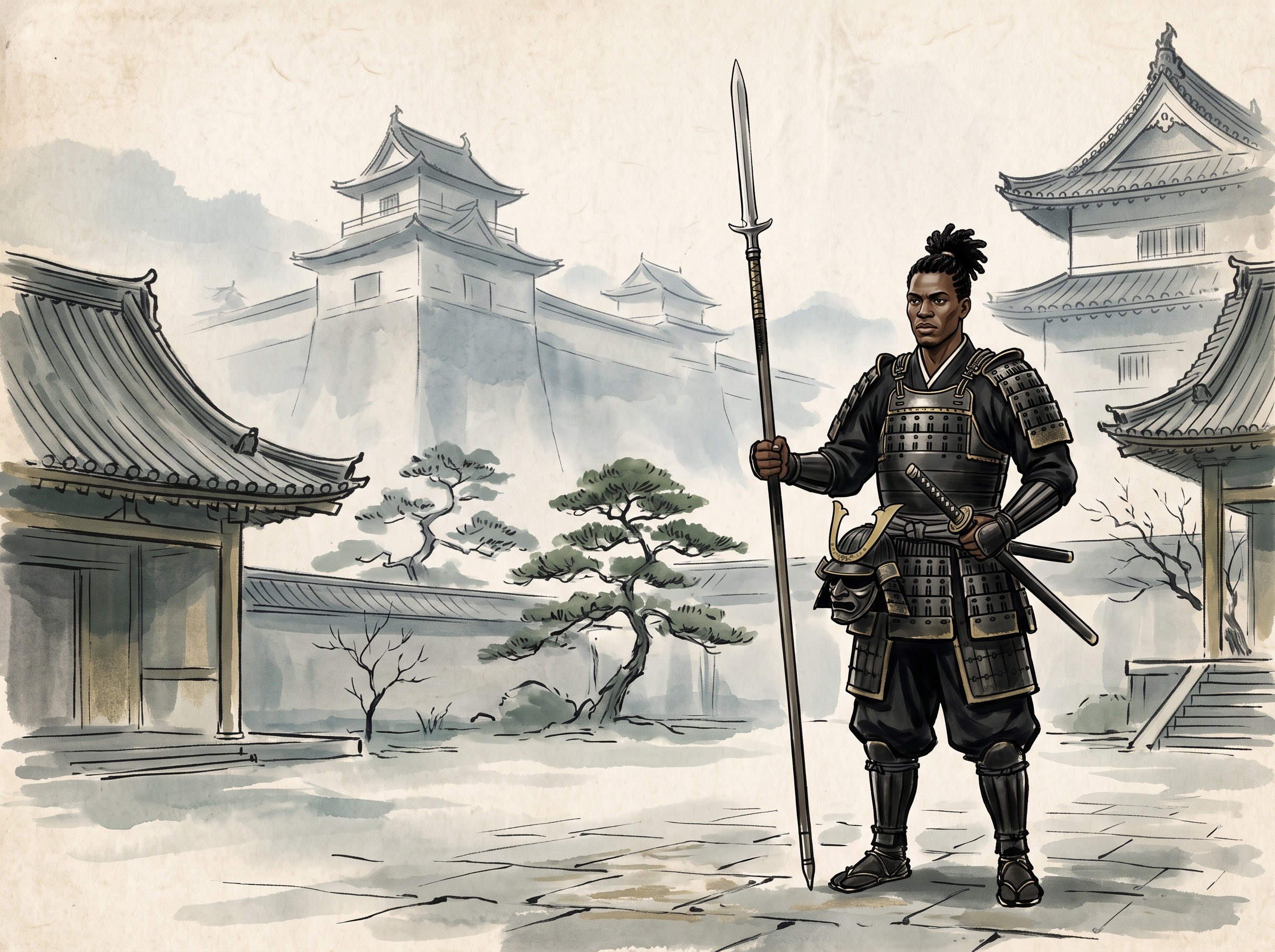
Here the story does something remarkable. Nobunaga did not keep the African as a mere exotic ornament. He gave him a Japanese name, Yasuke, a stipend, and his own residence. The Shinchō Kōki, the near-contemporary chronicle of Nobunaga’s life compiled by his retainer Ōta Gyūichi, records Yasuke’s presence in the lord’s entourage, and other accounts say Nobunaga granted him a short sword — the kind of honour that marked a man as a genuine retainer rather than a servant. Yasuke carried Nobunaga’s weapons, attended him closely, and by some reports sat and ate in the warlord’s presence, a privilege reserved for men of standing.
Whether Yasuke was a “samurai” in the strict later sense of a hereditary warrior caste is a question historians still debate — the rigid class system came after Nobunaga’s day. But in the terms of his own time, a man who drew a lord’s stipend, lived in a lord’s house, bore a short sword and fought at a lord’s side was, functionally, a retainer in arms. For an African man in sixteenth-century Japan, with no clan and no birthright, to reach that position in a matter of months is staggering. Japan prized bloodline and lineage above almost everything; Yasuke rose on nothing but the impression he made and the favour of one extraordinary patron. It places him in the small, strange company of outsiders who bent a rigid world to fit themselves — the way the Mongols remembered the wrestling princess Khutulun, who refused the single role her society offered her.
The night the record turns to fire
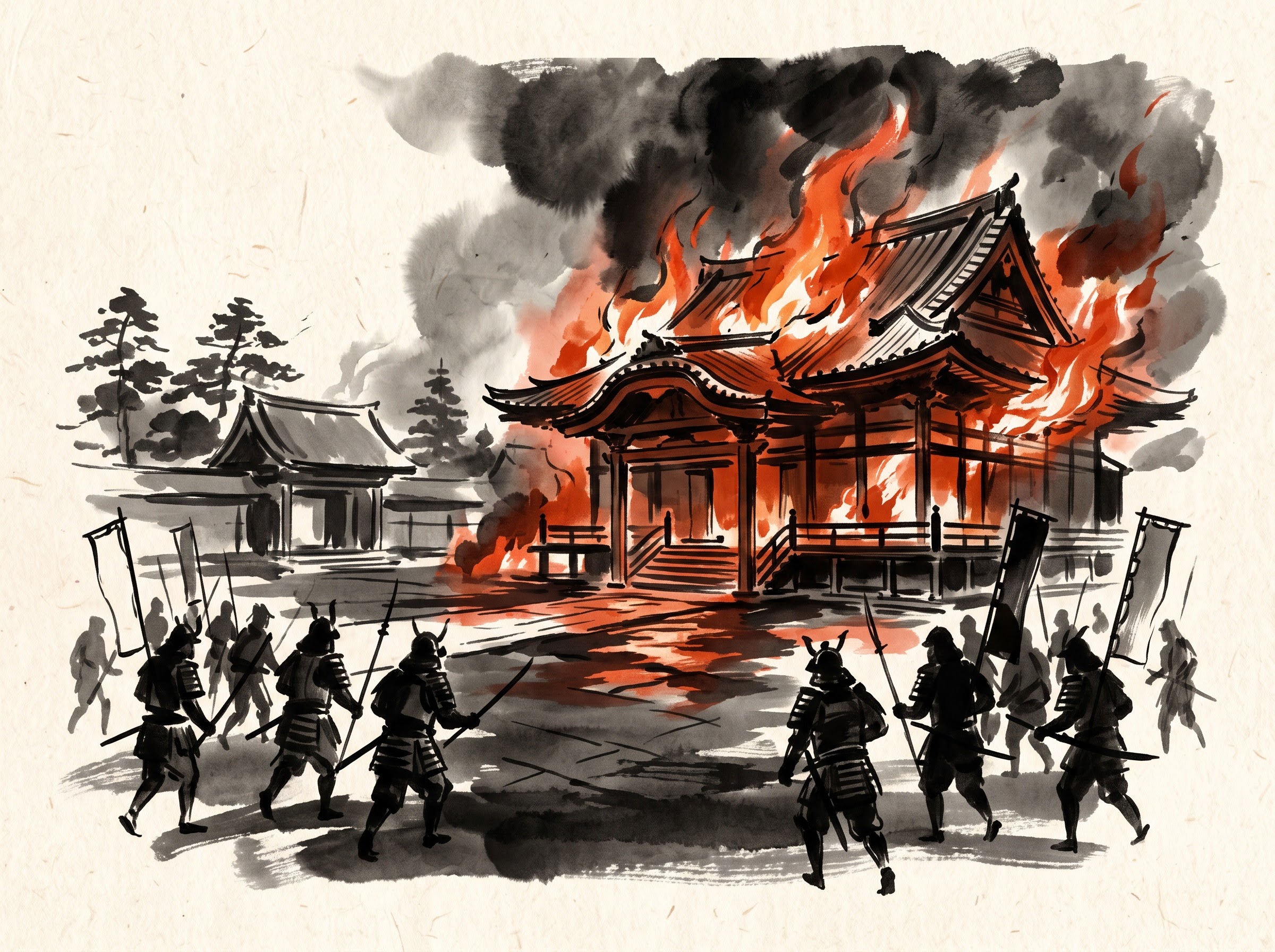
Yasuke’s time in the sun was brutally short. In June 1582, Nobunaga was near the height of his power, poised to finish the conquest of Japan. He was resting at Honnō-ji, a temple in Kyoto, with only a small guard, when one of his most senior generals, Akechi Mitsuhide, turned his army around and marched it against his own lord. In the pre-dawn dark, Akechi’s thousands surrounded the temple. Nobunaga, hopelessly outnumbered, fought briefly and then — as a defeated warlord was expected to — took his own life as Honnō-ji burned around him. It is one of the most consequential betrayals in Japanese history, the Honnō-ji Incident.
Yasuke was there. He fought in the defence of the temple, and when it fell he did not flee the country — he made his way to the nearby residence of Nobunaga’s son and heir, Oda Nobutada, who was mounting his own last stand at Nijō. Yasuke fought there too, until that position also collapsed and he was captured by Akechi’s men. He had stayed loyal to the house that raised him to the very end, the same unbending fidelity that later Japanese storytellers would prize above life itself in tales like the forty-seven ronin, who gave everything to avenge their dead master.
Spared, and then gone
What Akechi did next is the final twist. When his soldiers brought the captured African before him, Akechi reportedly declared that the man was not a true Japanese but a beast or an animal, and that it would be wrong to kill him. Whether this was contempt, superstition, or a strange mercy, the effect was the same: Yasuke’s life was spared. Akechi ordered him taken back to the Jesuit church in Kyoto and delivered to the priests.
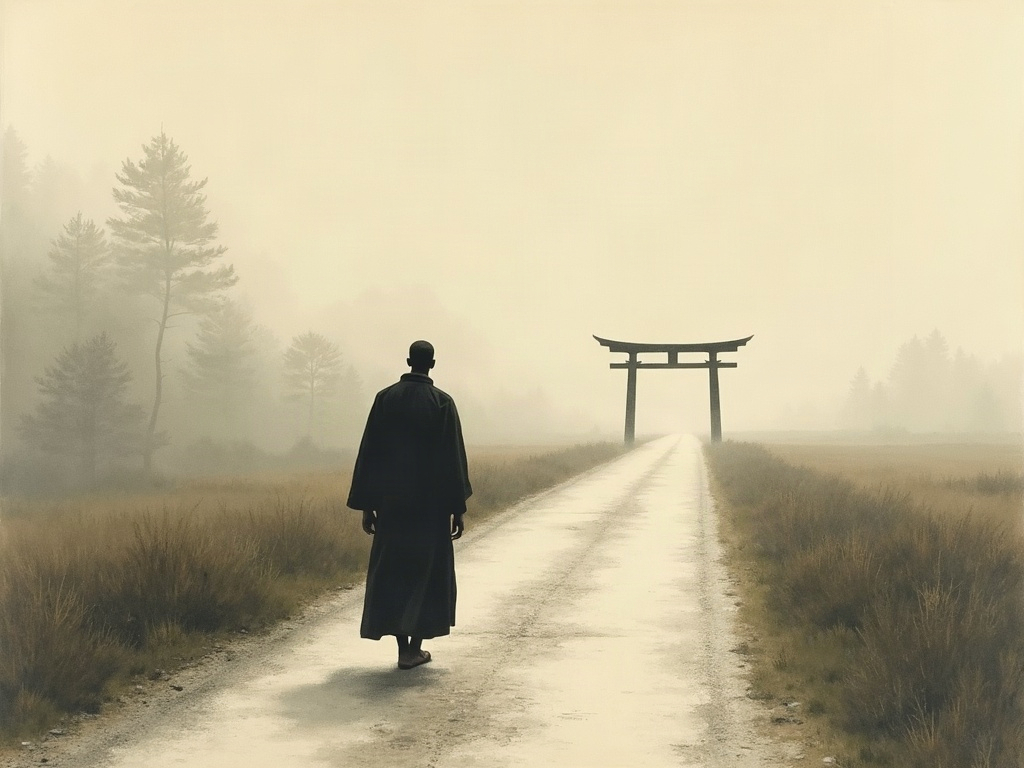
And there, in 1582, the historical record of Yasuke simply ends. The man who had crossed an ocean, astonished a warlord, risen to bear his sword, and survived the fire of Honnō-ji walks out of the Jesuit letters and the Japanese chronicles alike and is never clearly mentioned again. Did he return to the mission and sail away with the departing priests? Did he fight in later battles under another lord, as a few unverified traditions hint? Did he live out a long, quiet life somewhere in Japan? We do not know. The sources that recorded his astonishing rise fell silent on his ending as completely as they did on so many who lived through Japan’s century of blood, from the lords to the Christian converts later crushed in uprisings like the doomed Shimabara Rebellion of 1637.
Why Yasuke still matters
It would be easy, and wrong, to flatten Yasuke into a modern slogan — the “first Black samurai,” a tidy label the people of 1581 would not have recognised. The truth underneath is more interesting than any slogan. A man whose own name we have lost, from a continent most Japanese had never heard of, arrived in the most insular country on earth at the most violent moment in its history, and in the space of a single year earned the trust and the sword of the man trying to rule it all. He did it with no lineage to trade on, in a society built almost entirely on lineage, on the strength of presence, loyalty and nerve.
That is what keeps Yasuke alive in the imagination four and a half centuries later, long after the warlords who towered over him have become dates in a textbook. His story is proof that even the most closed and hierarchical world can, now and then, make room for the complete outsider — and that a life can blaze brightly enough in a single year to outlast the records that forgot to write down how it ended. We do not know what became of Yasuke. But we know he was there, at the burning temple, sword in hand, to the last. For a man history nearly erased, being remembered as the one who did not run may be the truest monument of all.
Sources & further reading:
- Yasuke (Encyclopaedia Britannica)
- The History of Japan, Jesuit accounts of Luis Frois (via Wikipedia, with primary citations)
Related Reading
More from the archive
- The Man Who Survived Two Atomic Bombs: Tsutomu Yamaguchi at Hiroshima and Nagasaki
- The Man-Eaters of Tsavo: The Lions That Brought an Empire’s Railway to a Halt