The Man-Eaters of Tsavo: The Lions That Brought an Empire’s Railway to a Halt

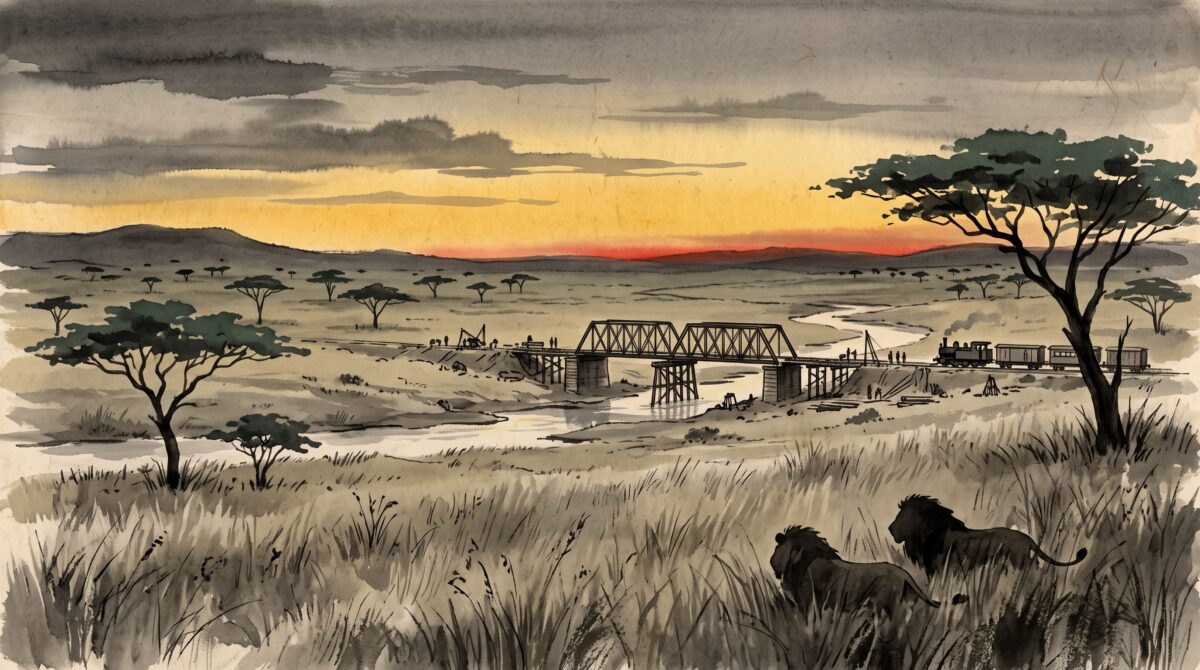
In the spring of 1898, deep in the wilderness of British East Africa, a British army of surveyors, engineers, and thousands of labourers was driving an iron line across a continent. The Uganda Railway — mocked by its critics back in London as the “Lunatic Line” for its cost and ambition — was clawing its way inland from the coast toward the great lakes, mile by sweated mile. And then, at a wide, grey river called the Tsavo, it stopped. Not because of mountains, or disease, or a rival empire, but because of two lions. For nine months they hunted the men who had come to build the railway, dragging them screaming from their tents in the dark, until the whole vast enterprise ground to a terrified halt around a single unfinished bridge.
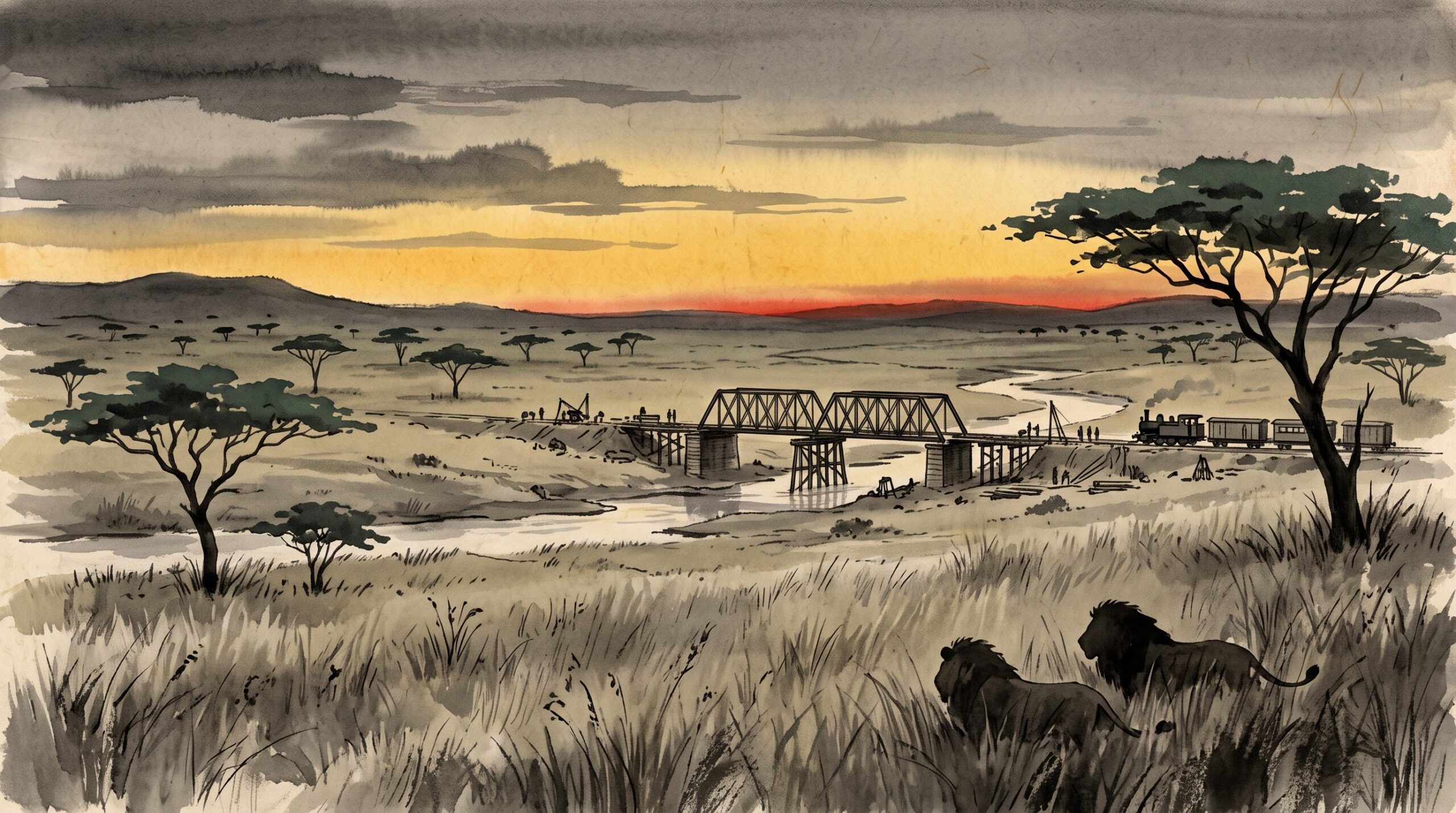
The bridge at Tsavo
The man charged with throwing a railway bridge across the Tsavo River was Lieutenant Colonel John Henry Patterson, a British engineer newly arrived in Africa. Under him laboured a workforce of several thousand — many of them Indian workers brought over for the great project, alongside local African men — living in a scattered chain of tented camps along the line. It was hard, hot, dangerous work in a landscape that was beautiful and utterly indifferent to them.
Almost as soon as Patterson arrived, men began to vanish. At first the disappearances were blamed on the rough characters the railway attracted, or on deserters slipping away into the bush. But the truth was far worse. Two large maneless male lions had discovered the camps, and had discovered that the men inside them were slow, soft, and easy to catch. Night after night the lions crept past the fires, tore through the thornbush fences, ripped open the canvas tents, and carried a living man off into the darkness. By morning there would be nothing left to bury but a few scraps and a trail of blood leading into the grass.
Nine months of terror
What made the Tsavo lions so horrifying was not merely that they killed, but how fearless and deliberate they became. Ordinary lions avoid people. These two seemed to hunt humans by preference, growing bolder with every success until they would walk openly into a lit camp to seize their prey. The workers, convinced no natural animal could behave this way, began to whisper that the lions were demons — the vengeful spirits of the land itself. They gave the pair the names by which they are still remembered: the Ghost and the Darkness.
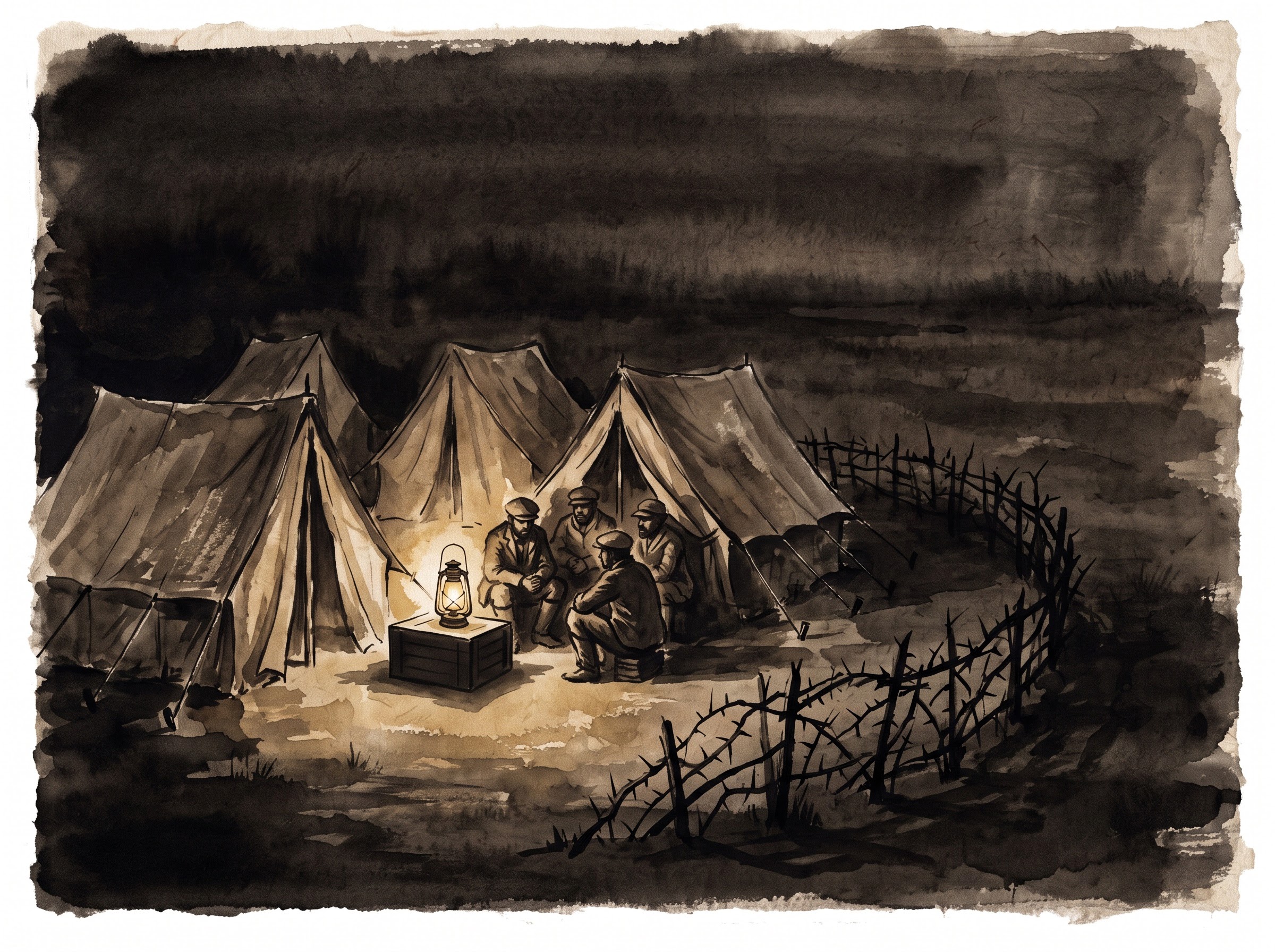
Patterson tried everything. He built stronger thornbush enclosures, called bomas, and ringed the camps with fires. He set traps baited with live goats. He ordered the men to stay inside after dark. Nothing worked for long. The lions simply adapted, testing each defence and finding its weakness, and the killings went on. As the death toll mounted the panic became unbearable, and at last the workforce did the only thing left to them: in their hundreds, they downed tools and fled, flagging down trains and clinging to the carriages to escape the river of death. The mighty Uganda Railway, backbone of an empire’s ambitions in East Africa, had been stopped in its tracks by two animals.
The long vigil
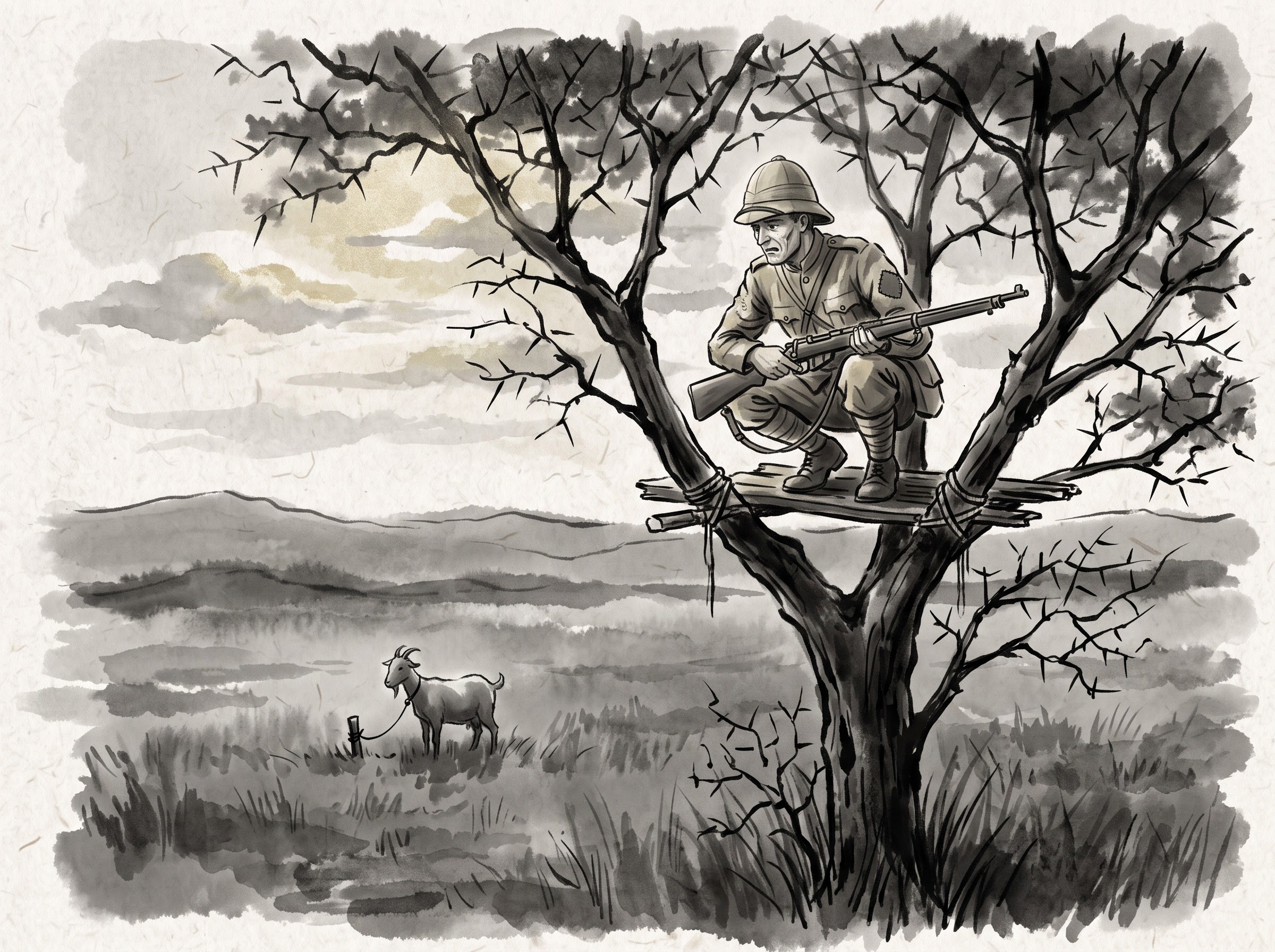
With the work abandoned and his authority collapsing, Patterson resolved to kill the lions himself. It became a private duel played out over many weeks. He studied their movements, learned the places they favoured, and began sitting up through the long nights on flimsy platforms lashed into trees — a goat or a donkey tethered below as bait, his rifle across his knees, the darkness alive with sounds. More than once the lions outwitted him, taking a victim from a camp on the far side of the river on the very night he waited for them elsewhere. The strain of those vigils, hour after hour alone in the dark listening for the brush of a heavy body through the grass, must have been almost beyond bearing.
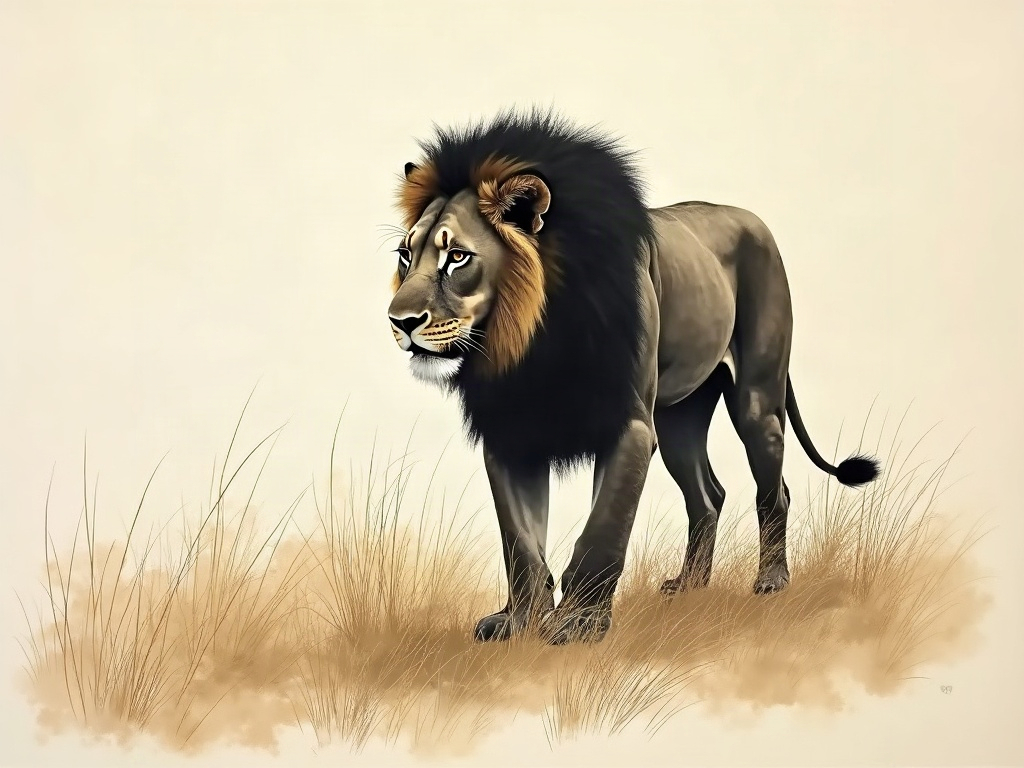
Finally, in December 1898, his patience was rewarded. On the ninth of the month he shot the first of the two lions. The second was harder to kill, and far harder to forget: it took several bullets over two separate encounters before it fell, and by Patterson’s account it died still dragging itself toward him, trying to reach the man who had hunted it. The animals proved to be enormous — maneless, scarred, each close to nine feet from nose to tail. With their deaths the terror lifted. The scattered workers drifted back, the bridge was completed, and the Lunatic Line resumed its march toward the interior.
Why did they do it?
For more than a century people have asked what turned the Tsavo lions into man-eaters, and the question has never been fully settled. One long-standing theory points to a cattle plague that swept East Africa in the 1890s, destroying the wild and domestic herds the lions would normally have hunted and leaving them desperate for other prey. Another notes the grim history of the region’s caravan and slave routes, along which the dead and dying were sometimes simply abandoned — a landscape that may have taught generations of lions to see humans as food.
Modern science has added its own clues. When researchers examined the lions’ actual remains, they found that one of the animals had a badly damaged mouth — a broken canine tooth with an infected, abscessed root — an injury that would have made bringing down strong, struggling game agonising, and softer human prey far more tempting. Chemical analysis of the lions’ bone and hair even allowed scientists to estimate how many people the pair had truly eaten: a figure far lower than the many dozens of the legend, but still a toll of horror measured in the lives of real men who had come to Tsavo only to work.
A legend that outlived the line
The Tsavo man-eaters passed almost at once into legend, helped by Patterson’s own vivid memoir of the ordeal, published in 1907. The skins he had kept as trophies and used for years as floor rugs were eventually sold, in 1924, to the Field Museum of Natural History in Chicago, where they were restored, mounted, and put on display — and where the two lions, still, draw crowds today. Their story has been retold in books and on screen, most famously in the 1996 film that borrowed the workers’ own names for its title, The Ghost and the Darkness.
There is something about Tsavo that places it among history’s great parables of empire meeting a frontier it could not simply command. An age that believed in its own unstoppable progress — that could survey a continent and lay steel across it — was brought to a standstill by two hungry animals, in a story as elemental as any told around a fire. It belongs beside those other moments when an empire’s reach ran up against a wall it never expected, like the handful of Spanish soldiers besieged for nearly a year at the end of the world in the Siege of Baler, where men kept fighting a war that had already ended, or the raw power of nature turning predator in the Children’s Blizzard of 1888, the storm that hunted the schoolhouses of the Plains.
The men the grass remembers
It is easy, more than a century on, to let the Tsavo story become a tale of one brave engineer and two monstrous lions, and to forget the people at the centre of it. The names that echo down to us are Patterson’s and the lions’; the names of the many workers who were killed in the dark, far from home and labouring on another nation’s railway, have mostly been lost — as so often happens to the ordinary people whose sweat and lives built the great works of empire, the same forgotten multitude that crewed the world’s ships through the brutal trade of shanghaiing, the kidnapping racket that manned the age of sail. They came to Tsavo to build a bridge, and some of them never left the river. If the Ghost and the Darkness are remembered, it is only right that the men they took are remembered too — the quiet cost, paid in the long grass at night, of a line drawn by distant hands across a map of the world.
Sources & further reading:
Related Reading
More from the archive
- Yasuke: The African Warrior Who Became a Samurai Under the Warlord Who Unified Japan
- The Black Donnellys