The Sultana: America’s Worst Maritime Disaster, and the Nation That Barely Noticed


They had already survived the worst thing they could imagine. The men crowding the decks of the steamboat Sultana in the last week of April 1865 were skeletons in faded blue — Union soldiers who had lived through the starvation, filth and slow dying of Confederate prison camps at Andersonville and Cahaba, and who had just heard the impossible news that the war was over and they were going home. Some weighed less than a hundred pounds. Many could barely walk up the gangplank. All of them believed the hard part was behind them. Within days, more of them would be dead than would die on the Titanic half a century later. It remains, to this day, the worst maritime disaster in American history — and almost no one has heard of it.

A Boat Built for 376
The Sultana was a fine, fast side-wheel steamboat, two years old, licensed to carry 376 passengers and crew. That number is worth holding on to, because on the night she died she was carrying more than 2,100 people, and by some estimates closer to 2,400. The decks sagged under the weight. Men were packed so tightly that the crew propped the sagging upper deck with heavy timbers to keep it from collapsing. No sane captain fills a boat to six times its capacity by accident. The Sultana was overloaded on purpose, for money.
The Arithmetic of Greed
At the end of the war, the U.S. government was paying steamboat operators a bounty for every released prisoner they carried north — five dollars a head for an enlisted man, ten for an officer. That created a grim incentive: cram every last soldier onto one boat rather than spread them safely across several. At Vicksburg, where thousands of freed men waited on the riverbank, the officers responsible for loading them — amid accusations of bribery and kickbacks that would echo through the investigations for years — funnelled the entire multitude onto the Sultana. Other steamboats left the same landing nearly empty. The men themselves were simply grateful. After what they had endured, a crowded deck felt like deliverance.

The Patch That Should Have Been a Repair
There was one more problem, and it was the one that mattered. On the way upriver, one of the Sultana‘s four boilers had begun to leak. A proper repair meant cutting out and replacing a bulged seam — several days’ work that would have forced the impatient soldiers onto other boats and cost the captain his lucrative human cargo. Instead, a Vicksburg boilermaker was persuaded to hammer a thin metal patch over the bulge, a temporary fix he warned was not enough. The captain, J. Cass Mason, wanted to go. And so, top-heavy with men and carrying a boiler that had been bandaged rather than healed, the Sultana pushed north into a Mississippi swollen to bursting by the spring thaw, its current fierce, its floodwaters spread for miles across the drowned lowlands.
Two O’Clock in the Morning
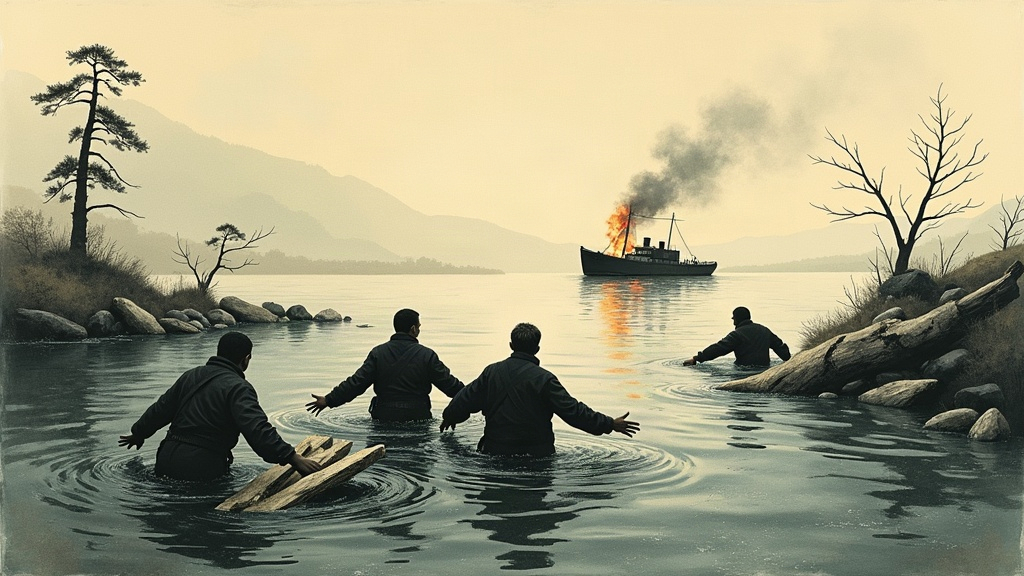
She stopped at Memphis late on 26 April to unload cargo, then pushed off into the dark. At around two o’clock in the morning on 27 April 1865, some seven to nine miles above the city, three of the four boilers let go at once. The explosion tore the heart out of the boat. Superheated steam and a storm of splintered wood scythed through the sleeping men; the great smokestacks toppled onto the crowded decks; and within minutes the shattered wooden hull was on fire, a floating pyre in the middle of a black, flooded river. Men who were not killed by the blast faced an impossible choice — burn, or leap into a cold, racing current a mile or more wide.

The Long Cold Hours Until Dawn
For most, the water was no salvation. The soldiers were weak from months of starvation; many could not swim at all, and those who could were quickly exhausted in the frigid, debris-choked flood. They clung to anything that would float — planks, doors, drowned treetops, one another — and were swept downstream past Memphis in the dark. Some drowned in sight of the lamps on shore. Rescue boats and the citizens of Memphis pulled survivors from the water for hours, and the injured filled the city’s hospitals, but hundreds were simply gone, carried off by the river or dragged under. The final toll was never counted with certainty. Official figures put it at 1,168; many historians believe the true number ran as high as 1,800. Either way, it exceeded the death toll of the Titanic, and it exceeded the loss of the SS Mendi, another shipload of soldiers swallowed by cold water and then by history’s short memory.
The Disaster the Nation Slept Through
Here is the cruellest part. A catastrophe of that scale should have seized a nation’s attention for weeks. It did not. The Sultana exploded in the worst possible fortnight to die. President Abraham Lincoln had been assassinated on 14 April; his funeral train was still crossing the country. His killer, John Wilkes Booth, had been cornered and shot dead only the day before, on 26 April. The Confederacy was collapsing, generals were surrendering, and a public that had absorbed the deaths of more than 600,000 soldiers over four years had, in a terrible way, run out of room to grieve. The newspapers gave the greatest maritime disaster in the country’s history a few columns and moved on. The men who had survived the prison camps died a second death — this time in the record, forgotten almost before the river had carried them away.
No One to Blame
Investigations followed, as they always do. Fingers were pointed at the officers who had overloaded the boat and at the quartermaster accused of taking bribes. One officer was court-martialled and convicted — and then had the verdict overturned. In the end, effectively no one was punished for the deaths of up to 1,800 men. Captain Mason had gone down with his boat. Decades later, a former Confederate agent claimed on his deathbed that he had smuggled a coal-shaped explosive — a “coal torpedo” — into the Sultana‘s fuel to sabotage her, and the story still surfaces now and then. Most historians doubt it. The evidence points, soberly and sufficiently, to the thing that was true from the start: a bandaged boiler under an impossible load, driven hard against a flooding river by men in a hurry.
Why the Sultana Still Matters
The survivors did not forget, even if the country did. For decades they gathered in small reunion halls across the Midwest every 27 April, fewer of them each year, to remember the ones who had made it through Andersonville only to drown within reach of home. A handful of modest monuments mark their loss. But the Sultana deserves more than a footnote, because her story is not really about a boiler. It is about what happens when human lives are converted into a fee per head, when a temporary patch is cheaper than a real repair, and when a tragedy arrives at a moment too crowded with other news to be seen. Like the men lost on the Edmund Fitzgerald or the lone sailor who drifted 133 days on an open raft, the soldiers of the Sultana ask the same quiet thing of us that the drowned always do: to be remembered, and to have their deaths mean that someone, somewhere, was paying attention.
Sources & further reading:
- The Sultana Disaster — American Battlefield Trust
- Sultana — Encyclopedia of Arkansas
- The Disaster — The Sultana Association of Descendants and Friends
Related Reading
- The Eastland Disaster: The Ship That Capsized at the Dock and Drowned 844 in the Chicago River
- The Bear River Massacre: The Deadliest Day for Native Americans That America Forgot
- The General Slocum: The Picnic Boat Fire That Erased a New York Neighborhood