The Ghost Army: The WWII Con Artists Who Fooled Hitler With Inflatable Tanks


On a quiet stretch of the front line, a German reconnaissance pilot banked over a French field and counted tanks. Rows of Shermans sat under imperfect netting, engines rumbling somewhere in the treeline, trucks churning the roads, laundry drying between the tents of a division at rest. He noted it all and flew home. What he could not know was that a single soldier could have picked up one of those tanks and carried it away under one arm. The entire army below him was made of rubber, recorded sound, and nerve.
This was the work of the 23rd Headquarters Special Troops, a unit so strange that the US Army kept it a secret for half a century. History remembers it by the name its own men gave it: the Ghost Army.

A Secret Weapon Made of Rubber and Sound
Activated on 20 January 1944, the Ghost Army was a gamble unlike anything in the American arsenal. Just 1,100 men strong, it was built for one purpose: to lie convincingly enough to move the German army. If the enemy could be persuaded that a powerful force sat in one place, real divisions could slip away and strike somewhere else entirely.
The idea was borrowed from the British, who had perfected battlefield illusion in the North African desert before the Second Battle of El Alamein. American planners took the concept, supercharged it with Hollywood-grade stagecraft, and sent it to Europe. The unit reached Britain in the spring of 1944, arriving on the Continent shortly after D-Day, and over the next year it staged more than twenty separate deceptions from Normandy to the German border. The men called it their traveling road show.
The Artists Who Went to War
What made the Ghost Army extraordinary was not just its equipment but its people. Rather than draft ordinary infantry, recruiters swept through art schools, advertising agencies, and design studios, hunting for imaginations. The result was a battalion of painters, illustrators, architects, actors, set designers, and engineers who happened to be wearing uniforms.
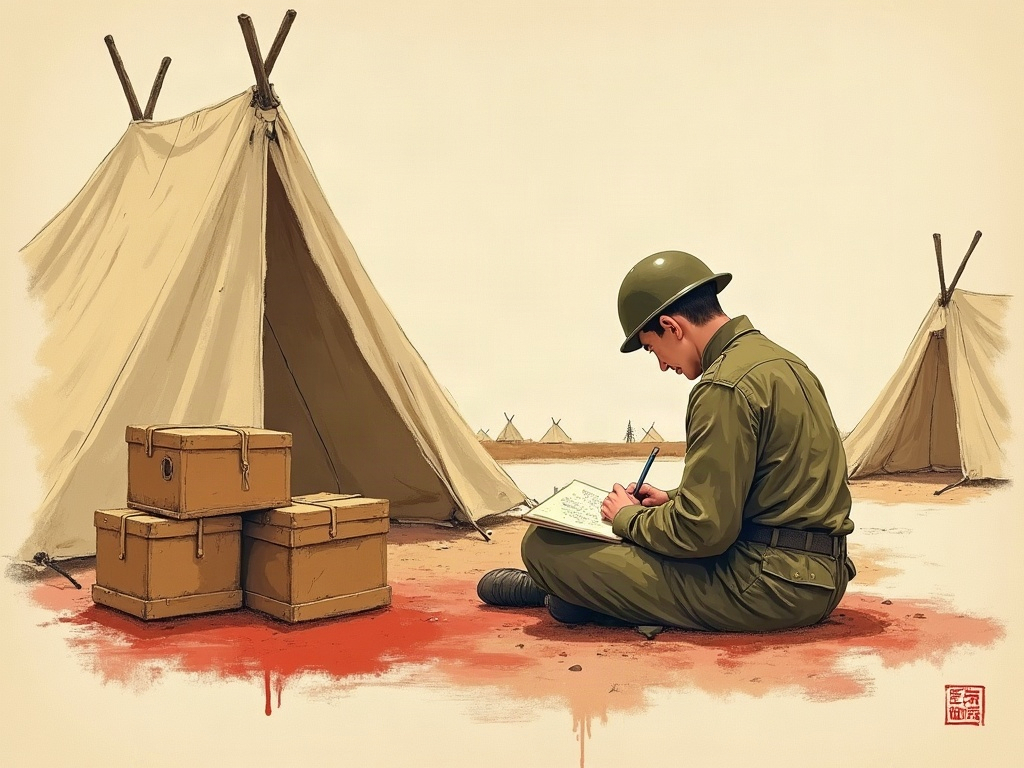
Some of them became household names. Fashion designer Bill Blass served in the ranks. So did the painter Ellsworth Kelly, a giant of postwar American abstraction, along with wildlife artist Arthur Singer and photographer Art Kane. Between deceptions, these soldier-artists sketched and painted their way across a ruined continent, filling notebooks with the faces of villagers and the wreckage of war. The unit became an unlikely incubator for a generation of American creativity.
Inflatable Tanks and Phantom Divisions
The visual illusions were the job of the 603rd Camouflage Engineers. Their arsenal was inflatable: rubber tanks, cannons, jeeps, trucks, and even aircraft that a small crew could pump full of air and set in place within hours. The trick was to camouflage them just badly enough. Netting was left slightly askew so that a German pilot’s eye would catch the shape beneath and congratulate itself for spotting a hidden division.
Around these props the men built entire fictions. They laid out dummy airfields and motor pools, staged artillery batteries, and hung laundry on clotheslines to suggest thousands of men living in the field. At its most ambitious the unit could conjure the appearance of two full divisions, some 30,000 soldiers, out of a force smaller than a single battalion. It was theatre performed for an audience that was never supposed to know it was watching a play. The same spirit of improvised, outnumbered ingenuity ran through history’s great underdog gambits, from the hand-cranked submarine that tried to sink the British navy in 1776 to the deceptions of the war itself.

The Sound of an Army That Wasn’t There
Sight was only half of the trick. An army makes noise, and the Ghost Army learned to counterfeit that too. The 3132 Signal Service Company handled what the men called sonic deception, and it was some of the most advanced audio engineering of its day.
Working with engineers from Bell Laboratories, a team traveled to Fort Knox and recorded the sounds of real armored and infantry units: the grind of tank treads, the clatter of bridge-building, the rumble of convoys. Those recordings were cut onto state-of-the-art wire recorders, the ancestors of magnetic tape. In the field, technicians could mix the sounds like a film score to fit whatever story they wanted the enemy to believe, then blast them through enormous amplifiers and speakers mounted on half-tracks. On a still night, the phantom army could be heard up to 15 miles away. Radio operators completed the illusion with a steady stream of fake transmissions, impersonating the chatter of units that existed only on the airwaves. Deception on this scale sat alongside the war’s other great cons, like the dead man who fooled Hitler and helped save Sicily.
The Rhine and the Final Illusion
The Ghost Army’s greatest performance came at the very end of the war. As Allied forces prepared to cross the Rhine into the heart of Germany in March 1945, the deceivers staged their most elaborate show, an operation often remembered as Viersen. They impersonated two entire divisions well downstream of the real crossing point, flooding the area with dummy tanks, artillery, sound, and radio traffic to convince German commanders that the main assault would come there.
The gamble worked. German attention and firepower were pulled toward the phantom force while the genuine crossing went in elsewhere. It was dangerous work; the men were deliberately drawing enemy fire onto themselves, and the illusion only held if they stood in harm’s way. A handful were killed and dozens wounded across the unit’s campaigns, a small price for deceptions that historians believe spared thousands of real soldiers. Their willingness to face fire echoed other overlooked units of the war, like the all-female Soviet bomber regiment that terrified the Germans.

Fifty Years of Silence
When the war ended, the Ghost Army came home and vanished into ordinary life. Their orders were simple: say nothing. The tactics they had pioneered were still valuable, and so the whole story was locked away, classified and unspoken, for more than fifty years. Men who had impersonated armies went back to painting, designing dresses, and drawing birds, unable to tell their own families what they had really done in France.
The secret finally lifted in 1996, when the records were declassified and the ghosts could speak at last. Documentaries followed, and in February 2022 the surviving members and the unit as a whole were awarded the Congressional Gold Medal, the nation’s highest civilian honor, nearly eighty years after they inflated their first tank.

The Ghost Army is a reminder that wars are not won by firepower alone, but sometimes by imagination, by a room full of artists who understood that the most powerful weapon can be a story the enemy chooses to believe. They fought with paint, rubber, and sound, and they saved lives with an illusion. That is why, long after the guns fell silent, their quiet deception still deserves to be remembered out loud.
Sources & further reading:
- Ghost Army – Wikipedia
- How the Ghost Army of WWII Used Art to Deceive the Nazis – Smithsonian Magazine
- Ghost Army: The Combat Con Artists of World War II – The National WWII Museum
Related Reading
- The Night Witches — The All-Female Soviet Bomber Regiment That Terrified the Nazis
- Agent Garbo: The Spy Who Invented an Army and Fooled Hitler on D-Day
- Operation Mincemeat: The Dead Man Who Fooled Hitler and Saved Sicily