The Turtle: The Hand-Cranked Submarine That Tried to Sink the British Navy in 1776


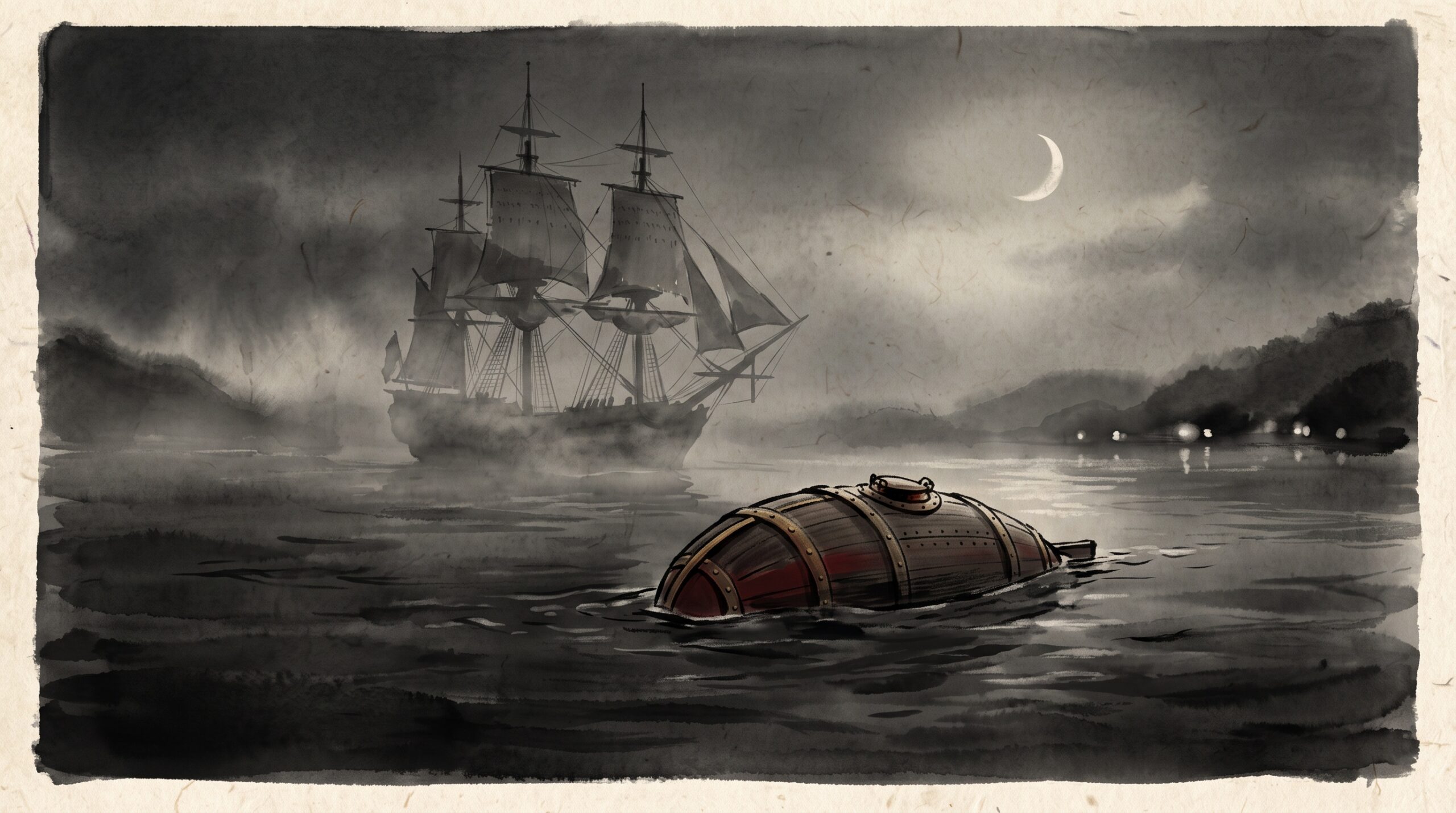
It was past midnight in New York Harbor, early September 1776, and a sergeant named Ezra Lee was sealed inside a machine no larger than a barrel, sweating in the dark. Above him rode the assembled might of the British fleet; directly ahead, its stern lanterns glowing on the black water, lay HMS Eagle, the sixty-four-gun flagship of Admiral Richard Howe. Lee’s craft carried no cannon, no crew but himself, and a single desperate idea: a keg of one hundred and fifty pounds of gunpowder that he meant to fasten to the warship’s hull and leave ticking behind him. He had perhaps half an hour of breathable air. He was, in that moment, the first human being ever to take a submarine into war.
A Yale Man’s Impossible Idea
The machine was the invention of David Bushnell, a Connecticut farmer’s son who had come late to education and enrolled at Yale in his thirties. There, absorbed by the physics of gunpowder, Bushnell proved something the age doubted: that a charge could be detonated underwater, and that water, far from smothering an explosion, would channel its force against a ship’s timbers with devastating effect. It was a discovery in search of a delivery system. How does one carry a bomb, unseen, to the bottom of an enemy hull guarded by the finest navy in the world? Bushnell’s answer was to go beneath the water entirely — to build a boat that could sink itself on purpose, creep along submerged, and rise again.
The Machine Called Turtle
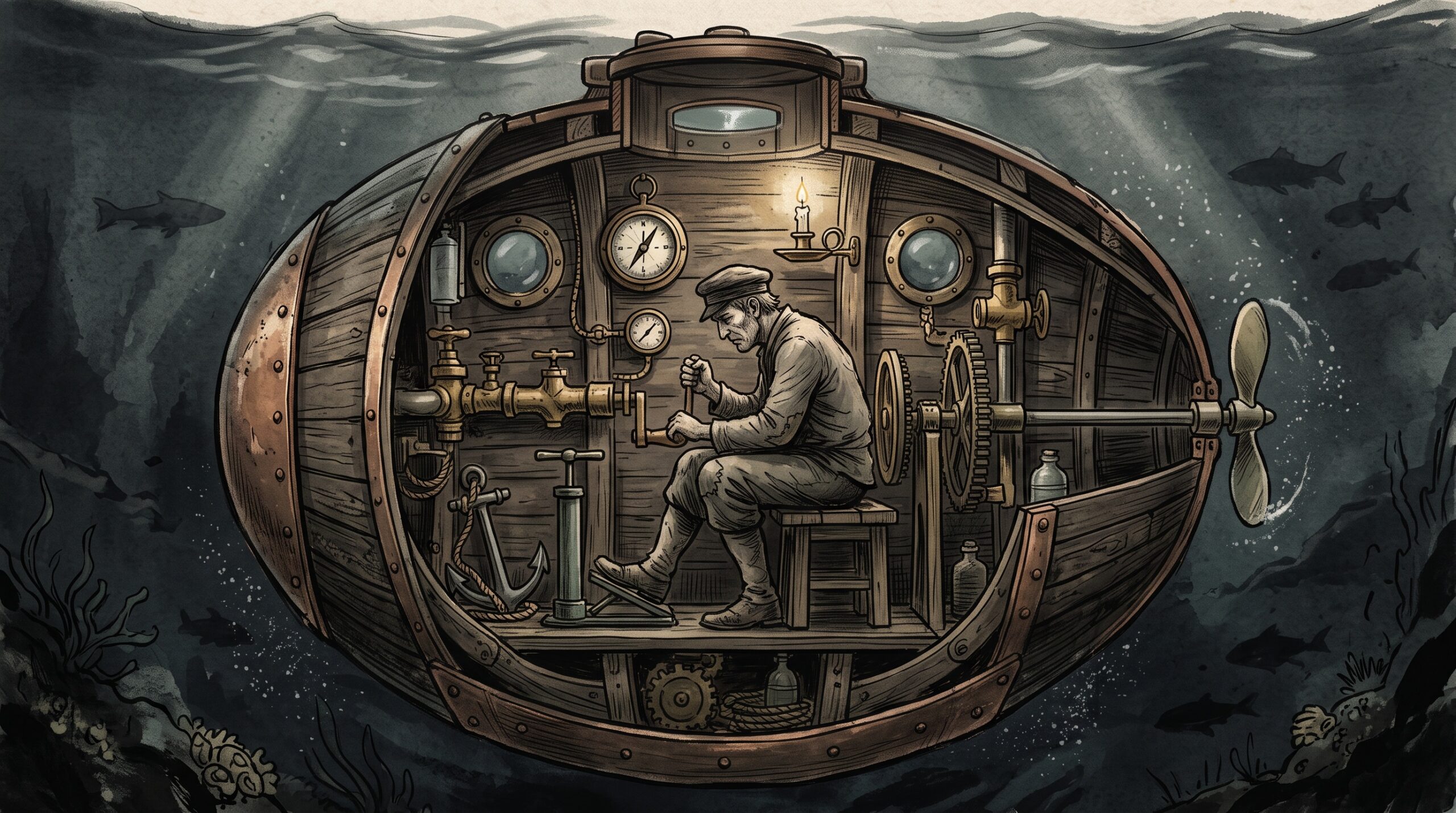
What he built looked, contemporaries said, like two great tortoise shells joined at the rim, and so they called it the Turtle. It stood upright in the water, an egg of tarred oak bound with iron bands, just large enough to hold one standing-crouching pilot. Every system inside it was worked by human muscle. To descend, the pilot opened a valve and let water flood a brass tank at his feet; to rise, he worked a foot pump to force the water back out. A hand crank spun a propeller to drive him forward — one of the earliest uses of a screw propeller anywhere — and a second crank could pull him up or down. He steered with a rudder, watched a glowing compass and a depth gauge lit by foxfire, the eerie natural phosphorescence of rotting wood, because an open flame would have burned his scarce air. Bolted to the outside was the weapon: a detachable powder magazine with a clockwork timer, and a long screw the pilot could drive up into the enemy’s planking to hang the charge in place.
The Long Crank Through the Dark
The plan demanded almost superhuman composure. Bushnell himself was too frail to pilot the craft, and his brother, trained for the task, fell ill before the attempt. So it fell to Ezra Lee, a volunteer who had only recently learned the controls. Towed out by whaleboats and cast loose near the fleet, Lee began to crank. The tide fought him; the harbor pushed him off course; and cranking the propeller, pumping the ballast, minding the compass and steering all at once, in a sealed box with a candle-stub of air, was labor of a kind few men have ever performed. Yet against every odd he reached the Eagle, sank beneath her, and brought the boring screw up against her hull to fasten his mine.
Iron, Not Oak
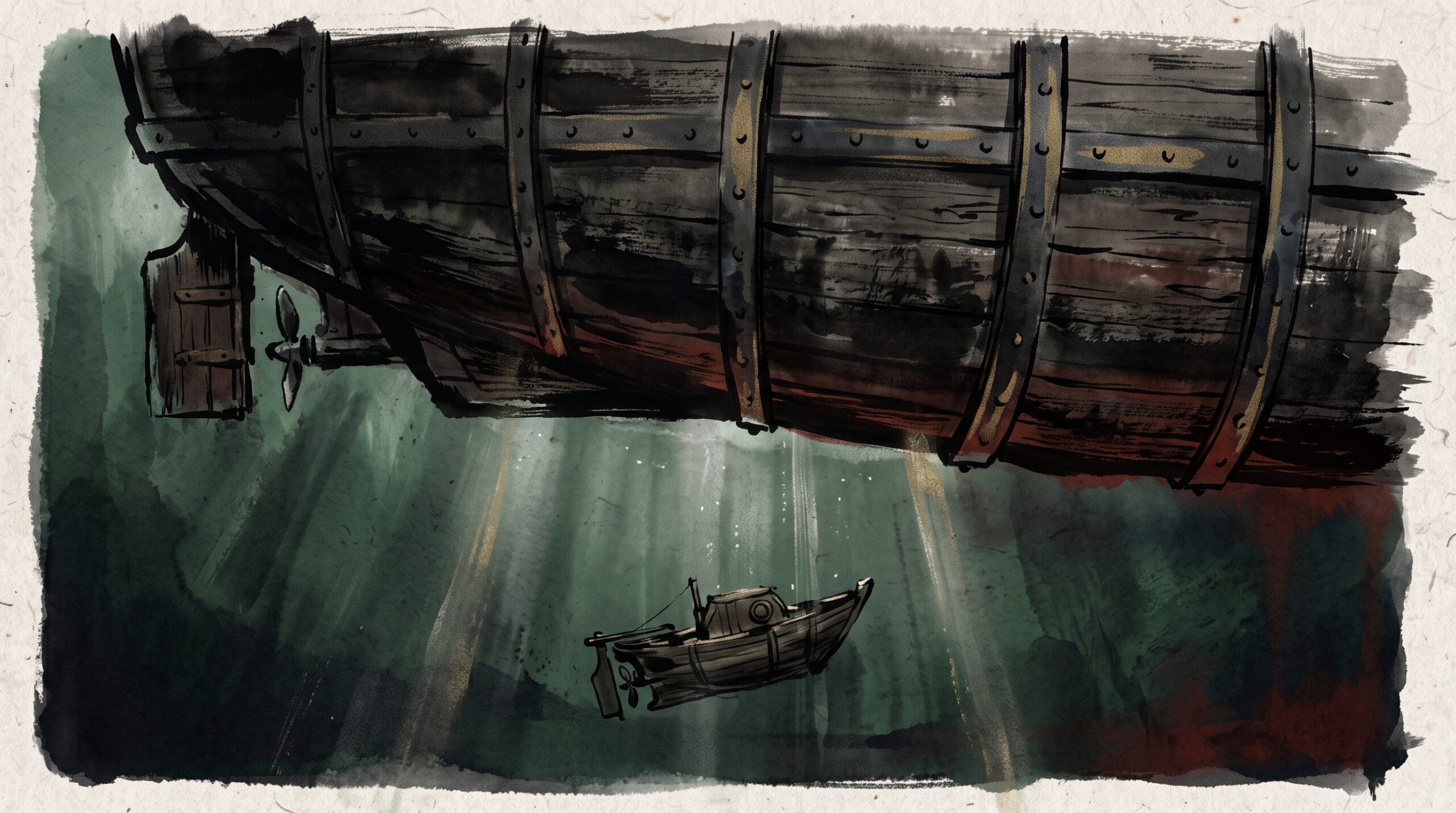
And there the great attempt failed. The screw would not bite. By the most common account, Lee had struck an iron bar or reinforcing strap — part of the fitting that held the rudder hinge, or the copper and iron sheathing that protected the hull — and the hand-driven auger simply could not penetrate it. Exhausted, low on air, and with the sky beginning to pale, Lee had no time to search for a softer spot. He released the ballast and rose, and now, drifting on the surface in daylight near the enemy, he was spotted. Redcoats put out after him in a barge. In a final act of desperation Lee released his powder magazine into the water behind him, and when it later detonated it threw up a great column of water and spray that sent his pursuers rowing hastily back. Lee cranked home, spent but alive.
A Failure That Refused to Die
The Turtle tried twice more against British shipping on the Hudson and failed each time, and not long after, the sloop carrying it was sunk by British fire. Bushnell recovered the machine but never sent it into action again. Judged as a weapon, the Turtle accomplished nothing: not a single ship was sunk, not a single sailor harmed. Yet General George Washington, who had cautiously backed the project, later reflected that it was a work of “genius,” even as he noted how many things had to go right at once for so fragile a scheme to succeed. He had put his finger on the truth of it. The Turtle was a century ahead of the materials, the mechanisms, and the reliability that could have made it deadly.
What Bushnell had actually built was not a successful weapon but a working proof — that a human could descend beneath the sea in a vessel of his own making, navigate there, and carry the war into a realm no army had ever entered. Every principle the Turtle embodied — controllable ballast, screw propulsion, a detachable underwater charge — would return, refined, in the submarines of the centuries to come, from the Confederate Hunley to the steel leviathans that would one day hold nations hostage. Bushnell had opened a door that could not be closed.
Why the Turtle Still Matters
History is full of secret weapons that promised to change everything and delivered nothing, and the Turtle belongs beside the boldest of them — the same audacious, against-all-odds spirit that later produced deceptions like Operation Mincemeat and shaped the fates of ordinary men swallowed by the sea, as in the sinking of the SS Mendi. It reminds us that innovation rarely arrives fully formed and victorious; more often it arrives as a brave, doomed first attempt that teaches the world what is possible. Ezra Lee cranked through a dark harbor toward the most powerful ship afloat and came home having sunk nothing at all. And yet, from that failure in the black water off Manhattan, an entire dimension of warfare was born. The Turtle proved that the sea could be entered from below — and once a thing has been proven possible, someone, eventually, makes it work.
Sources & further reading:
More from the archive
- The Mary Celeste: The Ship Found Sailing Itself With No One Aboard
- 133 Days at Sea: The Sailor Who Refused to Die on a Wooden Raft
- The Wreck of the Whaleship Essex: The Real Disaster That Inspired Moby-Dick