The Arrow Stork: How One Wounded Bird Finally Revealed Where Birds Go in Winter


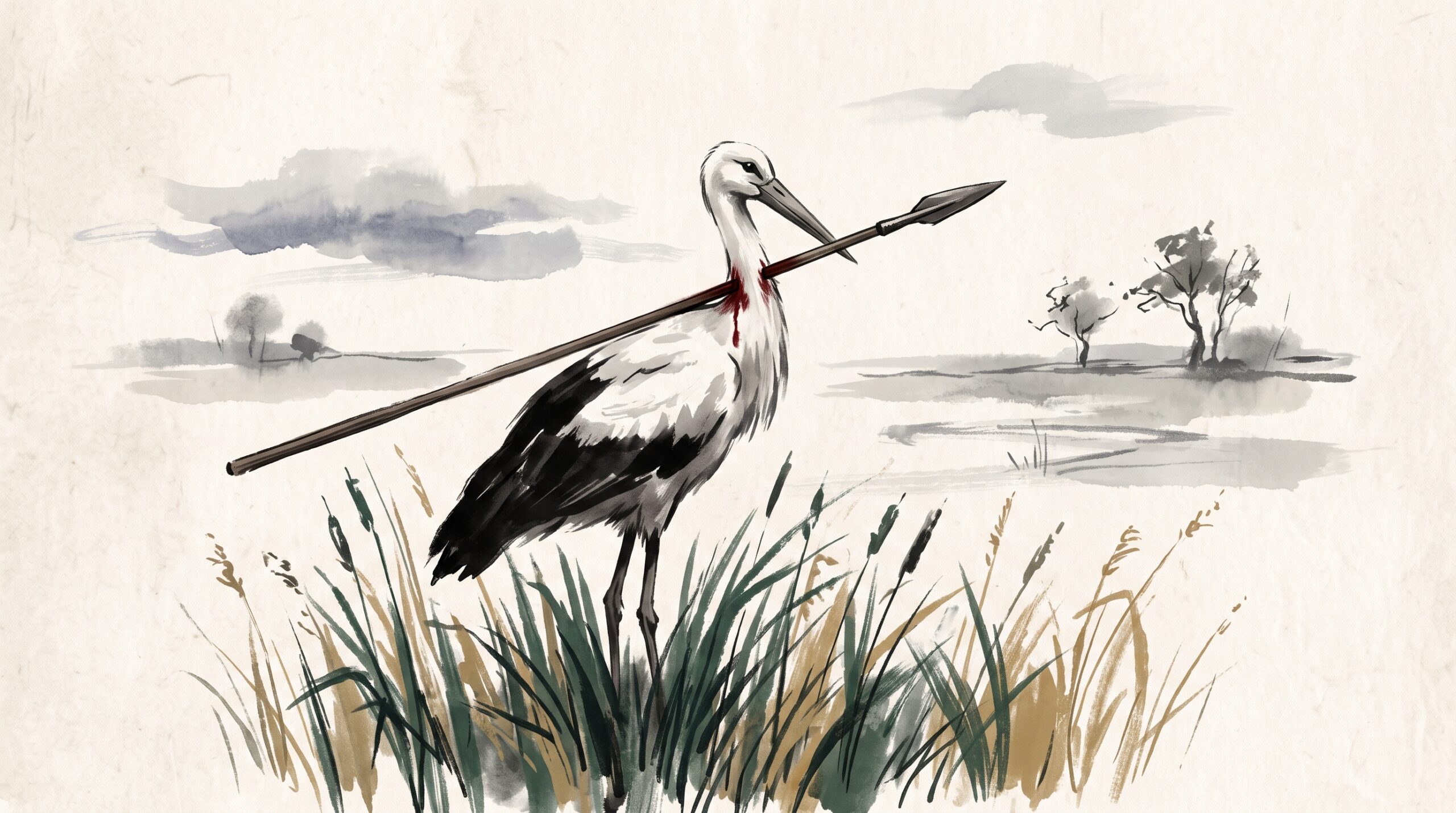
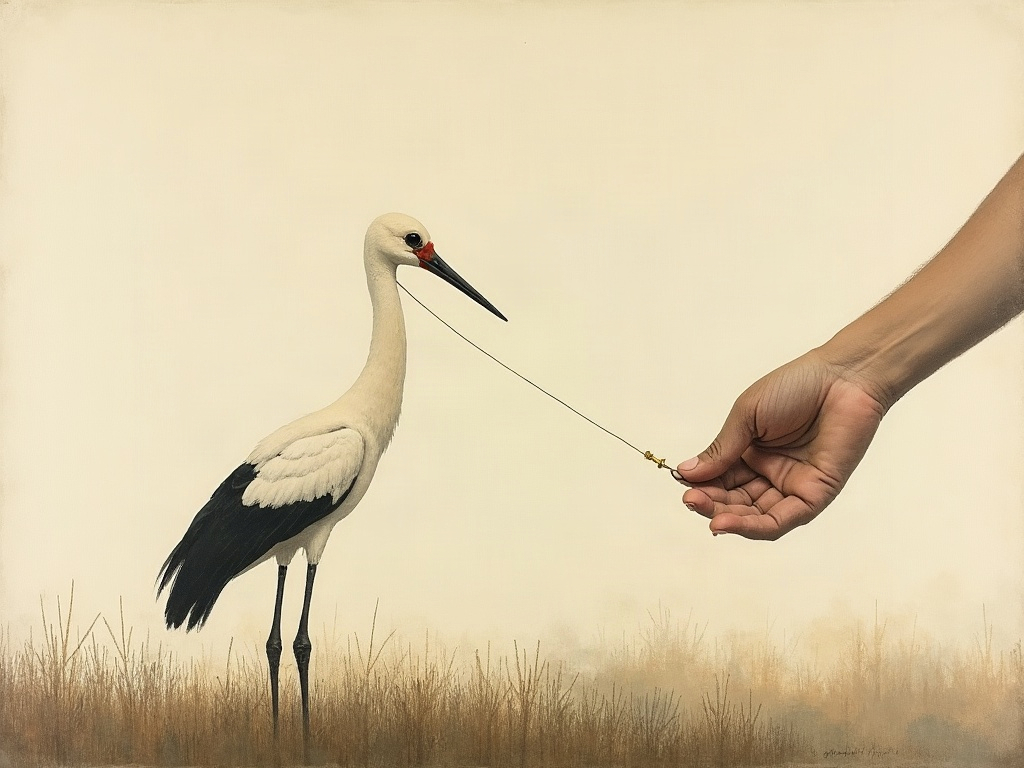
In the spring of 1822, on a country estate near the little town of Klütz in northern Germany, a white stork came home. Storks had been returning to those rooftops and meadows for as long as anyone could remember, and nobody paid them much mind. But this one was different, and it stopped people in their tracks. Jutting clean through the base of its long neck was a slender wooden spear nearly three feet long — a weapon of a kind no German had ever made, tipped with iron forged in a style unknown to Europe. The bird had flown an unthinkable distance with that shaft driven through it, and in doing so it carried home the answer to a question that had baffled humanity since antiquity: where on earth do the birds go in winter?
A Mystery Older Than Science
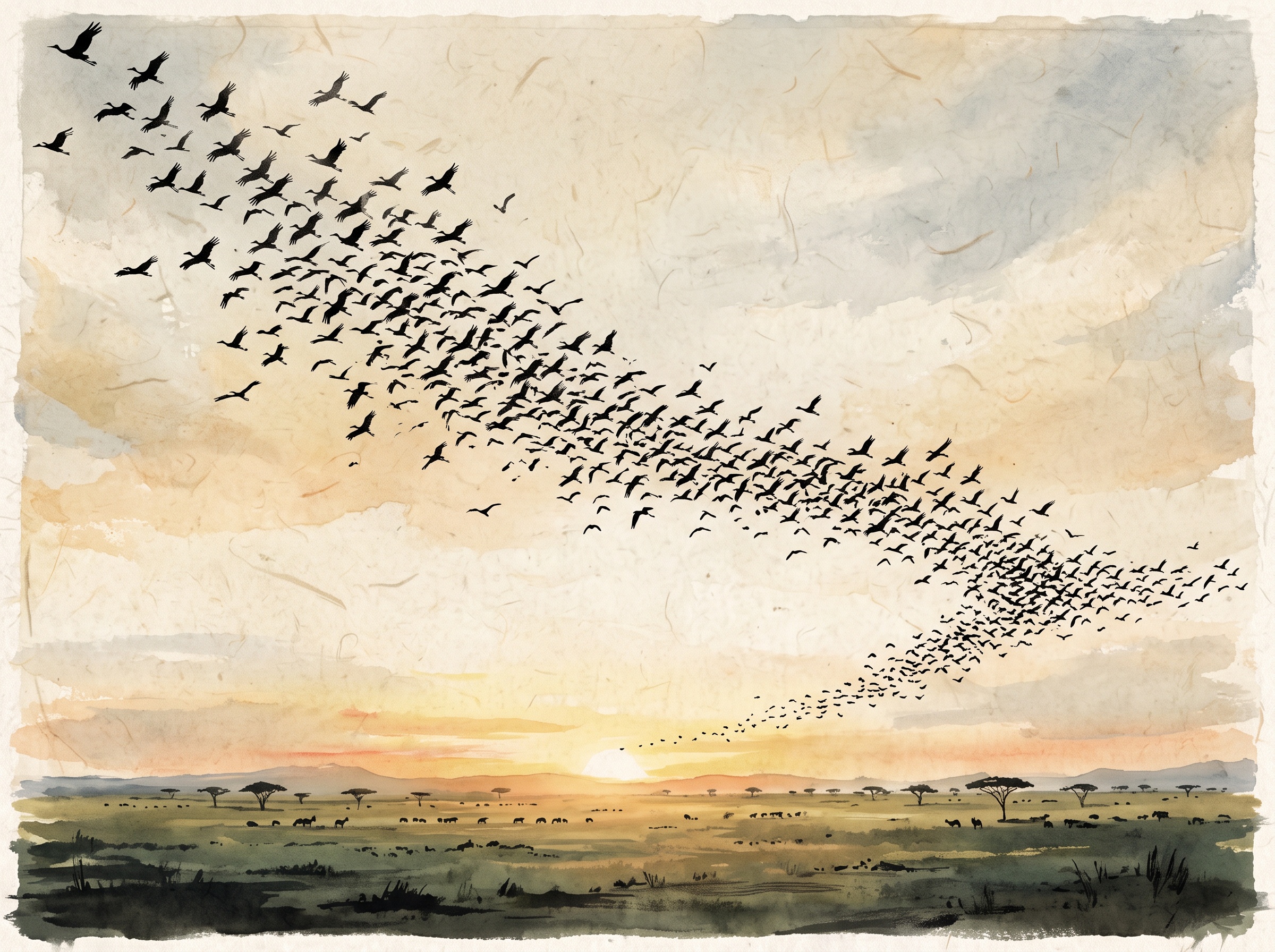
Today the answer seems obvious, almost childish. But put yourself in the mind of someone before telegraphs, before cameras, before anyone could follow a bird past the horizon. Every autumn the skies of Europe emptied. Swallows, storks, cuckoos, and countless songbirds simply vanished, all at once, as if the world had swallowed them. Every spring they came back. For thousands of years, no one could say where they had been. There was no way to follow them, no way to prove anything, and so the gap filled with some of the strangest theories serious people have ever committed to paper.
It was not a question left to cranks. It occupied the finest minds of every age, and for most of recorded history they got it spectacularly wrong.
Mud, Moons, and Magical Transformations
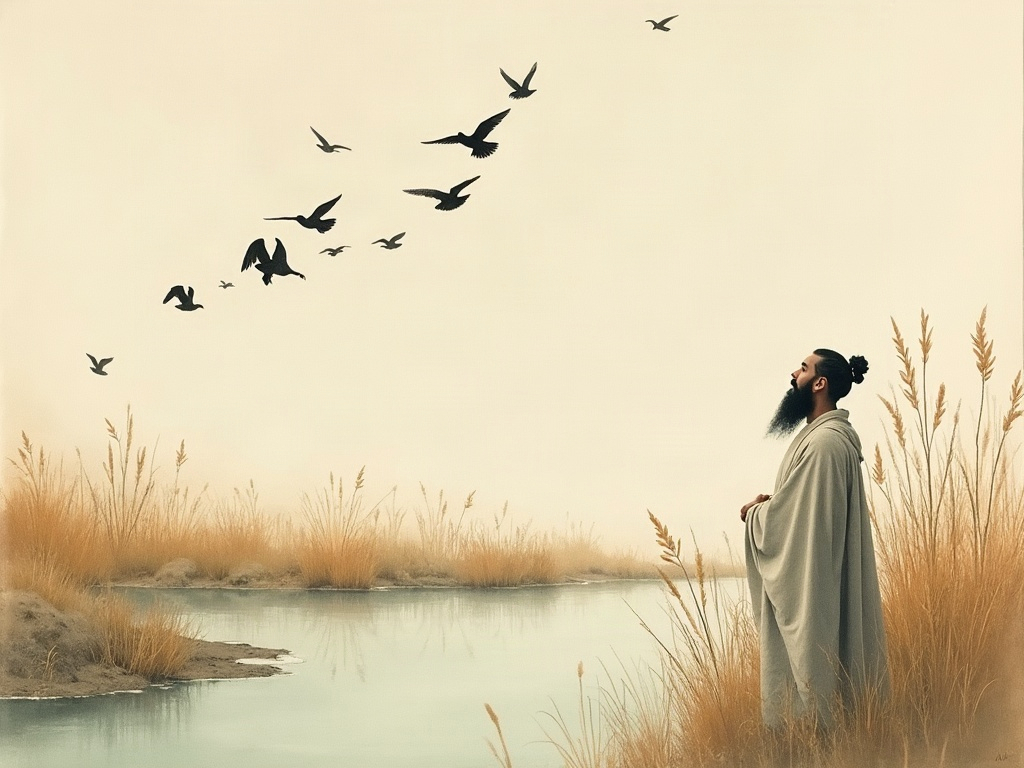
Aristotle, writing in the fourth century BC, set the tone that would dominate Western thought for two millennia. He proposed that birds like swallows did not travel at all but hibernated, burrowing into the mud of marshes and riverbanks to sleep away the cold months, emerging bedraggled in spring. He also floated the idea of transmutation — that one species simply turned into another with the seasons, a summer redstart becoming a winter robin. These were not idle musings; they were taught as fact into the Renaissance and beyond.
Other explanations grew wilder still. A widely believed medieval notion held that barnacle geese were born not from eggs but from barnacles growing on driftwood and ships’ hulls — a convenient theory that also let the devout classify them as something closer to fish than fowl, and therefore fair to eat on fast days. And in 1703 an English clergyman published a pamphlet arguing, in all seriousness and with theological confidence, that migrating birds flew to the Moon each winter and back — a round trip he calculated took about two months each way. When you cannot follow the evidence, the Moon is no more absurd than the mud.
The Bird That Could Not Be Argued With
What made the Klütz stork so important was that it did something no theory could: it offered physical, undeniable proof. The spear through its neck was unmistakably African. Here was a bird that had been speared by a hunter somewhere in central Africa, survived the wound, and then flown all the way back to the exact same corner of Germany it had left the previous autumn — arriving alive, spear and all, to be shot and examined by astonished naturalists.
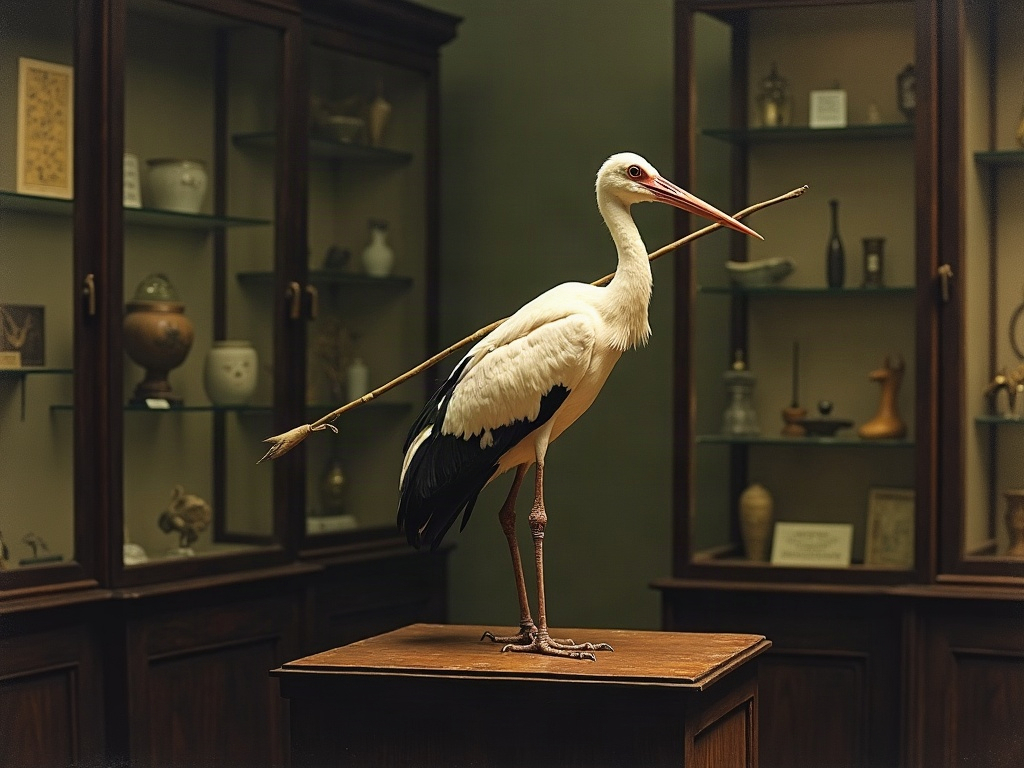
No stork hibernated in a German pond with that weapon in it. No species transmuted into another. The bird had quite literally brought the evidence of its winter whereabouts home on its own body. The specimen was preserved, mounted spear and all, and it survives today in the zoological collection of the University of Rostock, a quiet monument to one of the most persuasive accidents in the history of science. Germans gave it a name that says everything: Pfeilstorch — “arrow stork.”
Not One Bird, But Dozens
The Klütz stork is the famous one because it was the first to be carefully documented, in 1822. But it was not alone. Over the following decades, naturalists recorded around two dozen more Pfeilstörche — storks returning to Europe pierced by African arrows and spears. Each one was another nail in the coffin of the old theories, another bird insisting, with a weapon through its throat, that it had been somewhere very far away and very warm.
It is worth sitting with how improbable each case is. For a single arrow stork to exist, a bird had to be struck by a spear in a way that pierced it without killing it, survive the massive wound, retain the strength to make a journey of thousands of miles across deserts and seas, and then be noticed and studied by someone who grasped what it meant. That this happened repeatedly is a reminder that nature occasionally hands us proof so vivid that even our most cherished mistakes cannot survive it. The long, patient work of science is often less about brilliant deduction than about finally being unable to look away — the same slow reckoning with evidence that eventually explained the man-eating Beast of Gévaudan and the rusted gears of the Antikythera mechanism.
From Accident to Instrument
The arrow storks proved that birds crossed continents, but they could not map the routes. A bird that happened to survive a spear was a dramatic clue, not a method. The real science of migration had to wait for a quieter, deliberate idea: if you could not follow a bird, you could mark it and wait for it to be found.
In 1899 a Danish schoolteacher named Hans Christian Cornelius Mortensen began fastening small numbered metal rings to the legs of starlings and storks, each inscribed with a number and a return address. When a ringed bird was later shot or found elsewhere in the world, the finder could report where and when — and slowly, report by report, the invisible highways of the sky were drawn onto maps. This practice, called bird ringing or banding, turned migration from a parlor mystery into a measurable, trackable science. The arrow stork had pointed the direction; the leg-ring walked the whole road.
Why a Speared Stork Still Matters
We now know the white storks of northern Europe winter in Africa, many of them south of the Sahara, undertaking a round trip of thousands of miles twice a year on wings that look far too casual for the task. Satellite tags today trace individual birds almost to the meter. The mystery that defeated Aristotle has become a children’s-book fact.
And yet the story of the Pfeilstorch deserves to be remembered, because it is really a story about how we come to know anything at all. For two thousand years, intelligent people filled an empty space with mud and moons and magic — not from stupidity, but because they had no way to see past the horizon, and the human mind cannot bear a blank. It took no grand experiment to break the spell, only an unlucky bird that refused to disappear politely, flying home with the evidence lodged in its own flesh. There is something humbling in that: the truth had been flying over their heads, every spring and every autumn, the entire time. They simply could not read it until one stork spelled it out in iron and blood. The next time a flock cuts across an autumn sky, it is worth a thought for the arrow stork of Klütz — the bird that answered a question older than history, and asked for nothing in return.
Sources & further reading:
More from the archive
- Mike the Headless Chicken: The Rooster Who Lived Eighteen Months After Losing His Head
- The Great Emu War: When Australia Lost a Battle to Birds
- The Most Bizarre Death in Ancient History: How an Eagle Killed the Father of Greek Tragedy