The Antikythera Mechanism: The 2,000-Year-Old Computer That Should Not Exist

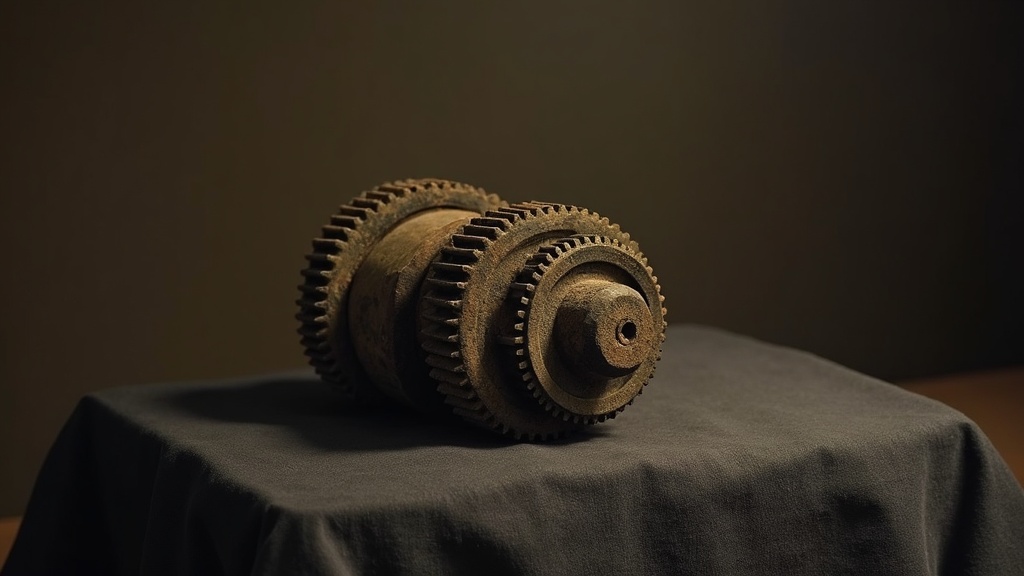
In the spring of 1901, a team of Greek sponge divers sheltering from a storm near the tiny island of Antikythera made a discovery that would embarrass the history of technology for the next hundred years. Diving on an ancient Roman shipwreck, they surfaced with bronze statues, glassware, and coins — the luxury cargo of a vessel that sank around 60 BC. Among the treasures was an unremarkable, shoebox-sized lump of corroded bronze and rotted wood. It was set aside. Nobody understood that it was, by two thousand years, the oldest known computer on Earth.
A Lump of Bronze With Gears Inside
Months later, as the waterlogged artifact dried in the National Archaeological Museum in Athens, it cracked apart. Inside the corrosion, astonished curators saw something impossible for its age: precisely cut gear teeth. Interlocking bronze wheels, some no larger than a coin, meshed together in a mechanism of bewildering complexity. Gearing this fine would not reappear in the historical record until the astronomical clocks of medieval Europe — more than a thousand years later.
For decades the object defied explanation. It was so far ahead of its time that some serious scholars suggested it must be a later artifact that had somehow fallen into the ancient wreck. The truth, it turned out, was stranger: the ancient Greeks really had built it.
The Wreck That Time Forgot
The ship itself tells part of the story. It was a large merchant vessel, likely carrying looted or purchased Greek treasures westward toward Rome when it went down in a storm. The divers who found it worked in heavy canvas suits and brass helmets, breathing air pumped from the surface — dangerous work that cost one diver his life and left others paralyzed by decompression sickness. They were hunting sponges and marble statues, not machines.

What they had actually recovered was a device that encoded the accumulated astronomical knowledge of the Hellenistic world into bronze.
Decoding the Impossible
The real breakthrough came in stages. In the 1970s, British physicist Derek de Solla Price used X-ray imaging to peer inside the fused fragments and count the gear teeth hidden within. He concluded that the mechanism was a calculating device driven by a hand crank. Then, in 2005, an international team brought industrial-grade X-ray tomography and advanced surface imaging to the surviving pieces, reading faint Greek inscriptions and mapping gear trains that had been invisible for millennia.
What they found was breathtaking. Turning a single knob on the side set the entire cosmos in motion. A front dial showed the position of the Sun and Moon against the zodiac and the Greek calendar. A clever pin-and-slot arrangement even reproduced the Moon’s varying speed across the sky — the ancient Greeks had mechanized an irregularity in the Moon’s orbit that would not be explained mathematically until Kepler.

A Calculator for the Heavens
The back of the device was, if anything, more ambitious. One spiral dial tracked the 19-year Metonic cycle that reconciles the lunar and solar calendars. Another predicted eclipses decades in advance, marking not only when they would occur but their expected color and even estimated winds. A separate small dial did something wonderfully human: it counted down the four-year cycle of the ancient games, including the Olympiad. This machine that modeled the sky also reminded its owner when it was time for the Olympics.
In total, the mechanism contained at least 30 meshing bronze gears, and reconstructions suggest there may originally have been more. It was, in every meaningful sense, an analog computer — a physical model that took a single input and computed the state of the heavens.
The Knowledge That Vanished
Perhaps the most haunting part of the story is what came after: nothing. No comparable device survives from the ancient world. The intellectual tradition that produced the Antikythera mechanism was scattered and lost as the classical world declined, and the art of precision gearing had to be reinvented from scratch more than a millennium later. For a thousand years, humanity was less capable of building such a thing than the Greek craftsman who made it.
The Antikythera mechanism forces a humbling question. If a single storm-sunk ship happened to preserve a machine this sophisticated, what else did the ancient world know how to build — knowledge that simply sank, rotted, or was melted down, leaving no trace at all? The corroded bronze box in Athens is not just a marvel. It is a warning about how much history we have lost, and how easily a civilization’s greatest achievements can disappear beneath the waves.
Sources & further reading:
- The Antikythera Mechanism Research Project
- Freeth et al., ‘Decoding the ancient Greek astronomical calculator’, Nature (2006)
- National Archaeological Museum, Athens — Antikythera Mechanism
More from the archive
- Ancient Egypt Had Power Tools: The 6,000-Year-Old Rotary Drill That Predates the Pharaohs
- The Greatest Literary Hoax in History: How George Psalmanazar Invented an Entire Civilization
- The Invisible Light: How X-rays Went from Accidental Discovery to World-Changing Technology