The Christmas Truce of 1914: The Night Enemies Sang, Shook Hands, and Stopped the War

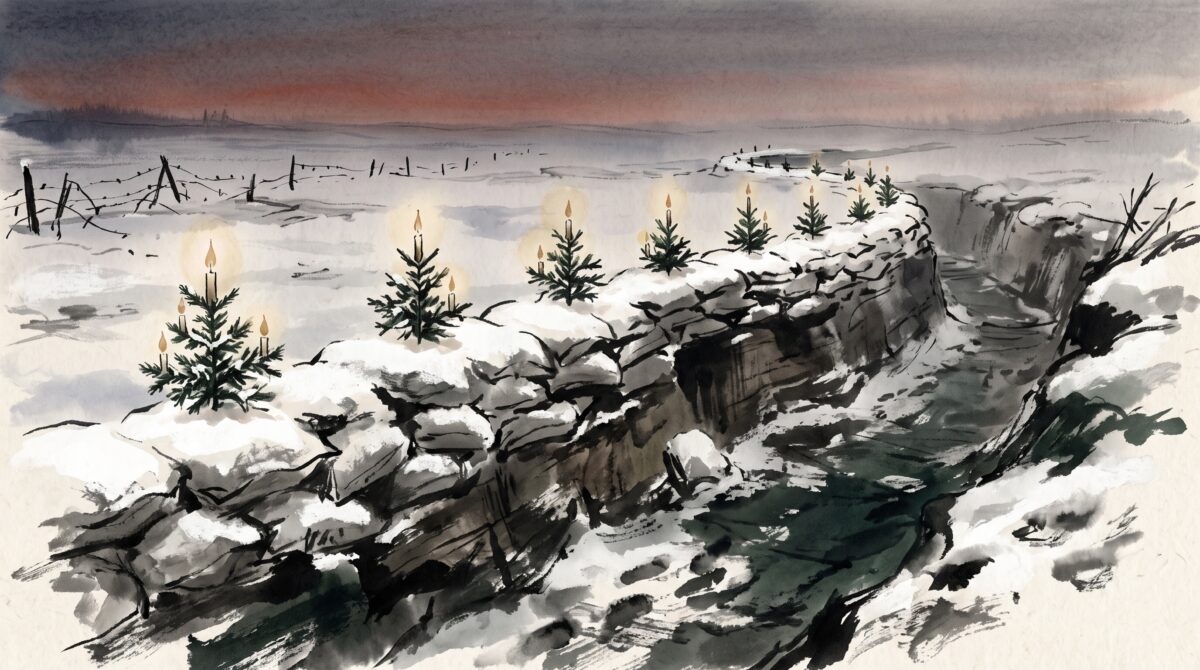
They had been told it would be over by Christmas. Instead, as December 1914 closed in, the young men of Europe found themselves crouched in flooded, freezing ditches that snaked for four hundred miles from the North Sea to the Swiss border. The great war of movement everyone had imagined had congealed into mud and barbed wire. And then, on the coldest, darkest night of the year, something happened along that scar of trenches that no general had ordered and none could quite believe — the shooting stopped, and the enemies began to sing to one another.
The War That Was Supposed to Be Over by Christmas
When the armies marched off in the late summer of 1914, the mood was almost festive. Soldiers on every side were promised a short, glorious campaign and a homecoming before the holidays. Reality arrived quickly. By autumn the front had frozen into place, and the men dug in — first shallow scrapes, then deep trenches, then whole subterranean cities of dugouts, duckboards, and machine-gun nests, separated in places by only a few dozen paces of churned earth called no man’s land.
By late December the fighting had settled into a grinding, pointless rhythm. The enemy was close enough to hear — a cough, a curse, the clatter of a mess tin. In some sectors the two sides had already reached quiet, unspoken understandings: don’t shoot during breakfast, don’t shell the men fetching water. The killing had not stopped, but it had begun to feel personal in a way that made the abstraction of “the enemy” harder to hold on to.
Candles on the Parapet
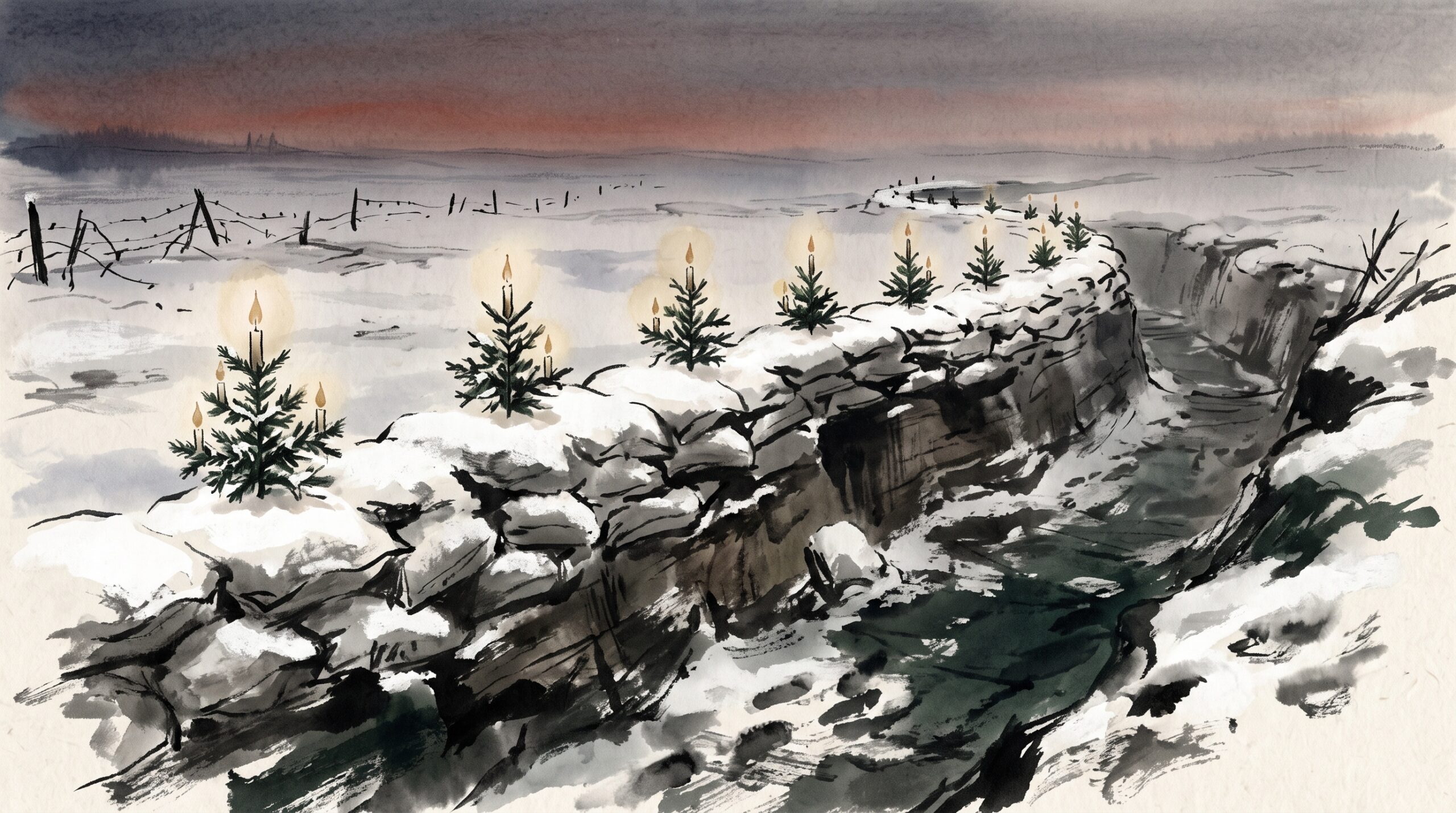
Christmas Eve fell hard and clear, the mud crusting into frost. Along parts of the line held by the Germans, British soldiers peering over their parapets saw something extraordinary: small points of light flickering into being above the opposing trench. The Germans, many of whom had been sent little fir trees and candles from home, were setting them along the tops of their sandbags — tiny illuminated Christmas trees glowing in the dark of no man’s land.
Then came the sound. A German voice, and then many, rising into the cold air with Stille Nacht — “Silent Night.” On the British side, men who had spent weeks trying to kill the singers listened, stunned, and answered with carols of their own. Back and forth across the ruined ground the two sides sang, applauding one another’s efforts. Shouted greetings followed, then cautious invitations. “You no shoot, we no shoot.” Slowly, disbelievingly, heads began to rise above the sandbags where a raised head had meant death only hours before.
Into No Man’s Land
What happened next has the quality of a dream that too many witnesses recorded for it to be one. On Christmas morning, in numerous places along the line, unarmed soldiers climbed out of their trenches and walked into the open. Men who had been enemies met in the middle of no man’s land and — after a frozen moment of uncertainty — shook hands.
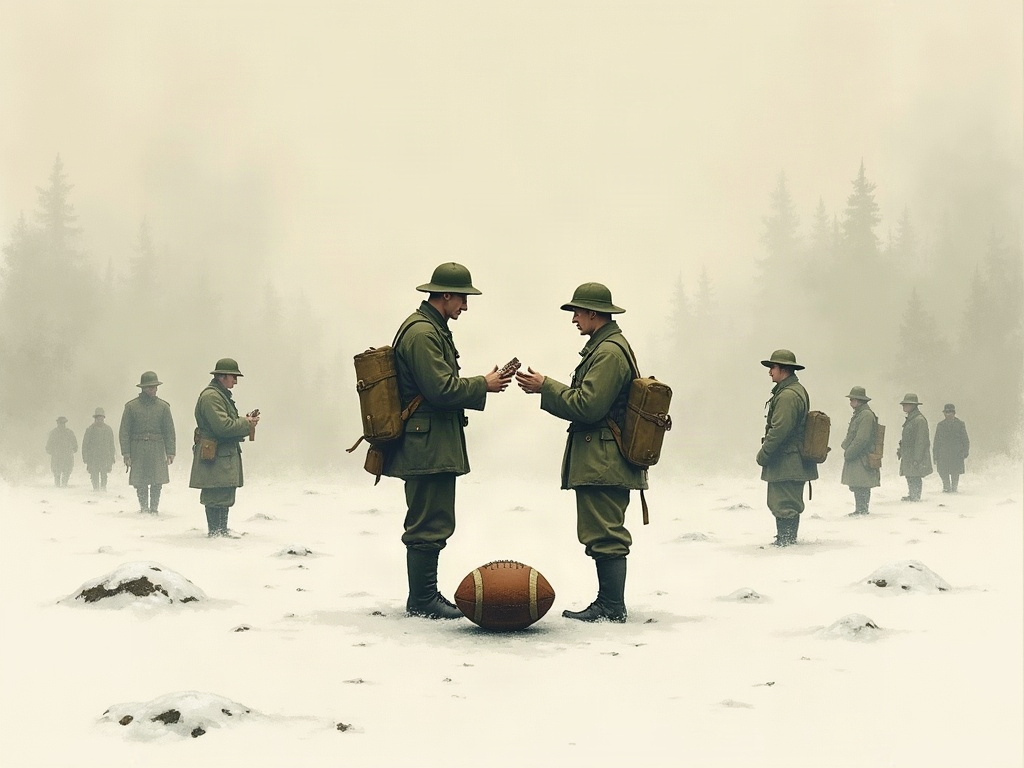
They swapped whatever they had. Buttons and cap badges, tins of bully beef and jars of jam, German cigars and British chocolate, sips of rum and schnapps. They passed around photographs of wives and children and mothers, discovering across the language barrier that the man opposite was frightened and homesick in exactly the way they were. Some had worked in each other’s countries before the war and could translate. Officers, uneasy at first, often found themselves drawn into the same courtesies as their men.
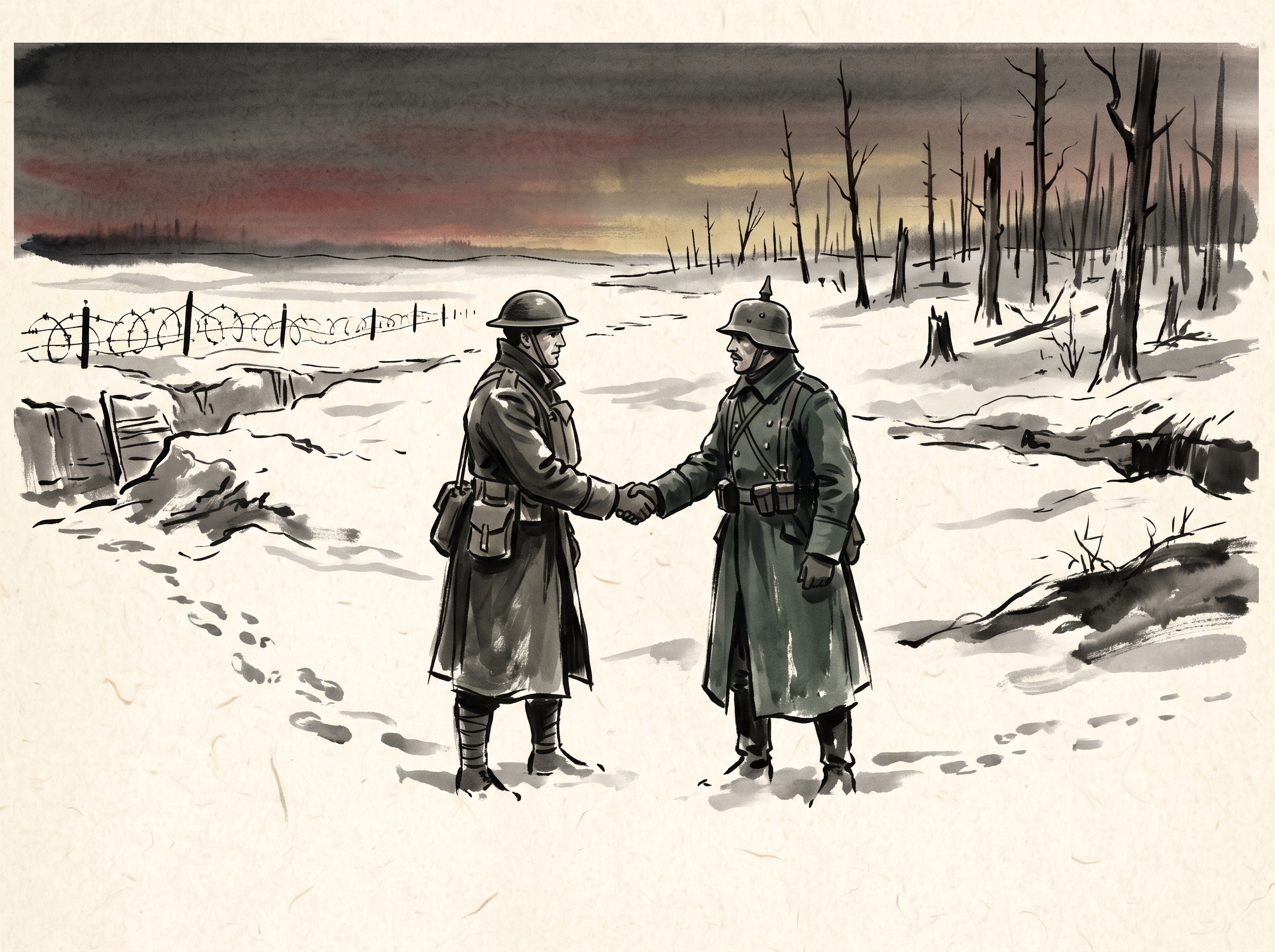
It was never universal. On many parts of the front the war ground on without pause, and men died on Christmas Day as on any other. But historians estimate that tens of thousands of soldiers — perhaps as many as a hundred thousand — took some part in the informal truces that spread along the British and German lines. The French and Belgian sectors, fighting on invaded home soil, were far less inclined to fraternize.
Before the Games, the Graves
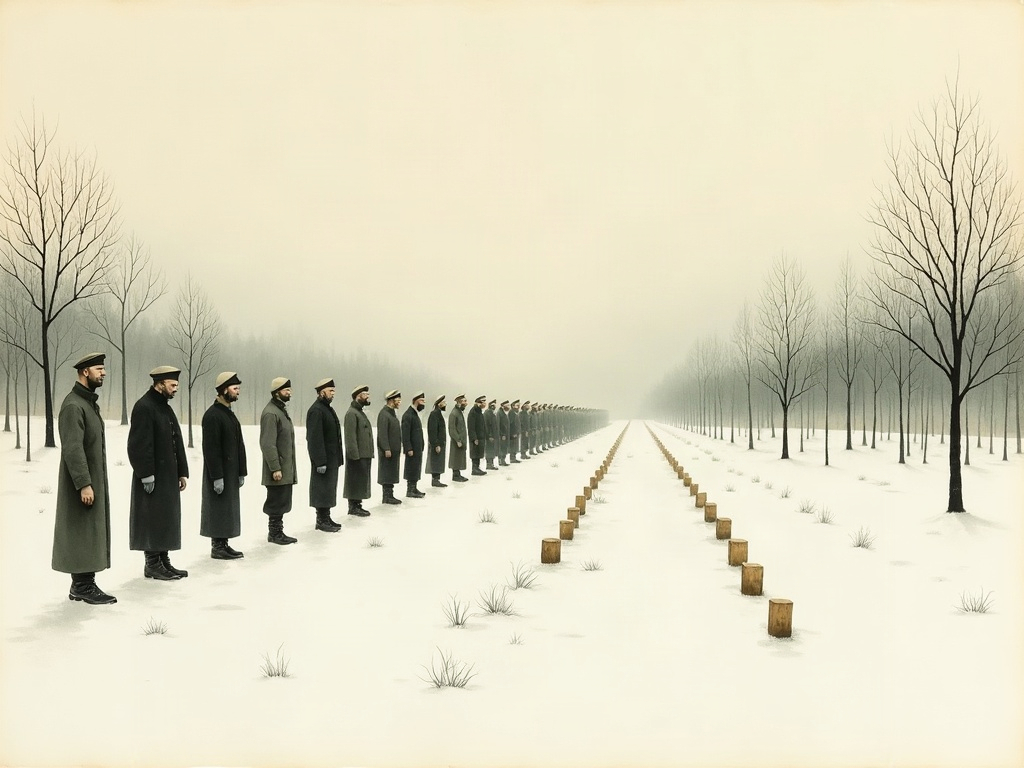
The most urgent business of the truce was not celebration but grief. For weeks the dead had lain out in no man’s land where no one could safely reach them. Now, in the fragile peace, both sides went out together to collect their fallen and bury them. There were joint services, with soldiers of both armies standing bareheaded in the snow while a chaplain read the same psalms over graves that held German and British men side by side.
It is worth pausing on that image — enemies helping each other carry the dead, then lining up together to mourn them. It was, for a few hours, an acknowledgment that the men on the far side of the wire were not monsters but conscripts and volunteers caught in the same machine, sharing the same cold and the same fear. That recognition is precisely what modern industrial war cannot afford, and precisely why the truce could not last.
The Football Match That May or May Not Have Happened
The most beloved detail of the Christmas Truce is also its most disputed: the football matches. In the popular memory, British and German soldiers organized proper games in no man’s land, complete with a scoreline. The truth is gentler and less tidy. There are genuine contemporary references to soldiers kicking a ball about in the snow, and letters describing informal knock-arounds between craters. But the neat account of an organized international fixture with an agreed result is largely the product of later retelling, embroidered over decades until it hardened into legend.
What almost certainly happened is that, amid the wandering and the gift-swapping, men did what young men do when a ball appears and the ground is frozen hard enough to run on — they played. Whether it was a formal match or a scattered kickabout hardly changes the deeper meaning. On a battlefield, for one morning, the most dangerous object between the trenches was a football.
The Truce the Generals Could Not Allow
High command was appalled. To the men in the mud, the truce was a moment of shared humanity. To the generals and politicians directing the war, it was something dangerous: soldiers were far harder to order into battle against an enemy they had shaken hands with and sung carols beside. Commanders on both sides issued furious orders forbidding fraternization, threatening courts-martial, and in some cases deliberately scheduling artillery barrages for future holidays to keep the two armies apart.
The 1914 truce was never repeated on the same scale. In later Christmases a few local ceasefires flickered up, but they were quickly and ruthlessly suppressed. And as the war dragged on into the horrors of poison gas, the meat-grinder of the Somme, and years of industrialized slaughter, the very idea of climbing out to shake the enemy’s hand came to seem impossible. The same war would go on to swallow men in ways the singers of 1914 could not have imagined — from the South African servicemen who drowned in the icy waters when the SS Mendi went down to a whole generation buried in the fields of France and Flanders.
Why We Still Tell This Story
More than a century later, the Christmas Truce endures as one of the most retold moments of the twentieth century — not because it changed the course of the war, which it did not, but because of what it revealed. Ordinary men, handed rifles and told to hate, discovered that the hatred was thin, and that given the smallest excuse they would rather sing than shoot. The war would go on to produce astonishing courage and unbearable cruelty in equal measure, from eccentric warriors who fought the next world war with a longbow and bagpipes to the ordinary civilians who paid the price, including the man who somehow survived both atomic bombs. But few of its moments still stop people cold the way this one does.
The candles on the parapet remind us that peace, even in the worst of places, is never quite as far away as those who profit from war would have us believe. For one frozen night, the men in the trenches proved it — and then, at dawn, on orders from far behind the lines, they picked up their rifles and went back to the terrible work of forgetting it. That is why the story still matters: not because the guns fell silent, but because, for a few hours, the men holding them chose to let them.
Sources & further reading:
- The Real Story of the Christmas Truce — Imperial War Museums
- Christmas truce — Wikipedia
- Legends, Myths and Realities — the Christmas Truce, 1914 — The Long, Long Trail
Related Reading
More from the archive
- The Battle of Karansebes: The Night an Army Destroyed Itself
- The Three Hundred and Thirty-Five Years War: The Longest Bloodless Conflict in History