The Emperor of the United States: How a Bankrupt Merchant Named Himself Ruler and Won a City’s Heart


On a foggy morning in San Francisco, sometime in the 1870s, a stout, bearded man in a threadbare blue army tunic and a tall beaver hat trailing an ostrich plume would step out onto the streets to inspect his empire. He wore a sabre at his hip and tarnished gold epaulettes on his shoulders. Policemen saluted him. Shopkeepers bowed. Children ran to walk beside him. He had no palace, no army, no treasury, and not a dollar to his name – and for twenty-one years the city of San Francisco addressed him, with a straight face and a real tenderness, as His Imperial Majesty, Norton the First, Emperor of the United States.

He was not a fraud, exactly, and he was certainly not sane. He was something rarer: a broken man who reinvented himself as a monarch, and a whole city that decided to let him be one.
The man who bet everything on rice
Joshua Abraham Norton was born in England in 1818 and raised at the Cape of Good Hope in South Africa. In 1849, carried on the same tide of hope that was emptying the world’s ports toward California, he arrived in San Francisco with a modest inheritance and a good head for business. Within a few years he had multiplied it into a real fortune – close to a quarter of a million dollars – trading in real estate and commodities in the boomtown chaos of the Gold Rush.
Then he made one enormous bet. In 1852, with famine gripping China and rice scarce in San Francisco, Norton tried to corner the market. He bought an entire shipload of Peruvian rice and expected the price to soar. Instead, ship after ship followed his into the harbour, the market collapsed, and the fortune he had spent years building drained away in a wretched tangle of lawsuits. By the late 1850s he was bankrupt and, it seems, quietly coming apart. For a while he simply vanished from the public eye.
The proclamation
When he reappeared, he was no longer a ruined merchant. On 17 September 1859, Norton walked into the offices of the San Francisco Bulletin and handed the editor a short notice, which the paper – sensing a good story, and perhaps a good heart – agreed to print. “At the peremptory request of a large majority of the citizens of these United States,” it began, “I, Joshua Norton… declare and proclaim myself Emperor of these United States.”
It was an act of audacity to rival any confidence trick – though where a swindler like the con artist who twice “sold” the Eiffel Tower spun his nerve into stolen gold, Norton wanted nothing so grubby. He asked only to reign. In 1863 he expanded his title to “Protector of Mexico,” later conceding that the Mexicans had proven ungovernable and that the job was frankly beyond him.
The reign of Norton I
What followed should have been a brief, sad joke. Instead it became a twenty-one-year performance that the city chose to sustain. The Emperor issued a steady stream of proclamations, printed by newspapers that had discovered readers loved them. He decreed the abolition of the United States Congress, which he judged corrupt and useless. He ordered the Democratic and Republican parties dissolved. He commanded, on pain of a fine, that no one call his beloved city “Frisco.”

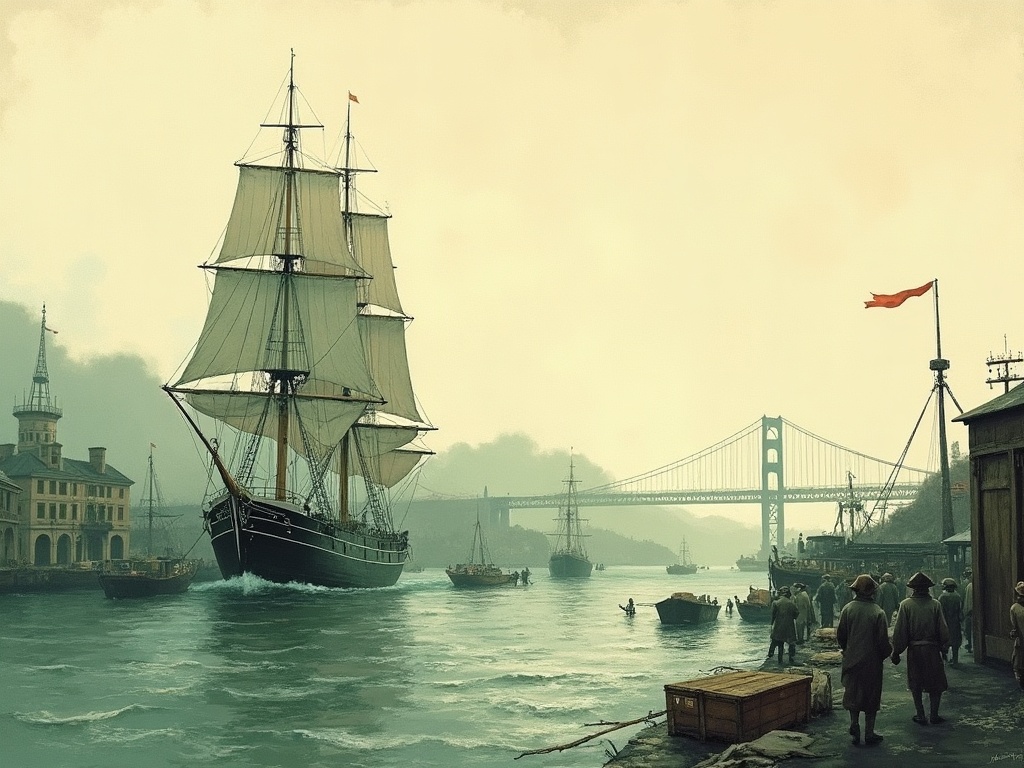
And now and then, beneath the pageantry, the Emperor was simply right. He decreed that a great suspension bridge should be built to link San Francisco with Oakland across the bay, and, when that seemed too modest, a tunnel beneath the water as well. His subjects smiled. Half a century after his death, the San Francisco–Oakland Bay Bridge opened along very nearly the line he had ordered. History has an old habit of calling its visionaries mad – the physician who begged doctors to simply wash their hands was hounded into an asylum for it – but San Francisco did something stranger with its madman. It humoured him until, on occasion, it found he had been humouring it.
He lived on the affection of his people. He ate for free in the city’s restaurants, which competed to display brass plaques announcing that they held an imperial warrant. He had reserved seats at the theatres, which he opened. He printed his own bonds and banknotes in small denominations, and the shopkeepers of San Francisco accepted them – part joke, part patronage, part genuine tribute to a man who never once tried to cheat anyone.

The night the city defended its emperor
In 1867 a young policeman, more literal-minded than his fellows, arrested the Emperor to have him committed to an asylum for a “disorder in the head.” The reaction was immediate and furious. The newspapers erupted. Citizens were outraged that anyone should treat their harmless monarch as a lunatic. The city’s police chief personally ordered Norton released with a formal apology – and from that day, San Francisco’s police officers saluted the Emperor whenever he passed. It is one thing for a city to tolerate an eccentric. It is another for it to close ranks and protect him. The Emperor, for his part, graciously granted the arresting officer an imperial pardon.
Le Roi est Mort
On the evening of 8 January 1880, walking to a lecture, Emperor Norton collapsed on the corner of California Street and died before a carriage could reach the hospital. In his pockets were a few coins, some worthless imperial bonds, and a handful of telegrams he had written to the world’s real heads of state.

The next morning the San Francisco Chronicle ran his obituary under the headline “Le Roi est Mort” – the King is Dead. What happened next astonished even the people who had loved him. A businessmen’s club paid for a dignified rosewood coffin, and on the day of the funeral the streets filled. Estimates ran from ten thousand to thirty thousand mourners, a cortege said to stretch two miles, drawn from every rung of the city – bankers and washerwomen, senators and street children – all come to bury a penniless madman who had made himself their emperor.
Why the story still matters
It would be easy to file Joshua Norton away as a curiosity, a footnote in the long ledger of history’s stranger-than-fiction lives. But the more you sit with his story, the less it is about him at all. Norton lost everything and retreated into a grand delusion – that much is only sad. The remarkable part is what the people around him decided to do with a broken stranger who believed he was a king.
They could have laughed him into an institution. Instead they fed him, saluted him, printed his decrees, and mourned him in their tens of thousands. San Francisco chose to meet one man’s madness not with cruelty but with an elaborate, sustained, city-wide act of kindness – and in doing so it gave a ruined merchant two decades of dignity he could never have bought back. Emperor Norton reigned over no territory and commanded no soldiers. What he ruled, in the end, was the better part of a city’s heart, and he governed it for twenty-one years without spilling a drop of blood or telling a single cruel lie. There have been far greater emperors, and almost none so fondly remembered.
Sources & further reading:
- Emperor Norton – Wikipedia
- America’s Emperor, San Francisco’s Treasure: Who Was Emperor Norton? – KQED
Related Reading
More from the archive
- The Man Who Found the Gold and Died Poor: James Marshall and the Discovery at Sutter’s Mill
- The Taiping Rebellion: When Jesus Christ’s ‘Brother’ Led the Deadliest War in Human History