Witch Bottles and Concealed Shoes: The Secret Charms People Hid in Their Own Homes

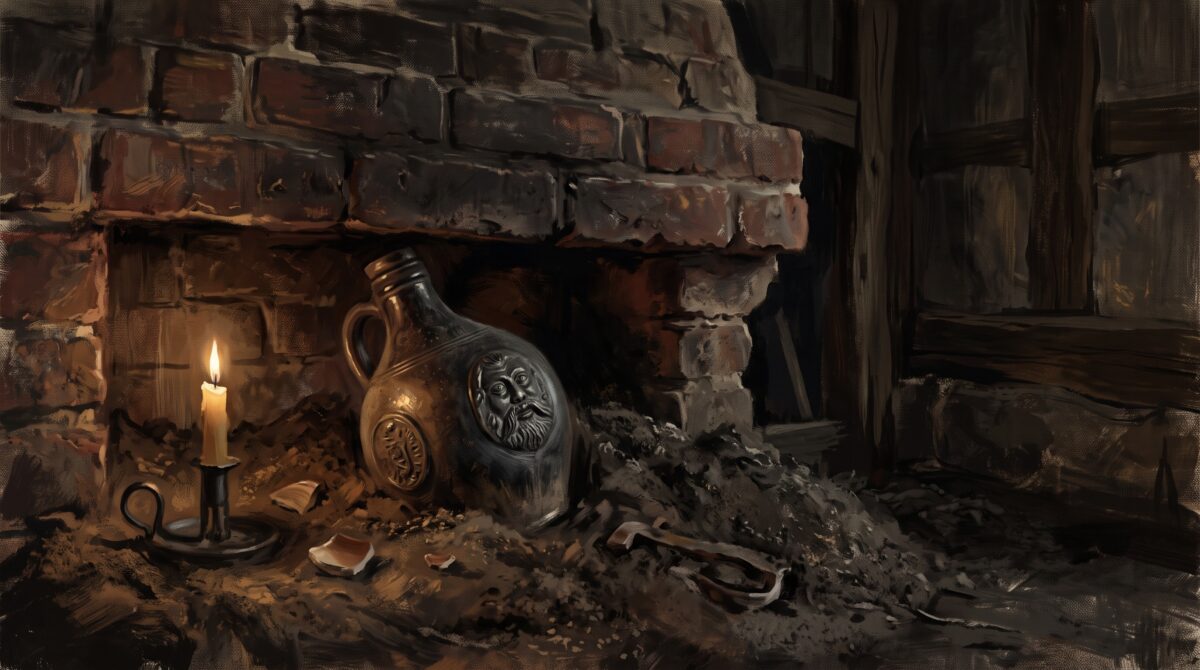
The workman had only meant to open up the old chimney breast. It was the kind of job that fills a skip with rubble and turns up nothing more interesting than a Victorian newspaper. Then his trowel struck something that rang wrong — not brick, not stone, but the dull chime of buried pottery. He worked it free and turned it over in his hands: a squat, bearded stoneware jug, its neck sealed hard, something rattling faintly inside. He had just disturbed a charm that a family had hidden there three hundred years before, and hidden for a reason. They had been trying to trap a witch.
Finds like this turn up across Britain, Europe, and colonial America with surprising regularity, usually during renovations, usually by accident. They are the physical fingerprints of a belief that once governed daily life: that evil was real, mobile, and hungry, and that an ordinary house was porous to it. To keep a home safe, you did not call a priest or a policeman. You practiced a quiet, homemade magic — and then you sealed the evidence into the walls and said nothing.
The Witch Bottle: A Trap Baited With Yourself
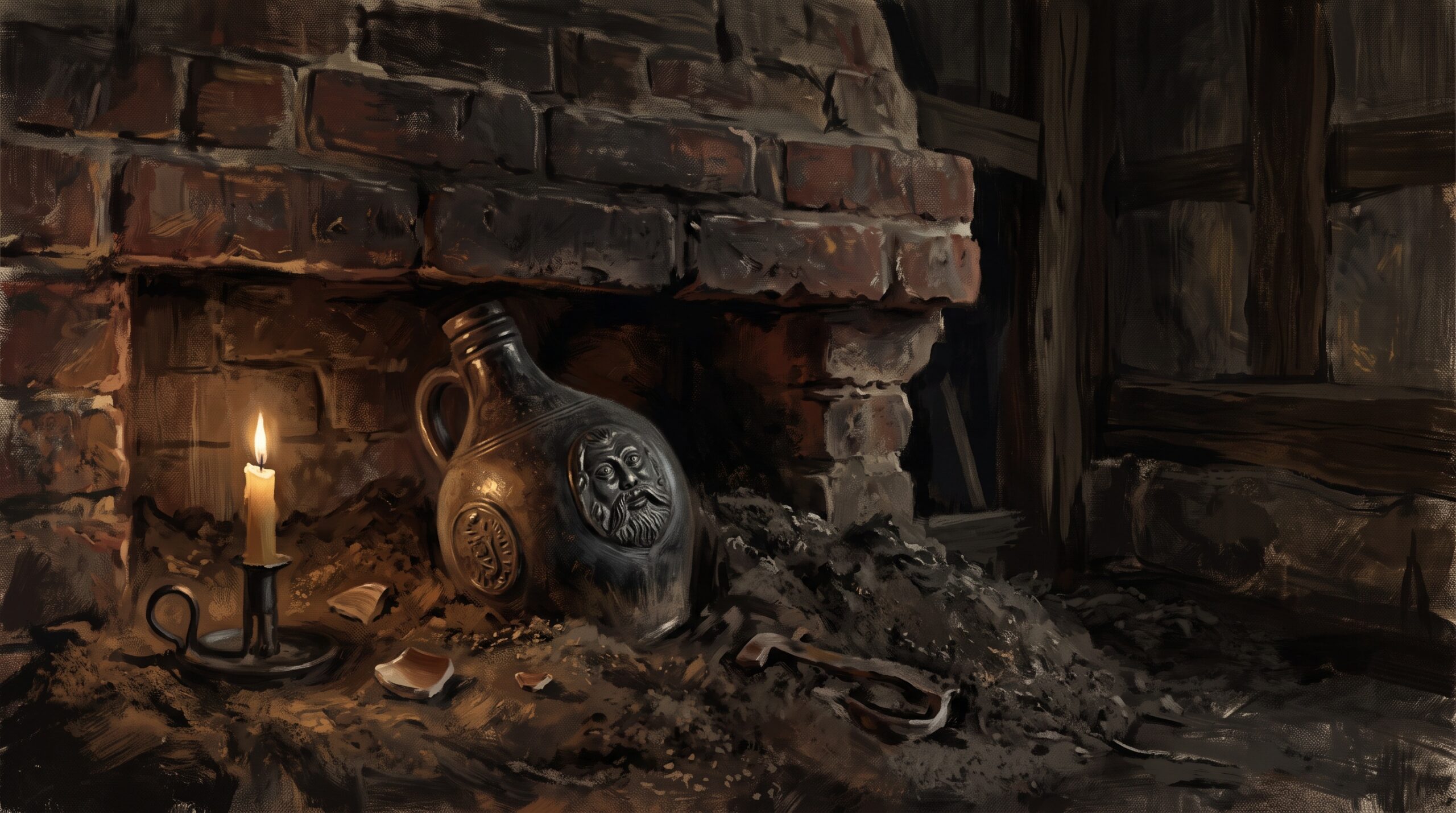
The bearded jug had a name. It was a bellarmine, a German stoneware vessel stamped with a scowling face, and in the 1600s it became the container of choice for one of the era’s strangest defensive weapons: the witch bottle. The recipe was intimate to the point of discomfort. Into the bottle went bent iron pins and nails, thorns, scraps of red cloth cut into hearts — and, most importantly, a sample of the household’s own urine, sometimes mixed with hair or nail clippings.
The logic was a kind of sympathetic warfare. A witch’s curse was thought to travel along a magical thread that connected her to her victim. By bottling up a piece of the victim — their own bodily fluid — and filling the vessel with sharp, painful iron, the householder turned that thread into a snare. The curse would follow the connection into the bottle, become tangled in the pins, and rebound agonizingly onto the witch herself. Some accounts insisted the witch would be unable to pass water, doubled over in pain, until she lifted the spell. The bottle was then buried beneath the hearth or the threshold — the two points where the outside world entered the home — and left to stand guard.
A Single Shoe in the Wall
If the witch bottle was an active trap, the concealed shoe was a patient sentry. Of all the objects deliberately hidden in old buildings, worn leather shoes are the most common by far, with thousands recorded. They are almost always single, never a pair, and almost always well used — cracked, patched, molded to the shape of a long-dead foot.
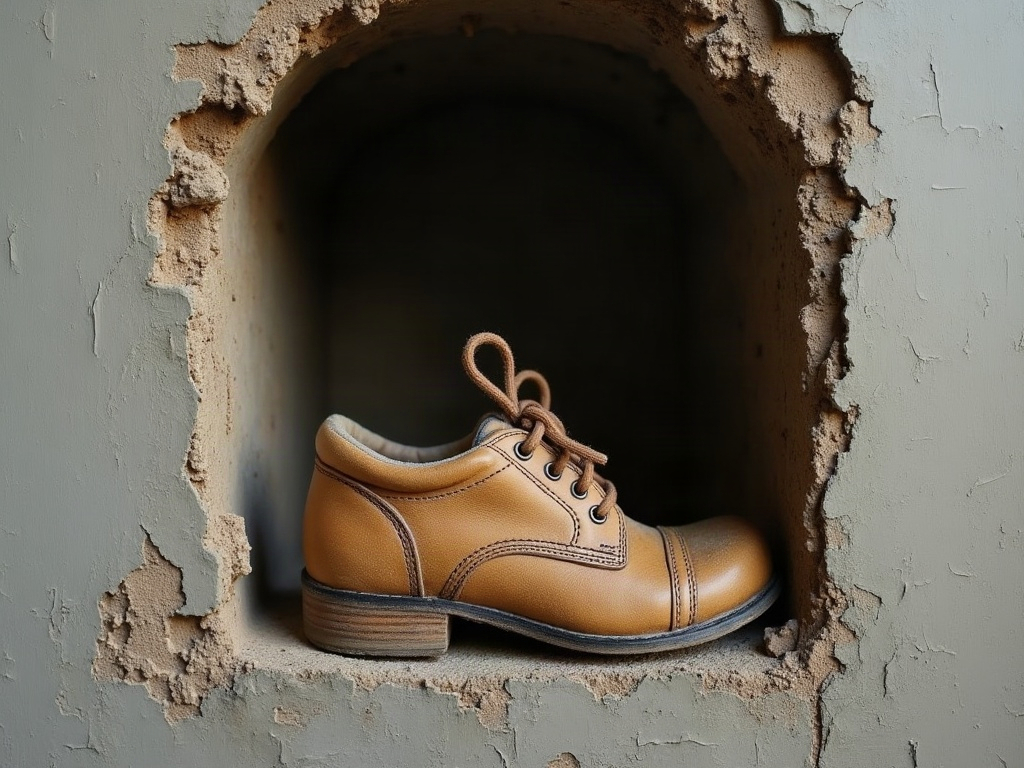
Why a shoe? A shoe is the one garment that permanently keeps the shape of its wearer, and that intimate imprint seems to be the whole point. Tucked into a void beside a chimney, a doorway, or a window — again, the vulnerable openings — the shoe is thought to have worked as a lure and a decoy. A malevolent spirit drawn to the human scent would investigate the shoe, crawl inside, and find itself trapped, unable to reverse out of the toe. Children’s shoes appear again and again, perhaps because a child’s innocence made the bait more irresistible, or the protection more urgent. Whatever the reasoning, generations of builders quietly honored the custom, and the tradition persisted well into the twentieth century.
Marks, Cats, and the Grammar of Fear
The hidden charms were only half the defense. The other half was written openly on the timber itself, in marks most people walked past for centuries without noticing. Look closely at the beams and doorframes of very old buildings and you may find compass-scratched circles filled with petals — “daisy wheels” — or two overlapping V shapes. The VV was not a random doodle. It stood for Virgo Virginum, the Virgin of Virgins, an appeal to Mary; the endless, unbroken line of a daisy wheel was thought to confuse and ensnare a demon, who was compelled to trace the pattern forever.

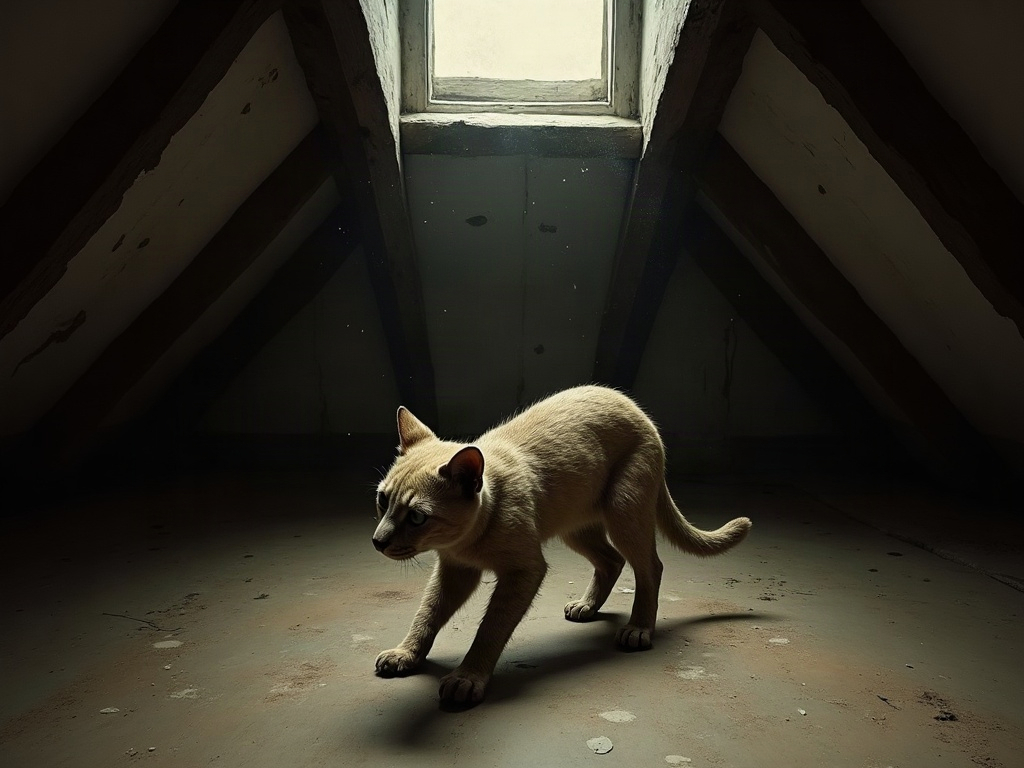
And then there are the cats. In roof voids and sealed chambers, builders have found the dried, mummified bodies of cats, sometimes posed mid-leap, occasionally clutching an equally desiccated rat or bird. These were not accidents — a cat cannot wall itself in. They were placed there deliberately, either to serve as an eternal spiritual mouser hunting vermin and evil in the dark spaces of the house, or as a foundation offering to bless the building. To modern eyes it is macabre. To the people who did it, it was simply prudent.
Why We Still Find Them
The remarkable thing about these charms is not that they existed, but that they survived. A witch bottle only works if it stays sealed and undisturbed; a concealed shoe only guards the threshold if no one ever pulls it out. The entire practice depended on secrecy and permanence, which is precisely why so much of it lay untouched until a twenty-first-century renovation cracked it open. Each discovery is a message from people who never intended to be read — who assumed their small, private terror of the dark would stay hidden inside the wall forever.
Folklorists now treat these objects as some of the best evidence we have for what ordinary people, as opposed to the educated elite who wrote the books, actually believed. The witch trials fill the archives with the words of judges and clergymen. The witch bottle, buried by a frightened family beneath their own fireplace, speaks in the language of the people who feared witches most and could afford protection least.

The Comfort of a Charm
It is easy to smile at a bottle of urine and bent pins, or a cat bricked into a roof. But strip away the specifics and the impulse is deeply familiar. These were people with no antibiotics, no insurance, and no explanation for why a healthy child sickened overnight or a herd died in the field. Evil was as plausible a cause as any, and doing something — anything — was better than lying awake helpless.
When we find their shoes and their bottles today, we are not really uncovering superstition. We are uncovering fear, and love, and the very human refusal to leave one’s home undefended against a threatening world. The next time an old house gives up one of its secrets, it is worth remembering: someone hid that charm hoping it would work, and hoping just as fervently that no one would ever have to find it.
Sources & further reading:
More from the archive
- From Speared Warriors to Vampire-Proofed Corpses: History’s Most Bizarre Burial Rituals
- The House That Grief Built: Sarah Winchester and the Mansion Meant to Confuse the Ghosts
- The Bizarre Medieval Practice of Stuffing Corpses: Austria’s 280-Year-Old Mystery