The Carrington Event: When the Most Powerful Solar Storm in History Brought the World to Its Knees

On September 1, 1859, amateur astronomer Richard Carrington witnessed something extraordinary while observing sunspots from his private observatory near London. A brilliant white light erupted from the sun’s surface—the first recorded observation of what we now call a solar flare. Little did Carrington know that this seemingly distant celestial event would soon unleash chaos across the globe.
What followed was the most powerful geomagnetic storm in recorded history: the Carrington Event. This solar superstorm would shut down the world’s telegraph systems, set fire to telegraph poles, and create auroras so bright that people could read newspapers by their light as far south as the Caribbean.
The Amateur Astronomer Who Witnessed History
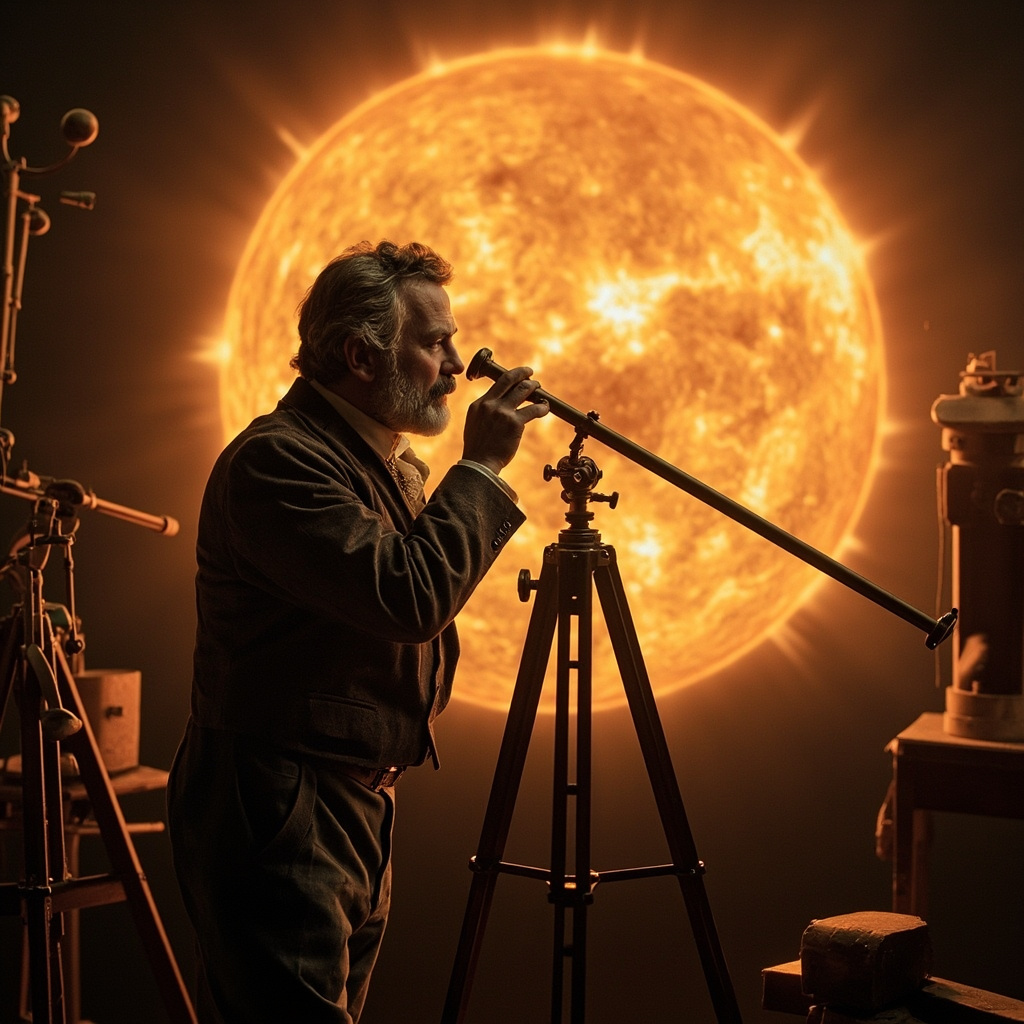
Richard Carrington was a 33-year-old brewery owner with a passion for astronomy. From his private observatory in Redhill, Surrey, he meticulously tracked sunspots—dark patches on the sun’s surface that were still poorly understood in the Victorian era. On that fateful morning, as Carrington projected the sun’s image onto a screen to safely observe it, he witnessed something unprecedented.
“Two patches of intensely bright and white light broke out,” Carrington later wrote to the Royal Astronomical Society. The flare lasted only about five minutes, but Carrington intuited that this solar explosion might be connected to the strange atmospheric phenomena that would soon follow.
His suspicion proved correct. What Carrington had observed was a massive coronal mass ejection—an enormous burst of solar wind and magnetic fields released from the sun’s corona. This cloud of charged particles was racing toward Earth at speeds exceeding one million miles per hour.
When Technology Met Its Match
Eighteen hours later, the solar storm struck Earth with unprecedented fury. The planet’s magnetosphere—our natural shield against space weather—was overwhelmed. The consequences were immediate and dramatic.
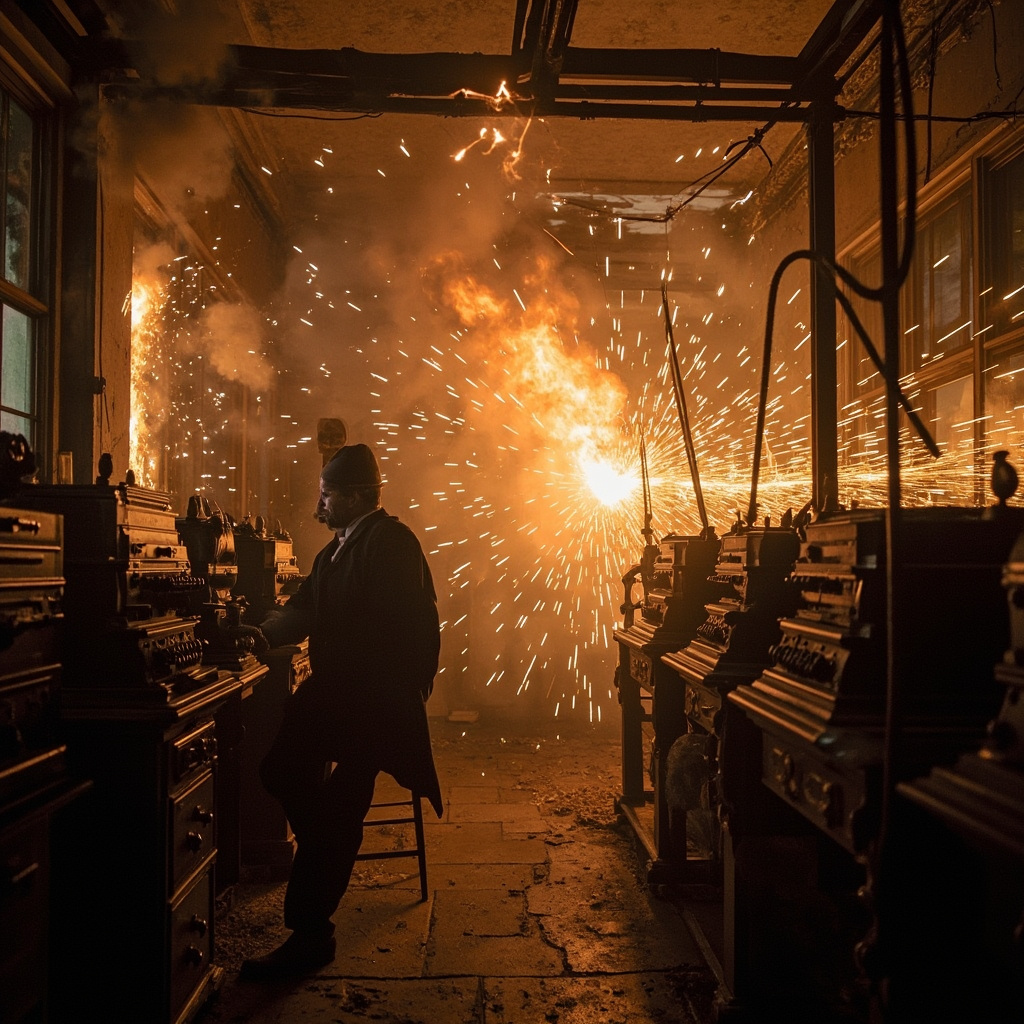
Telegraph systems across North America and Europe went haywire. In Boston, telegraph operators received electric shocks so severe they were thrown from their chairs. Telegraph lines caught fire, and some telegraph poles burst into flames from the induced electrical currents. In many cities, telegraph paper ignited, creating small fires in telegraph offices.
But perhaps most remarkably, some telegraph operators discovered they could continue sending messages even after disconnecting their power sources. The solar storm itself was providing enough electrical current to power the telegraph lines. Operators in Boston successfully sent messages to Portland, Maine, for two hours using only the electricity induced by the geomagnetic storm.
The Night the Sky Burned
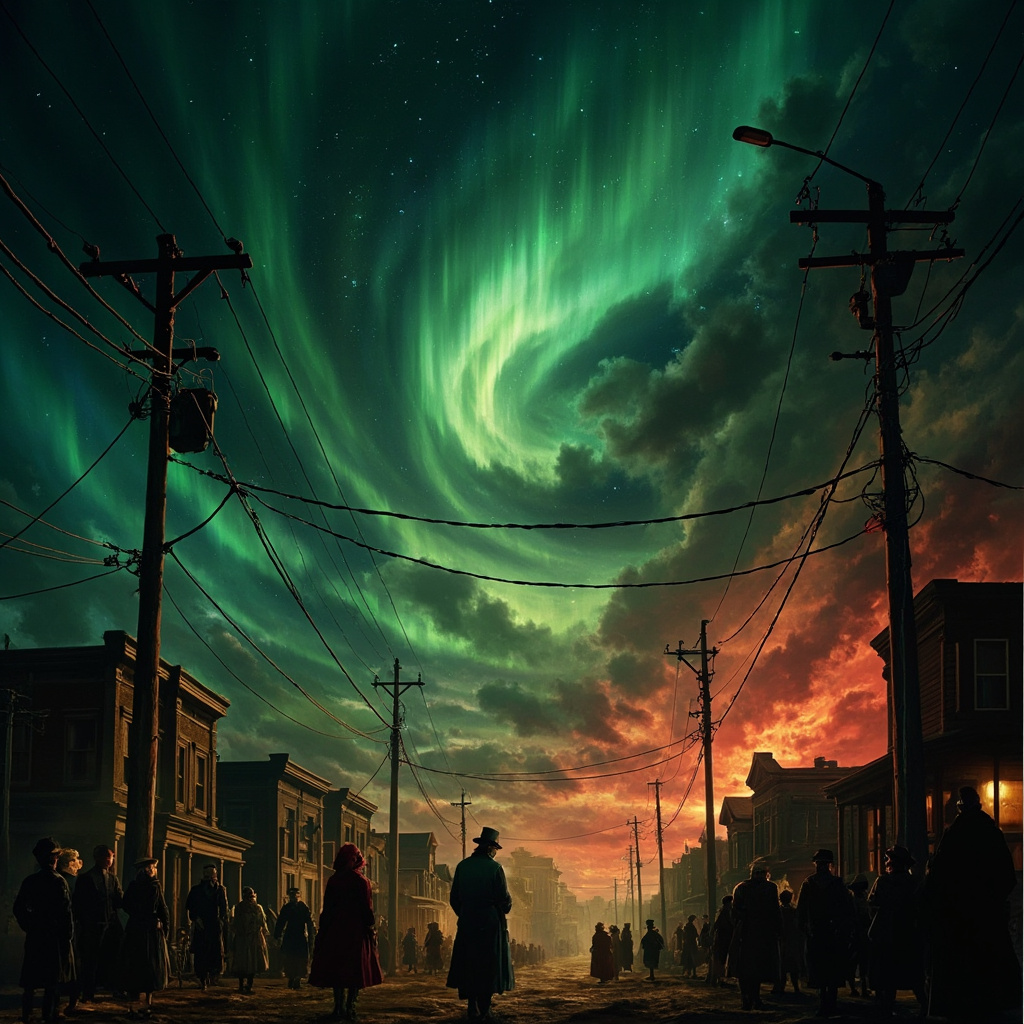
The most spectacular consequence of the Carrington Event was the display of aurora borealis—the northern lights—visible far from their usual Arctic home. Witnesses reported auroras as far south as the Caribbean, Hawaii, and southern Italy. In the Rocky Mountains, miners woke up thinking it was dawn because the aurora was so bright.
The colors were extraordinary. Accounts describe not just the typical green aurora, but brilliant reds, yellows, and whites that painted the entire sky. One witness in Boston wrote that “the whole sky appeared as a sheet of red light.” In New York, people gathered on rooftops to watch the celestial light show, and many could read newspapers by the aurora’s glow.
Some people were terrified, believing the end times had arrived. Churches filled with congregants convinced they were witnessing signs of the apocalypse. Others were simply amazed by the beauty of nature’s most spectacular light show.
The Science Behind the Chaos
The Carrington Event was the perfect storm of solar activity. The sun was near the peak of its 11-year solar cycle, making it particularly active. The solar flare Carrington observed was what scientists now classify as an X-class flare—the most powerful category. But it was the accompanying coronal mass ejection that caused the real damage.
When this cloud of charged particles reached Earth, it compressed our planet’s magnetic field and induced powerful electrical currents in conductive materials—including the primitive telegraph networks of the 1850s. The storm’s intensity measured between -850 and -900 nanoteslas on modern scales, making it roughly twice as powerful as the strongest geomagnetic storm in modern memory.
A Glimpse of Vulnerability
The Carrington Event offers a sobering glimpse into our technological vulnerability. In 1859, the most advanced technology was the telegraph system, and even that was overwhelmed. Today, a similar solar storm would likely cause catastrophic damage to our electronic infrastructure.
Satellites would fail, GPS systems would go offline, and power grids across the globe could collapse. The economic damage from a Carrington-level event today is estimated at over $2 trillion worldwide. Communication systems, banking networks, and internet infrastructure could be crippled for months.
Scientists estimate that solar superstorms like the Carrington Event occur roughly every 150-500 years. The last comparable event was in 1859, making another major solar storm increasingly likely in the coming decades.
Carrington’s Legacy
Richard Carrington’s careful observations during that September morning established the first scientific link between solar activity and geomagnetic storms on Earth. His meticulous records provided crucial data for understanding space weather—a field of study that didn’t even have a name in 1859.
The Carrington Event stands as both a testament to the awesome power of our sun and a warning about the fragility of our technological civilization. As we become increasingly dependent on electronic systems, understanding and preparing for space weather has never been more critical.
Today, space weather monitoring systems keep constant watch on the sun, providing early warning of dangerous solar storms. But even with our modern understanding and technology, a repeat of the Carrington Event would test the limits of our preparedness.
The next time you see the aurora dancing across the night sky, remember Richard Carrington and that extraordinary September day when the sun reminded humanity just how connected we are to the cosmos—and how vulnerable our technology can be to the awesome forces of nature.