The Defenestrations of Prague — Solving Political Disputes by Throwing People Out Windows

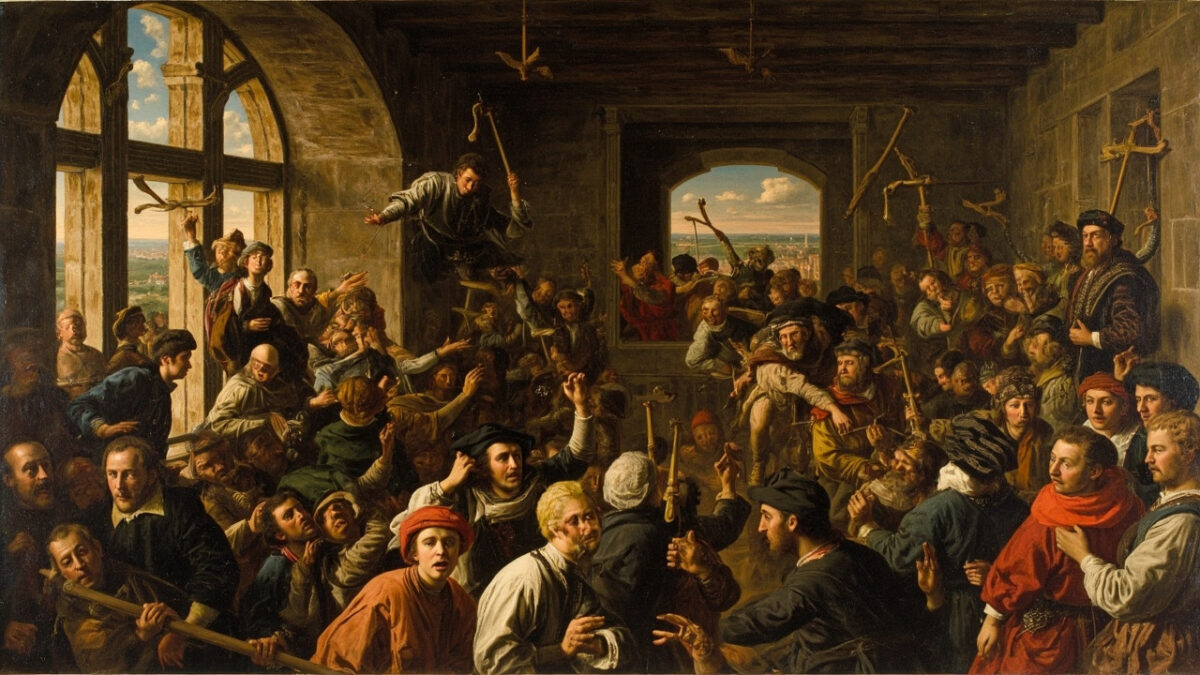
Most political traditions involve handshakes, speeches, and the occasional filibuster. But in Prague, the capital of what is now the Czech Republic, they developed a rather more dramatic method of expressing political disagreement: throwing people out of windows.
This practice happened so often that it got its own word — defenestration, from the Latin de (out of) and fenestra (window). And the most famous instances, known as the Defenestrations of Prague, literally changed the course of European history.
The First Defenestration (1419)
The first major defenestration was born from religious fury. In the early 1400s, Bohemia (the historical region centered on Prague) was a hotbed of religious reform. The followers of Jan Hus — a Czech priest who had been burned at the stake for heresy in 1415 — were furious at the Catholic Church and the political establishment that supported it.
The Hussites, as they were called, wanted church reform, communion in both kinds (bread AND wine for laypeople — a radical idea at the time), and an end to what they saw as clerical corruption. The Catholic authorities wanted them to shut up and go away. It was, suffice to say, a tense situation.
On July 30, 1419, a Hussite priest named Jan Želivský led a procession through the streets of Prague. When the marchers reached the New Town Hall, someone reportedly threw a stone at them from a window. Whether this actually happened or was just a pretext, the result was spectacular.
The Hussite mob stormed the town hall and threw the judge, the burgomaster, and several town council members out of the windows. The fall was about three stories. Those who survived the impact were reportedly finished off by the crowd below.
When King Wenceslas IV heard about the incident, he was so shocked that he reportedly suffered a fatal heart attack (or possibly a stroke — accounts vary). His death triggered the Hussite Wars, a series of brutal conflicts that ravaged Central Europe for the next 15 years and saw the Hussites defeat multiple Catholic crusades sent against them.
All because someone threw some politicians out a window.
The Second Defenestration (1618)
If the first defenestration was dramatic, the second was world-changing. And it happened in an even more spectacular fashion.
By the early 1600s, religious tensions in Bohemia had flared up again — this time between Protestants and Catholics. The Protestant estates of Bohemia had been guaranteed religious freedom by Emperor Rudolf II’s “Letter of Majesty” in 1609. But when the devoutly Catholic Ferdinand II became King of Bohemia in 1617, Protestants feared those freedoms would be revoked.
Their fears were justified. Ferdinand began restricting Protestant rights and closing Protestant churches. The Protestant nobles were not amused.
On May 23, 1618, a group of Protestant nobles marched into Prague Castle for what was supposed to be a meeting with the Catholic regents. The “meeting” quickly deteriorated. After heated arguments about religious freedom, the Protestants decided to settle the matter in traditional Prague fashion.
They grabbed two of the Catholic regents — Jaroslav Bořita of Martinice and Vilém Slavata of Chlum — along with their secretary, Philip Fabricius, and threw all three of them out of a window approximately 70 feet above the ground.
Here’s where it gets interesting: all three survived.
The Miraculous Survival
The Catholics claimed it was a miracle — that angels had caught the men and gently lowered them to safety. This version was enthusiastically promoted by the Catholic Church as evidence of divine favor.
The Protestants had a rather different explanation: the men landed in a large pile of horse manure that had accumulated in the dry moat below the window. The dung heap broke their fall.
Modern historians generally lean toward the manure theory, possibly combined with the fact that the men’s heavy cloaks may have slowed their descent somewhat. But the Catholic version makes for a much better painting, which is why you’ll find numerous artworks depicting angels catching the falling regents.
Philip Fabricius, the secretary, was later ennobled by Emperor Ferdinand for his suffering. His new title? Baron von Hohenfall — literally “Baron of the High Fall.” You genuinely cannot make this stuff up.
The Consequences
If the first defenestration triggered the Hussite Wars, the second defenestration triggered something far worse: the Thirty Years’ War (1618-1648), one of the most destructive conflicts in European history.
The Protestant Bohemian estates, having committed an act that was basically a declaration of war, went all in. They deposed Ferdinand and elected Frederick V of the Palatinate as their new king. Ferdinand, now Holy Roman Emperor, was not about to take this lying down.
What followed was three decades of warfare that engulfed most of Europe. Catholic vs. Protestant, Habsburg vs. everyone, France vs. Spain — the Thirty Years’ War became a sprawling, overlapping mess of conflicts that killed an estimated 8 million people. In some parts of Germany, the population was reduced by 30-40%.
All because some angry nobles threw some guys out of a castle window in Prague. (Well, there were deeper structural causes, obviously. But the defenestration was the spark that lit the powder keg.)
The Third Defenestration (1948)
Prague’s window-related political tradition didn’t end in the 17th century. On March 10, 1948, Jan Masaryk — the Foreign Minister of Czechoslovakia and the last non-Communist member of the government — was found dead below the bathroom window of his apartment in the Foreign Ministry.
The Communist government, which had seized power in a coup just weeks earlier, declared it a suicide. But many Czechs believed Masaryk had been murdered — thrown from the window by Communist agents.
The debate raged for decades. In 2004, a Czech police investigation concluded that Masaryk was indeed murdered — thrown or pushed from the window. A subsequent forensic analysis in 2021 supported this conclusion, finding that the evidence was inconsistent with suicide.
If true, it means Prague’s tradition of political defenestration extended well into the 20th century.
Why Prague?
So what is it about Prague and windows? Why did this particular city develop a habit of resolving political disputes through gravity?
Part of the answer is simply that Prague was a flashpoint — a city where different religious, ethnic, and political factions coexisted in often volatile tension. Bohemia sat at the crossroads of Germanic and Slavic cultures, Catholic and Protestant faiths, and competing imperial ambitions. Tensions ran high, and when they boiled over, they did so dramatically.
There’s also a symbolic element. Defenestration wasn’t just murder — it was a public statement. Throwing someone out of a window, in full view of the city, was a way of saying: “We reject your authority so completely that we’re literally expelling you from the building.” It was political theater of the most visceral kind.
And once it happened a couple of times, it became part of Prague’s political identity. The citizens of Prague knew their history, and when tensions rose, the symbolism of the window was already loaded.
A Legacy of Flying Politicians
Today, the word “defenestration” has entered common English usage, meaning the act of throwing someone or something out of a window — or, more metaphorically, the abrupt removal of someone from a position of power. Every time a CEO is “defenestrated” by their board of directors, they have Prague to thank for the vocabulary.
The windows of Prague Castle are now a tourist attraction. Visitors can peer out of the very same windows from which the Catholic regents took their involuntary flying lesson in 1618. There’s something darkly comic about tourists cheerfully photographing the spot where an event occurred that led to the deaths of millions.
But that’s history for you — equal parts tragedy, comedy, and people being thrown out of windows. Prague wouldn’t have it any other way.