The Fascinating History of the Ukulele: From Portuguese Workshops to Global Phenomenon


If someone asked you to name the most iconic Hawaiian instrument, you’d probably say the ukulele without a moment’s hesitation. But here’s a twist that might surprise you — this beloved four-stringed wonder isn’t actually Hawaiian at all. Its origins lie thousands of miles away, on a small Portuguese island in the Atlantic Ocean. The story of how the ukulele traveled from Madeira to Honolulu, and eventually conquered the entire world, is one of history’s most delightful tales of cultural fusion.
A Ship Called the Ravenscrag
Our story begins on August 23, 1879, when the British sailing vessel SS Ravenscrag pulled into Honolulu Harbor after a grueling 123-day voyage from the Portuguese island of Madeira. On board were approximately 420 Portuguese immigrants, recruited to work on Hawaii’s booming sugar plantations. Among them were three cabinetmakers who would change the course of musical history: Manuel Nunes, Augusto Dias, and José do Espírito Santo.
These craftsmen had brought with them small stringed instruments from their homeland — the machete de braça (also called the braguinha), the rajão, and the cavaquinho. These weren’t just instruments; they were a lifeline to home, a piece of Portugal carried across the ocean. According to legend, when the ship finally docked, one of the passengers was so overjoyed to reach land that he burst into song and dance on the wharf, strumming his machete with wild abandon. The Hawaiians watching were enchanted.
What’s in a Name? Jumping Fleas and Royal Gifts
The word “ukulele” itself is a source of cheerful debate among historians. In Hawaiian, ‘uku means “flea” and lele means “to jump.” So “ukulele” literally translates to “jumping flea” — but why?
There are three competing theories. The first, and most popular, suggests that the rapid finger movements of skilled players reminded Hawaiian observers of fleas hopping across the fretboard. The second theory points to Edward Purvis, a small, energetic British officer at the court of King Kalākaua, who was an enthusiastic early adopter of the instrument. His lively playing style and diminutive stature reportedly earned him the nickname “ukulele” — the jumping flea.
Queen Lili’uokalani, the last reigning monarch of the Hawaiian Kingdom, offered a more elegant interpretation. She preferred to read ‘uku as “gift” and lele as “to come,” translating the name as “the gift that came here” — a poetic nod to the instrument’s journey from Portugal.
Royal Patronage and Hawaiian Identity
The ukulele might have remained a niche curiosity if not for the enthusiastic support of Hawaiian royalty. King David Kalākaua, known as the “Merrie Monarch” for his passionate revival of Hawaiian arts and culture, fell in love with the instrument almost immediately. He incorporated it into royal gatherings and performances, and encouraged its adoption throughout the islands.
Under royal patronage, the ukulele rapidly evolved from its Portuguese ancestors. Hawaiian luthiers, led by Nunes, Dias, and Santo, began building instruments from native Hawaiian koa wood, giving the ukulele its distinctive warm, bright tone. The tuning was modified, the body shape refined, and within a decade, the ukulele had become something entirely new — unmistakably Hawaiian.
By the 1890s, Queen Lili’uokalani herself was composing songs for the ukulele, including the immortal “Aloha ‘Oe.” The instrument had become so central to Hawaiian culture that it was essentially considered the national instrument of the Kingdom of Hawai’i.
The Ukulele Craze Hits the Mainland
The ukulele’s big break on the American mainland came at the 1915 Panama-Pacific International Exposition in San Francisco. The Hawaiian Pavilion featured live performances by ukulele players and Hawaiian steel guitar musicians, and mainland Americans went absolutely crazy for the sound. It was exotic, it was fun, and — crucially — the ukulele was small, affordable, and relatively easy to learn.
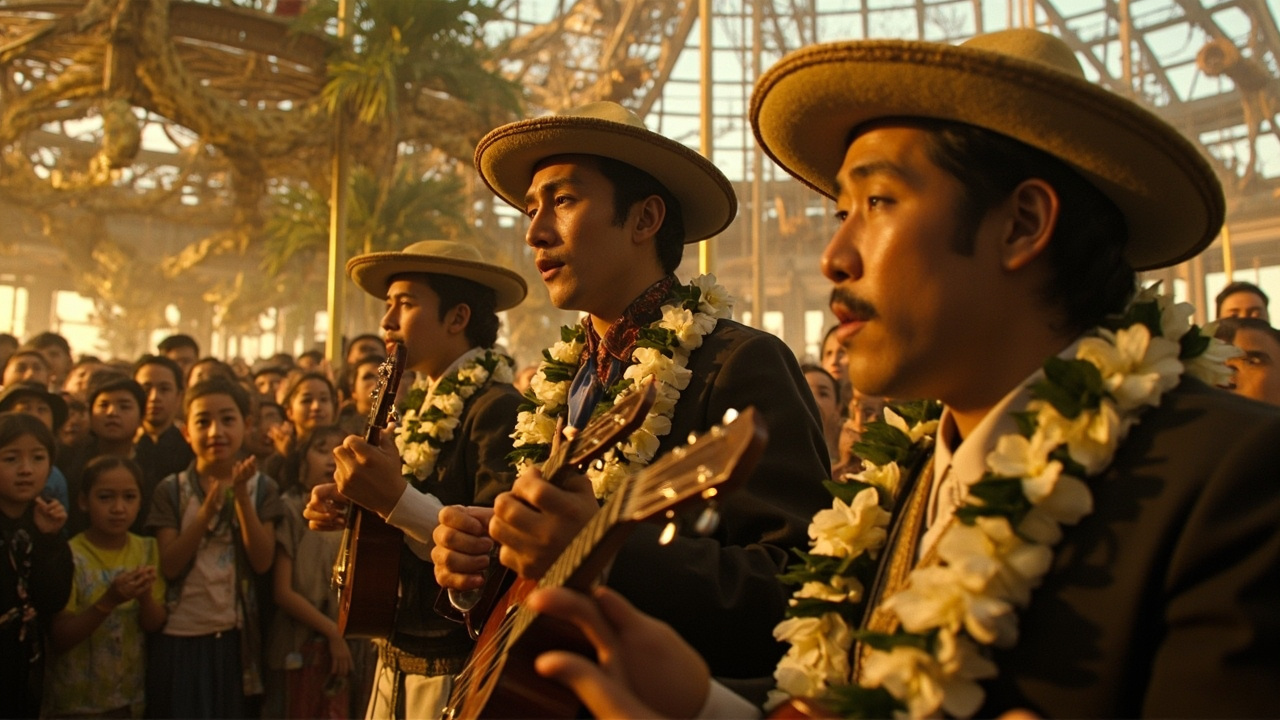
What followed was nothing short of a musical revolution. Tin Pan Alley songwriters churned out Hawaiian-themed tunes by the dozens. Music publishers released ukulele songbooks. Department stores couldn’t keep ukuleles in stock. By the 1920s, the ukulele had become the instrument of the Jazz Age, associated with flappers, vaudeville performers, and carefree fun.
The instrument’s greatest early champion was arguably Cliff Edwards, better known as “Ukulele Ike.” Edwards was a massive star of the 1920s and 1930s, performing on Broadway and in Hollywood films. He even provided the voice of Jiminy Cricket in Disney’s Pinocchio (1940), singing “When You Wish Upon a Star” — though sadly, not with a ukulele.
Ups, Downs, and a Spectacular Comeback
The ukulele’s first wave of popularity began to fade in the late 1930s as the guitar took center stage in American popular music. But the little instrument proved remarkably resilient. Arthur Godfrey, a hugely popular television host in the 1950s, was an avid ukulele player who introduced the instrument to a whole new generation of Americans, sparking a second ukulele boom.
Then came another quiet period. By the 1970s and 1980s, the ukulele was widely dismissed as a toy or a novelty item — the musical equivalent of a whoopee cushion. It seemed destined for the dustbin of musical history.

But history loves a good comeback story. In 1993, a Hawaiian musician named Israel Kamakawiwo’ole recorded a medley of “Somewhere Over the Rainbow” and “What a Wonderful World” on his ukulele. The recording, made in a single take at 3 AM, became one of the most beloved songs of the modern era, introducing millions of people to the pure, crystalline beauty of the ukulele. “IZ,” as he was known, proved that this tiny instrument could produce music of profound emotional depth.
The 21st century has seen the ukulele experience its biggest boom yet. YouTube helped fuel the fire, with players like Jake Shimabukuro stunning audiences with virtuoso performances that redefined what was possible on four strings. His 2006 video of “While My Guitar Gently Weeps” went viral and made him an international star. Today, the ukulele is one of the world’s fastest-growing instruments, embraced by artists from Eddie Vedder to Taylor Swift, and taught in schools around the globe.
Four Strings, One World
The ukulele’s journey — from a Portuguese cabinetmaker’s workshop in Madeira to Hawaiian royal courts, from Tin Pan Alley to YouTube — is a remarkable story of cultural exchange. It reminds us that some of history’s most enduring creations emerge not from isolation, but from the beautiful collision of different cultures and traditions.
Next time you hear those four cheerful strings, remember: you’re listening to the sound of Portuguese immigrants playing on a Hawaiian dock in 1879, of King Kalākaua strumming at royal luaus, of Jazz Age flappers dancing in speakeasies, and of Israel Kamakawiwo’ole singing into a microphone at 3 AM. Not bad for a little instrument named after a jumping flea.