The Cadaver Synod — When the Pope Put a Dead Pope on Trial

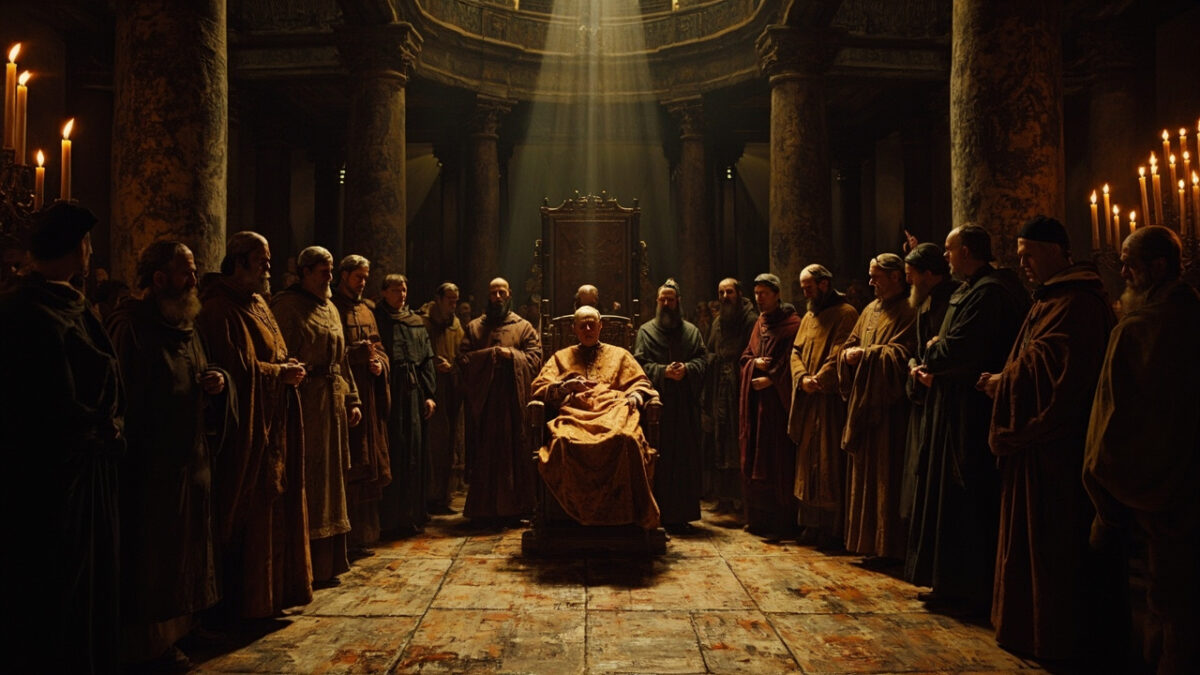
In the annals of history, there are trials that shocked the world — the Salem witch trials, the trial of Socrates, the Nuremberg trials. But none of them can match the sheer absurdity of what happened in Rome in January 897 AD, when Pope Stephen VI put the corpse of his predecessor, Pope Formosus, on trial.
Yes, you read that right. They dug up a dead pope, dressed him in papal vestments, propped him up on a throne, and conducted a full legal trial. Welcome to the Cadaver Synod — quite possibly the most bizarre event in the history of the Catholic Church.
The Road to Madness
To understand how we got here, we need to rewind a bit. The late 800s were not exactly the Catholic Church’s finest hour. Rome was a hotbed of political intrigue, with various factions of Italian nobility jockeying for power, and the papacy was essentially a political football.
Pope Formosus had a complicated career even by the standards of the time. He’d been a bishop, been excommunicated, been restored, and eventually became pope in 891 AD. During his five-year papacy, he made plenty of enemies — particularly by crowning Arnulf of Carinthia as Holy Roman Emperor, which didn’t sit well with the powerful Spoleto faction in Italian politics.
When Formosus died in April 896, you might think his troubles were over. After all, what more can you do to a dead man? As it turns out, quite a lot.
Enter Stephen VI
After a brief intervening papacy (Pope Boniface VI, who lasted all of 15 days — possibly murdered, because of course), Stephen VI became pope. Stephen was firmly in the Spoleto camp, and he had a score to settle with the deceased Formosus.
Whether driven by political pressure from the Spoleto Duke Lambert, genuine theological conviction, or simple spite, Stephen decided that Formosus’s papacy needed to be declared illegitimate. And apparently, the best way to do this was to put the dead man on trial in person.
The Trial Itself
In January 897, roughly seven months after Formosus had died, Stephen ordered the former pope’s body exhumed from its tomb in St. Peter’s Basilica. The corpse, now in an advanced state of decomposition, was dressed in full papal vestments and seated on a throne in the Basilica of St. John Lateran.
A teenage deacon was appointed to stand behind the corpse and answer questions on Formosus’s behalf. Imagine being that kid. “Hey, congratulations on the new assignment! You’ll be the legal representative for… a rotting corpse. In front of the entire papal court. Good luck!”
Stephen VI himself served as both prosecutor and judge — a conflict of interest that would make even the most corrupt modern judge blush. He reportedly screamed at the corpse, demanding answers to the charges against it. The main accusations were:
- That Formosus had committed perjury
- That he had illegally served as pope while previously being bishop of another diocese (which violated canon law at the time)
- That he had coveted the papacy
Unsurprisingly, the defense was… lacking. The corpse offered no rebuttal. The teenage deacon presumably stood there in mute horror. And the assembled clergy, many of whom had been appointed by Formosus himself, were too terrified of Stephen to object.
The Verdict
In a shocking twist that surprised absolutely no one, Formosus was found guilty on all charges. Stephen declared his papacy retroactively null and void. All of Formosus’s papal acts, ordinations, and decrees were annulled.
But Stephen wasn’t done. In a final act of desecration, he ordered the three fingers of Formosus’s right hand — the fingers used to give papal blessings — to be cut off. The papal vestments were stripped from the body, and the corpse was initially buried in a common grave.
Still not satisfied, Stephen later ordered the body dug up again and thrown into the Tiber River. Because apparently, one exhumation just wasn’t enough.
The Aftermath
Here’s where karma enters the picture. The Cadaver Synod was so grotesque, so obviously a travesty of justice, that it sparked a massive public backlash. The Roman populace was horrified. Even by the rough standards of the Dark Ages, putting a dead man on trial was considered beyond the pale.
Legend has it that Formosus’s body washed up on the banks of the Tiber, where it was recovered by a monk. Miracles were reportedly attributed to the corpse, which only fueled public anger against Stephen.
Within months, Stephen VI’s political allies abandoned him. He was seized by a mob, stripped of his papal vestments, and thrown into prison, where he was strangled to death in the summer of 897. His papacy had lasted barely a year.
The subsequent popes went back and forth on the Cadaver Synod’s legitimacy like a theological ping-pong match. Pope Theodore II recovered Formosus’s body and had it reburied in St. Peter’s with full honors. Pope John IX convened a synod that declared the Cadaver Synod null and void and prohibited future trials of dead people (the fact that they needed to make this a rule tells you everything about the era).
But then Pope Sergio III, another Formosus hater, came along and reaffirmed the Cadaver Synod’s verdict. The debate continued for years.
What It All Means
The Cadaver Synod stands as one of the most dramatic examples of how intertwined religion and politics were in medieval Europe. It wasn’t really about theology — it was about power. The Spoleto faction needed Formosus’s papacy delegitimized to secure their own political position, and they were willing to go to literally any lengths to achieve it.
It also serves as a sobering reminder that even institutions claiming divine authority are ultimately run by humans, with all their pettiness, ambition, and capacity for the absurd. When you’re so consumed by political rivalry that you think “let’s dig up the dead guy and yell at him” is a reasonable course of action, you’ve probably lost the plot.
The Cadaver Synod is often cited as one of the low points of the so-called “pornocracy” — the period of papal history from roughly 904 to 964 when the papacy was dominated by corrupt Roman noble families. But honestly, the Synod makes even the pornocracy’s other scandals look tame by comparison.
So the next time you think your workplace politics are bad, just remember: at least nobody has dug up your predecessor and put them on trial. Yet.