The War of the Bucket: When Italy Fought a Bloody Battle Over a Wooden Pail

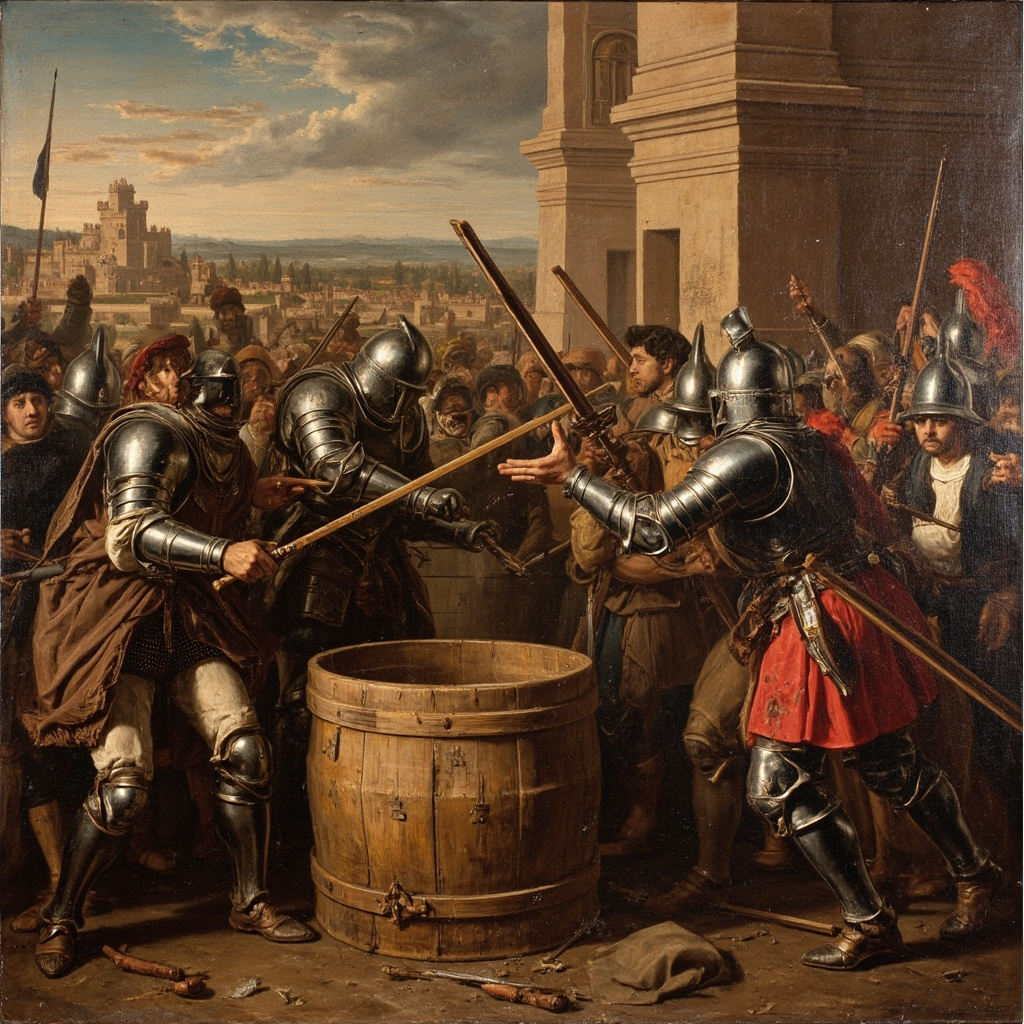
In 1325, soldiers from the Italian city-states of Bologna and Modena fought a pitched battle involving thousands of troops, cavalry charges, and considerable bloodshed. The prize they were fighting over? A wooden bucket.
The War of the Bucket — or Guerra della Secchia Rapita — is one of the most absurd conflicts in military history. But beneath its comical surface lies a story about the deadly factional politics that tore medieval Italy apart for centuries.
Guelphs vs. Ghibellines: Italy’s Endless Civil War
To understand the War of the Bucket, you need to understand the conflict that dominated Italian politics for nearly three hundred years: the struggle between the Guelphs and the Ghibellines.
The Guelphs supported the Pope as the supreme authority in Italy. The Ghibellines backed the Holy Roman Emperor. Every Italian city was forced to choose a side, and the rivalry infected every aspect of civic life. Neighboring cities often chose opposite factions specifically to justify attacking each other.
Bologna was a Guelph city — prosperous, home to one of Europe’s oldest universities, and loyal to the papacy. Modena, just 25 miles to the northwest, was Ghibelline — smaller, scrappier, and perpetually in Bologna’s shadow. The two cities had been feuding for generations, and by the early fourteenth century, tensions were at a breaking point.
The Bucket Raid
In 1325, a group of Modenese soldiers carried out a daring raid into the heart of Bologna. They fought their way into the city, and in an act of supreme provocation, stole an oak bucket from the main city well in the central square. The bucket — a secchia — was an ordinary wooden pail, worth almost nothing in monetary terms. But in symbolic terms, it was an intolerable insult.
Stealing from a city’s central well was a deliberate humiliation, equivalent to capturing an enemy’s flag. It announced to the world that Modena’s soldiers had penetrated Bologna’s defenses and taken a trophy from the very heart of the city. For proud, wealthy Bologna, this was an affront that demanded a military response.
The Battle of Zappolino
Bologna assembled a massive army. Historical accounts vary, but most sources suggest the Bolognese force numbered around 32,000 men — including 2,000 cavalry — making it one of the largest armies fielded by an Italian city-state in the medieval period. They also called upon allies from Florence, Romagna, and other Guelph cities. A papal legate accompanied the army, underscoring the involvement of the papacy itself.
Modena’s army was significantly smaller, perhaps 5,000 infantry and 2,000 cavalry, bolstered by Ghibelline allies including the fearsome warlord Passerino Bonacolsi, the lord of Mantua, who brought experienced troops hardened by years of factional warfare.
The two armies met on November 15, 1325, at the town of Zappolino, about nine miles south of Modena. What followed was a decisive and humiliating defeat for Bologna.
Despite their overwhelming numerical superiority, the Bolognese army was poorly coordinated and overconfident. The Modenese and their allies launched a devastating cavalry charge that broke the Bolognese lines. The rout was swift and total. The Bolognese army fled the field, abandoning equipment, supplies, and pride.
Modenese forces pursued the retreating Bolognese all the way back to the gates of Bologna, where, according to tradition, they carried out one final humiliation: they held a mock jousting tournament within sight of the city walls, taunting the defeated Bolognese from the safety of their own suburbs.
The Casualties and the Peace
The Battle of Zappolino was bloody by medieval Italian standards. Estimates of the dead range from several hundred to over 2,000, depending on the source. Thousands more were captured. For a conflict triggered by the theft of a bucket, the human cost was staggering.
Despite their crushing victory, the Modenese were unable to capture Bologna itself — the city’s walls were too strong and well-defended. A peace treaty was eventually negotiated, but the fundamental Guelph-Ghibelline tensions remained unresolved. The two cities would continue to skirmish for decades.
And the bucket? Modena kept it. It was never returned.
The Bucket Today
Nearly seven hundred years later, the stolen bucket still exists. It hangs in the bell tower of the Cathedral of Modena — the Torre della Ghirlandina — where it has been displayed as a trophy of victory for centuries. A replica can be seen in the town hall. Modenese citizens remain proud of their ancestors’ audacious theft and the military triumph that followed.
The War of the Bucket was immortalized in 1622 by the Italian poet Alessandro Tassoni, whose mock-heroic epic La Secchia Rapita (“The Stolen Bucket”) used the conflict as the basis for a satirical poem that mocked the absurdity of Italian factional warfare. The poem was a bestseller in its day and remains a classic of Italian literature.
More Than a Joke
It’s tempting to treat the War of the Bucket as a historical punchline — and it is genuinely funny that thousands of men fought and died over a wooden pail. But the conflict illuminates something important about how wars actually start.
The bucket wasn’t really the cause of the war. It was the spark. The underlying fuel was centuries of accumulated grievance, factional hatred, economic competition, and wounded civic pride. The theft of the bucket was simply the final provocation in a long chain of provocations, the insult that made war feel not just justified but necessary.
History is full of wars triggered by seemingly trivial incidents — a severed ear, a football match, a pig wandering across a border. In each case, the triviality of the trigger obscures the depth of the underlying tensions. The War of the Bucket reminds us that when communities are primed for conflict, even the most absurd catalyst can unleash devastating violence.
So the next time someone tells you that a particular dispute is “too silly to fight over,” remember Modena and Bologna. Remember the bucket that launched a war, killed hundreds, and still hangs in a cathedral tower as a proud trophy of victory. In politics, as in life, nothing is ever really about the bucket.