The Most Bizarre Death in Ancient History: How an Eagle Killed the Father of Greek Tragedy

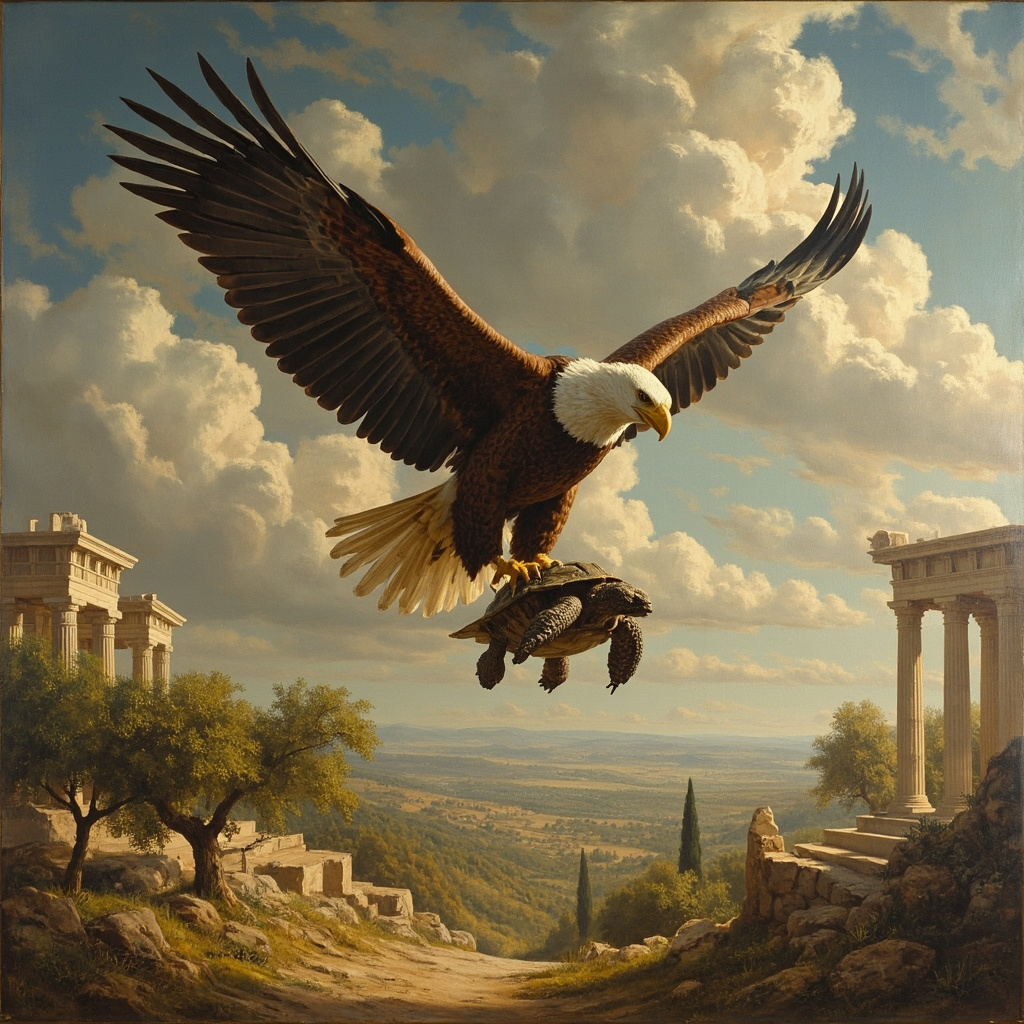
In the annals of history’s most bizarre deaths, few stories rival that of Aeschylus, the father of Greek tragedy, who met his end in 456 BC when an eagle dropped a tortoise on his bald head. The great playwright, credited with transforming theater into high art, died in the most ironically dramatic fashion possible.
The Father of Tragedy
Aeschylus (525-456 BC) was no ordinary playwright. Born into the golden age of Athens, he revolutionized theater by introducing a second actor, allowing for true dialogue and conflict on stage. His works, including the legendary Oresteia trilogy and Prometheus Bound, established the foundations of tragic drama that would influence Western literature for millennia.
Known as “the father of tragedy,” Aeschylus was the first dramatist to present plays as trilogies, creating complex narratives that unfolded across multiple performances. His Oresteia remains the only complete ancient trilogy to survive to modern times, a testament to his enduring genius.
A Prophecy Fulfilled
According to ancient sources, including the historian Valerius Maximus, Aeschylus had received a prophecy that he would die when something fell from the sky. Naturally cautious, the playwright began avoiding buildings and spending more time outdoors, believing this would protect him from falling objects like roof tiles or masonry.
The irony was exquisite. In trying to avoid his fate, Aeschylus positioned himself perfectly for it. During his final visit to Gela in Sicily, the 67-year-old playwright was walking in an open area when a lammergeier (bearded vulture) soared overhead, clutching a large tortoise in its talons.
The Fatal Mistake
These magnificent birds of prey have a unique hunting technique: they drop tortoises and other hard-shelled creatures onto rocks to crack them open and access the meat inside. The eagle, spotting Aeschylus’s gleaming bald pate from above, mistook it for a perfect rock surface.
The tortoise struck the playwright’s head with fatal force, killing him instantly. The man who had created some of literature’s most dramatic and tragic deaths had become the victim of perhaps the most absurdly dramatic death in recorded history.
Legacy of a Literary Giant
Aeschylus left behind a body of work that fundamentally shaped Western drama. He wrote an estimated 70 to 90 plays, though only seven complete works survive today. His innovations included the introduction of elaborate costumes, painted scenery, and choreographed dance sequences that elevated theater from simple storytelling to sophisticated art form.
His plays dealt with weighty themes of justice, divine retribution, and human suffering—themes that took on a darkly humorous dimension given his own bizarre demise. The Oresteia, his masterpiece about the curse of the House of Atreus, explores how violence begets violence in an endless cycle—a concept that gains extra poignancy when considering that Aeschylus himself became victim to nature’s own violent caprice.
Historical Accuracy and Modern Skepticism
Modern historians debate whether the tortoise story represents literal truth or symbolic narrative. Some scholars suggest the tale may be allegorical, representing the random nature of death that can strike even the most celebrated individuals. Others point out that lammergeiers do indeed practice this hunting technique in Mediterranean regions, making the account plausible.
Regardless of its literal truth, the story has endured for over two millennia precisely because it captures something profound about the human condition. The greatest tragedian of the ancient world, a man who understood better than anyone how fate could strike without warning, became the protagonist of his own tragic tale.
Today, Aeschylus is remembered not just for his revolutionary contributions to theater, but for embodying the very principles of Greek tragedy in his death: the powerful brought low, fate fulfilled despite attempts at avoidance, and the cosmic irony that governs human existence. In death, as in life, Aeschylus proved that truth can indeed be stranger than fiction.