The Dancing Plague of 1518: When Hundreds Danced Themselves to Death

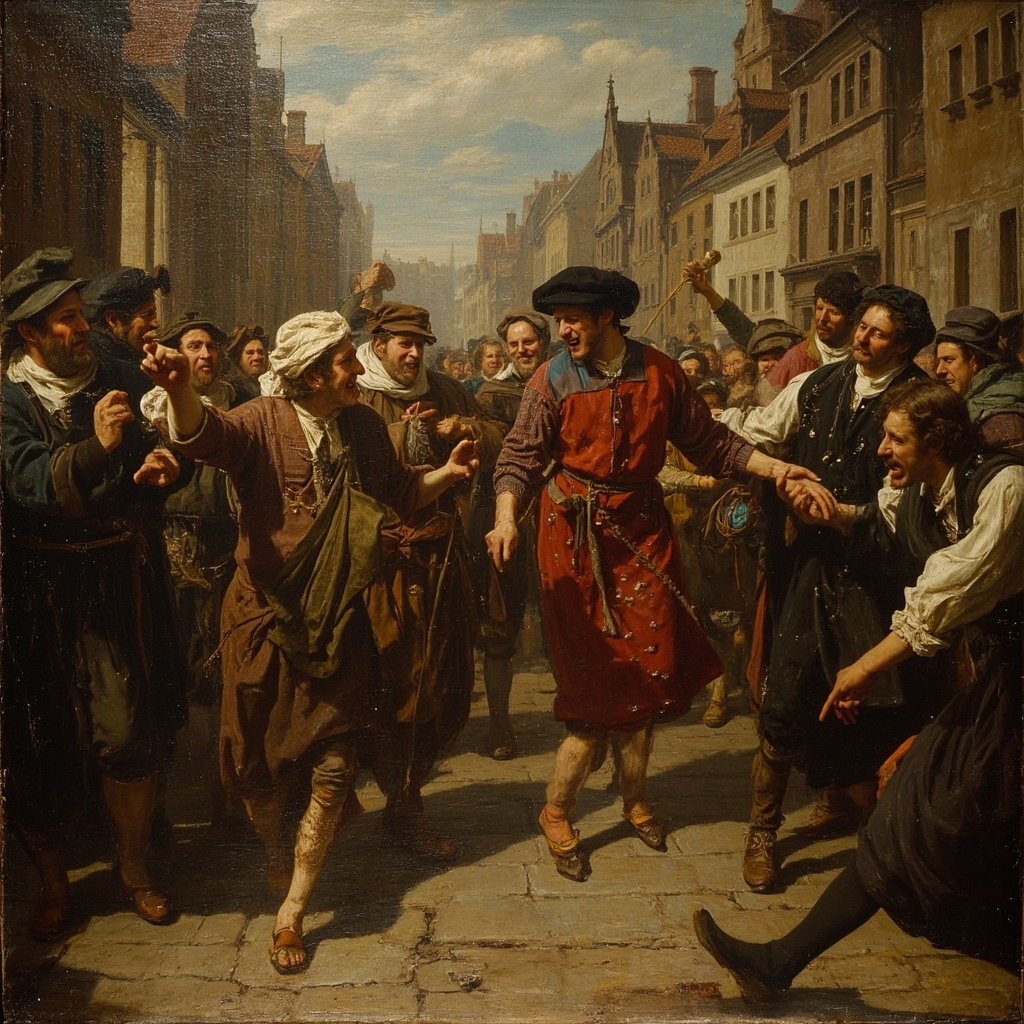
In the sweltering heat of July 1518, a woman named Frau Troffea stepped into a narrow street in Strasbourg, Alsace (then part of the Holy Roman Empire), and began to dance. There was no music, no celebration, no apparent reason. She simply danced — twisting, turning, and flailing her arms with wild abandon. She danced for hours. She danced until her shoes were soaked with blood. And she did not stop.
Her husband begged her to rest. Neighbors stared in bewilderment. Local authorities scratched their heads. But Frau Troffea danced through the night, and into the next day, and the day after that. Within a week, 34 others had joined her in the streets. Within a month, the number had swollen to approximately 400 people, all dancing uncontrollably in what would become one of the strangest and most disturbing episodes in European history: the Dancing Plague of 1518.
A City in Crisis
Strasbourg in 1518 was already a city under immense strain. The years leading up to the dancing plague had been brutal. A series of harsh winters and scorching summers had devastated crops across the region. Smallpox, syphilis, and other diseases swept through the population with terrifying regularity. Famine was widespread, and the poor — who made up the vast majority of the city’s residents — were desperate and starving.
Into this cauldron of misery came the dancing. The afflicted didn’t dance with joy or rhythm. Witnesses described their movements as frenzied and tormented. Many wept and screamed as their legs carried them in endless, exhausting circles. They begged for help. They pleaded for it to stop. But their bodies refused to obey.
The city council, desperate for a solution, initially made a decision that seems baffling in hindsight: they decided to encourage the dancing. Operating under the theory that the afflicted needed to “dance it out of their systems,” authorities opened two guild halls and even constructed a wooden stage. They hired musicians — pipers and drummers — to play accompanying music, hoping that structured rhythm would help the dancers exhaust themselves and recover.
It didn’t work. The music only seemed to attract more dancers. The epidemic grew worse.
The Toll
Historical accounts vary, but chroniclers of the time reported that at the peak of the plague, as many as fifteen people were dying per day from heart attacks, strokes, and sheer exhaustion. Their feet were bloody and blistered. Some collapsed and never rose again. The city’s physicians were completely baffled.
When it became clear that encouraging the dancing was catastrophically counterproductive, the authorities reversed course. The musicians were dismissed. The guild halls were closed. The afflicted were loaded onto wagons and transported to a mountaintop shrine dedicated to Saint Vitus, the patron saint associated with dancing and epilepsy. There, the dancers were given small crosses, led around holy altars, and placed in red shoes that had been blessed with holy water and anointed with oil.
Remarkably — whether through divine intervention, psychological relief, or simply the passage of time — the plague began to subside. By early September, the dancing had largely stopped. The survivors were left physically shattered but alive.
What Caused It?
For centuries, the Dancing Plague of 1518 was dismissed as legend or exaggeration. But extensive research by historian John Waller and others has confirmed that the event absolutely happened. City council records, physician notes, cathedral sermons, and regional chronicles all document it in remarkable detail.
So what caused hundreds of people to dance themselves to injury and death?
One popular theory involves ergot poisoning. Ergot is a fungus that grows on grain, particularly rye, and contains chemicals related to LSD. Consuming contaminated bread could cause convulsions, hallucinations, and involuntary muscle movements. However, most experts have rejected this explanation for the dancing plague — ergot poisoning typically causes constricted blood flow to the extremities, making coordinated dancing essentially impossible.
The most widely accepted modern explanation is mass psychogenic illness — sometimes called mass hysteria. Under this theory, the extraordinary psychological stress of life in 1518 Strasbourg created the perfect conditions for a collective psychological breakdown. The people were starving, sick, and terrified. They lived in a culture that deeply believed in supernatural punishment, particularly the curse of Saint Vitus, who was said to afflict sinners with compulsive dancing.
Waller argues that Frau Troffea, overwhelmed by the misery of her circumstances, entered a stress-induced trance state. In a community primed by superstitious belief, others who witnessed her dancing interpreted it through the lens of Saint Vitus’s curse — and their terror of the same fate actually triggered it. Fear became a self-fulfilling prophecy. One by one, the most psychologically vulnerable members of the community fell into the same dissociative state.
Not an Isolated Incident
As bizarre as the 1518 event seems, it was not unique. Outbreaks of compulsive dancing — known as “choreomania” or “dancing mania” — were documented repeatedly across Europe between the 7th and 17th centuries. A major outbreak in 1374 swept through towns along the Rhine River, affecting thousands. Smaller episodes were recorded in Switzerland, Germany, and Holland throughout the medieval period.
These outbreaks shared common features: they occurred during times of extreme hardship, they spread through communities like contagion, and they were deeply intertwined with religious belief and superstition. They typically affected the poorest and most vulnerable members of society.
Legacy
The Dancing Plague of 1518 remains one of history’s most fascinating medical mysteries. It offers a window into the extraordinary power of the human mind — how belief, fear, and collective psychology can produce physical symptoms that are entirely real and genuinely deadly, even without any biological pathogen.
It also serves as a sobering reminder of what happens when communities are pushed to the breaking point. The dancers of Strasbourg weren’t performers or revelers. They were people in profound distress, trapped in bodies that had betrayed them, dancing not with joy but with desperation — a physical manifestation of a suffering too great for words.
Five hundred years later, we still can’t fully explain what happened in those streets. But we can recognize in those tormented dancers something deeply, unsettlingly human: the knowledge that sometimes, when the weight of the world becomes too much to bear, the mind finds its own terrible way to scream.