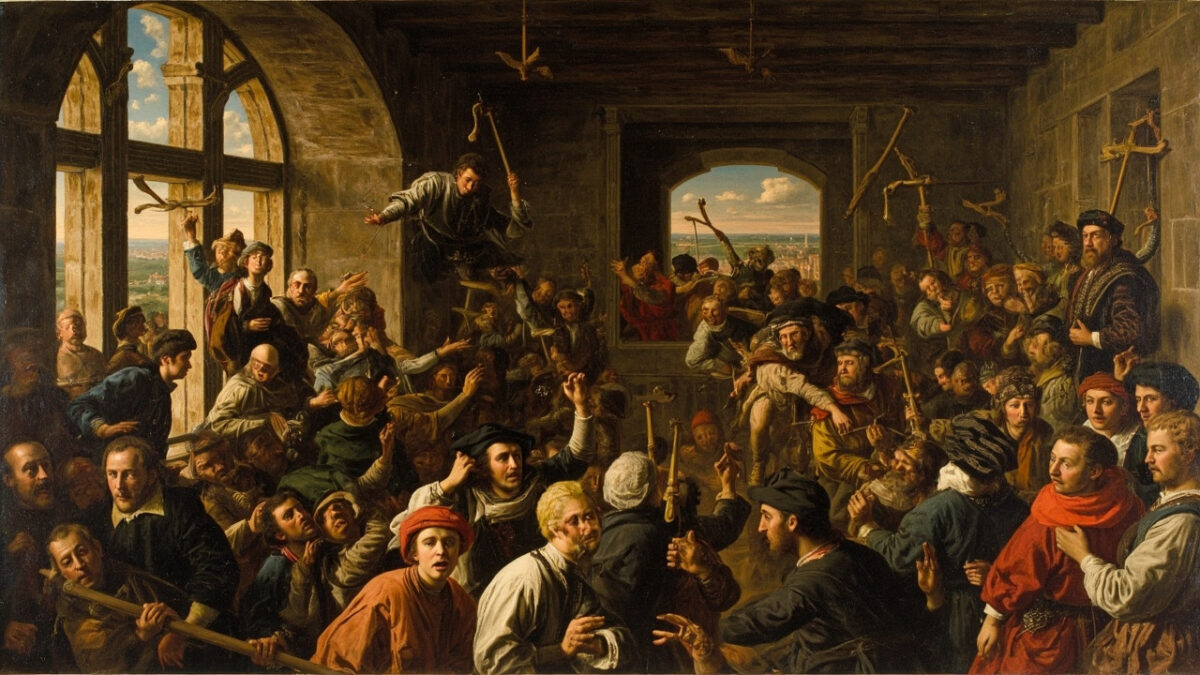
Double Vision: Famous Twins Who Shaped History


From the mythological founders of Rome to groundbreaking scientific subjects, twins have fascinated humanity for millennia. Their stories — sometimes triumphant, sometimes tragic — reveal deep truths about identity, connection, and what it means to share your life with someone who entered the world alongside you. Here are some of history’s most remarkable twin stories.

Romulus and Remus: The Twins Who Built an Empire

Perhaps no twins loom larger in Western civilization than Romulus and Remus, the legendary founders of Rome. According to myth, these twin brothers were born to Rhea Silvia, a Vestal Virgin, and Mars, the god of war. Their great-uncle, King Amulius, ordered them drowned in the Tiber River to eliminate any threat to his throne. But fate — or the gods — had other plans.

A she-wolf discovered the abandoned infants and nursed them in a cave called the Lupercal. Later, a shepherd named Faustulus found and raised them. When the brothers grew to manhood and learned their true origins, they overthrew Amulius and restored their grandfather to power. Then they set out to build their own city.

What happened next is one of history’s darkest twin stories. The brothers quarreled over where to build and how to rule. In a fit of rage, Romulus killed Remus and became the sole founder of Rome — a city that would grow to dominate the known world. The tale of Romulus and Remus isn’t just a founding myth; it’s a meditation on rivalry, ambition, and the terrible price of power, even between those who share the closest possible bond.

Chang and Eng Bunker: The Original “Siamese Twins”
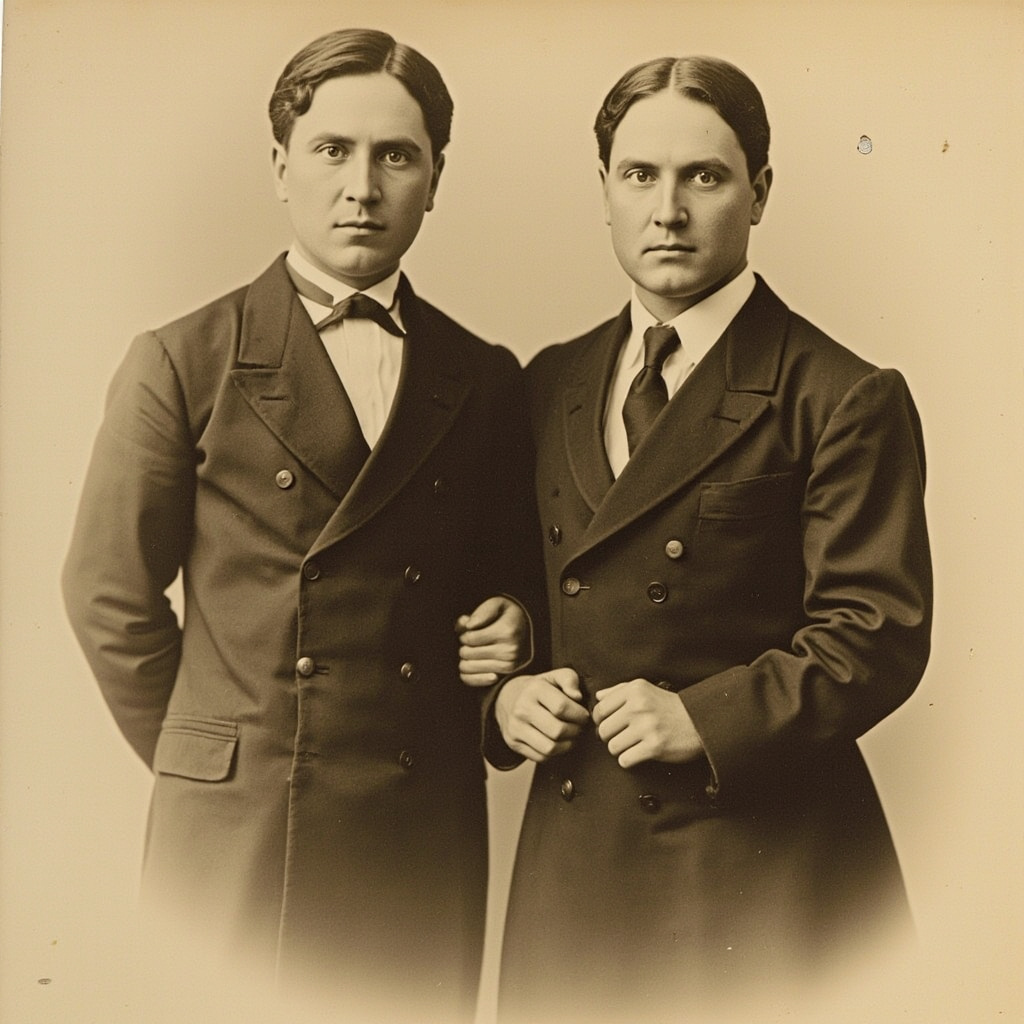
Chang and Eng Bunker, the original Siamese twins

Born in 1811 in Siam (modern-day Thailand), Chang and Eng Bunker were conjoined twins connected at the chest by a band of cartilage. Their story would give the world the now-outdated term “Siamese twins” — but their lives were far more interesting than any label.

Discovered by a British merchant, the brothers were brought to the West as curiosities and toured with P.T. Barnum’s circus. But Chang and Eng were no passive spectacles. They were shrewd businessmen who eventually bought their freedom, became American citizens, purchased a plantation in North Carolina, and married two sisters — Adelaide and Sarah Yates.

Between them, the brothers fathered 21 children. They developed a rotating schedule, spending three days at Chang’s home and three at Eng’s. Despite being physically inseparable their entire lives, the twins had distinctly different personalities: Chang was more outgoing and drank heavily, while Eng was quieter and more reserved. When Chang died in his sleep on January 17, 1874, Eng reportedly said, “Then I am going too,” and passed away hours later. Modern doctors believe surgical separation would have been possible — and relatively simple — with today’s techniques.

The Dionne Quintuplets: Canada’s Famous Five

While not twins in the strict sense, the Dionne quintuplets — Yvonne, Annette, Cécile, Émilie, and Marie — were born near Callander, Ontario, in 1934 as the first quintuplets known to survive infancy. What makes their story relevant to twin history is that they were identical siblings, all developed from a single fertilized egg, making them essentially twins multiplied.

Their birth was a sensation, but what followed was exploitation on a staggering scale. The Ontario government removed the girls from their parents and placed them in a specially built facility called “Quintland,” where they became a tourist attraction. Up to 6,000 people a day watched them play behind one-way glass. They generated an estimated $500 million in tourism revenue during the Great Depression — money they never saw.

The quintuplets were eventually returned to their parents, but the damage was done. In later years, the surviving sisters revealed they had suffered abuse at home and carried deep psychological scars from their childhood as exhibits. Their story remains a powerful cautionary tale about the exploitation of multiple births and the dark side of public fascination with twins and multiples.

The “Silent Twins”: June and Jennifer Gibbons

The Silent Twins, June and Jennifer Gibbons

Of all the twin stories in history, few are as haunting as that of June and Jennifer Gibbons, known as the “Silent Twins.” Born in 1963 in Barbados and raised in Haverfordwest, Wales, the identical twins were the only Black children in their community and suffered severe bullying. They withdrew into each other completely, developing a secret language and refusing to communicate with anyone else.

Their bond was intense and suffocating. They made a pact: if one died, the other must begin to speak and live a normal life. They wrote novels — Jennifer authored The Pepsi-Cola Addict and June wrote The Pugilist — but their isolation eventually led to a crime spree of arson and theft that landed them in Broadmoor, Britain’s notorious high-security psychiatric hospital, where they spent 11 years.

The most chilling chapter came in 1993 when the twins were being transferred to a less restrictive facility. Jennifer suddenly became ill on the bus and died of acute myocarditis — inflammation of the heart — with no clear medical explanation. There were no drugs in her system, no obvious cause. June later told a reporter, “I’m free at last, liberated, and at last Jennifer has given up her life for me.” June has lived a quiet, independent life ever since, fulfilling their pact.

Twin Science: The Minnesota Twin Study

Beyond individual stories, twins have played a crucial role in advancing our understanding of human nature itself. The most famous scientific twin study — the Minnesota Study of Twins Reared Apart — began in 1979 under psychologist Thomas Bouchard. The study tracked identical twins who had been separated at birth and raised in different families, comparing their traits, behaviors, and life choices.

The results were astonishing. Jim Lewis and Jim Springer, separated at four weeks old and reunited at age 39, discovered they had both married women named Linda, divorced, and then married women named Betty. Both had sons named James. Both drove the same car, smoked the same cigarettes, and vacationed at the same Florida beach. Coincidence? The Minnesota study suggested that genetics played a far larger role in personality and behavior than scientists had previously believed — a finding that reshaped psychology, medicine, and our understanding of what makes us who we are.

Royal Twins and Political Power

Twins have also shaped political history. In 17th-century France, the birth of twin sons to Queen Anne of Austria in 1638 and 1640 (Louis XIV and Philippe, Duke of Orléans, who were not actually twins but were close in age) inspired Alexandre Dumas’s famous novel The Man in the Iron Mask, which imagined a secret twin imprisoned to prevent a succession crisis.

Real twin rulers have existed, too. Lech and Jarosław Kaczyński, identical twins from Poland, simultaneously held the positions of President and Prime Minister from 2006 to 2007 — one of the only times in modern history that twins controlled both the executive offices of a nation. Their political partnership and rivalry echoed, in democratic form, the ancient tensions of Romulus and Remus.

The Eternal Fascination

Why do twins captivate us so? Perhaps it’s because they challenge our deepest assumptions about individuality. In a world that prizes uniqueness, twins remind us that identity is more complicated than we think — that two people can share a face, a genome, even a womb, and still become entirely different people. Or, in some cases, remain so deeply connected that one cannot survive without the other.

From Roman myth to modern science, the stories of twins are really stories about all of us: about nature and nurture, love and rivalry, independence and connection. They are mirrors reflecting the fundamental question of what makes a person who they are — and whether any of us are truly alone in the world.

The Invisible Light: How X-rays Went from Accidental Discovery to World-Changing Technology

On a chilly November evening in 1895, a 50-year-old German physicist named Wilhelm Conrad Röntgen was working alone in his darkened laboratory at the University of Würzburg. He was experimenting with cathode ray tubes — the cutting-edge technology of his day — when something peculiar caught his eye. A fluorescent screen on the other side of the room was glowing. It shouldn’t have been. The tube was completely covered in thick black cardboard. Whatever was causing that glow was passing straight through the covering like it wasn’t even there.

Röntgen was baffled. He spent the next several weeks barely eating or sleeping, locked in his laboratory, obsessively investigating this mysterious new radiation. He didn’t know what it was, so he called it “X-rays” — X for unknown. It was a placeholder name that stuck forever. What he discovered in those feverish weeks would transform medicine, reshape warfare, revolutionize industry, and accidentally kill quite a few people along the way.

The Photograph That Stunned the World

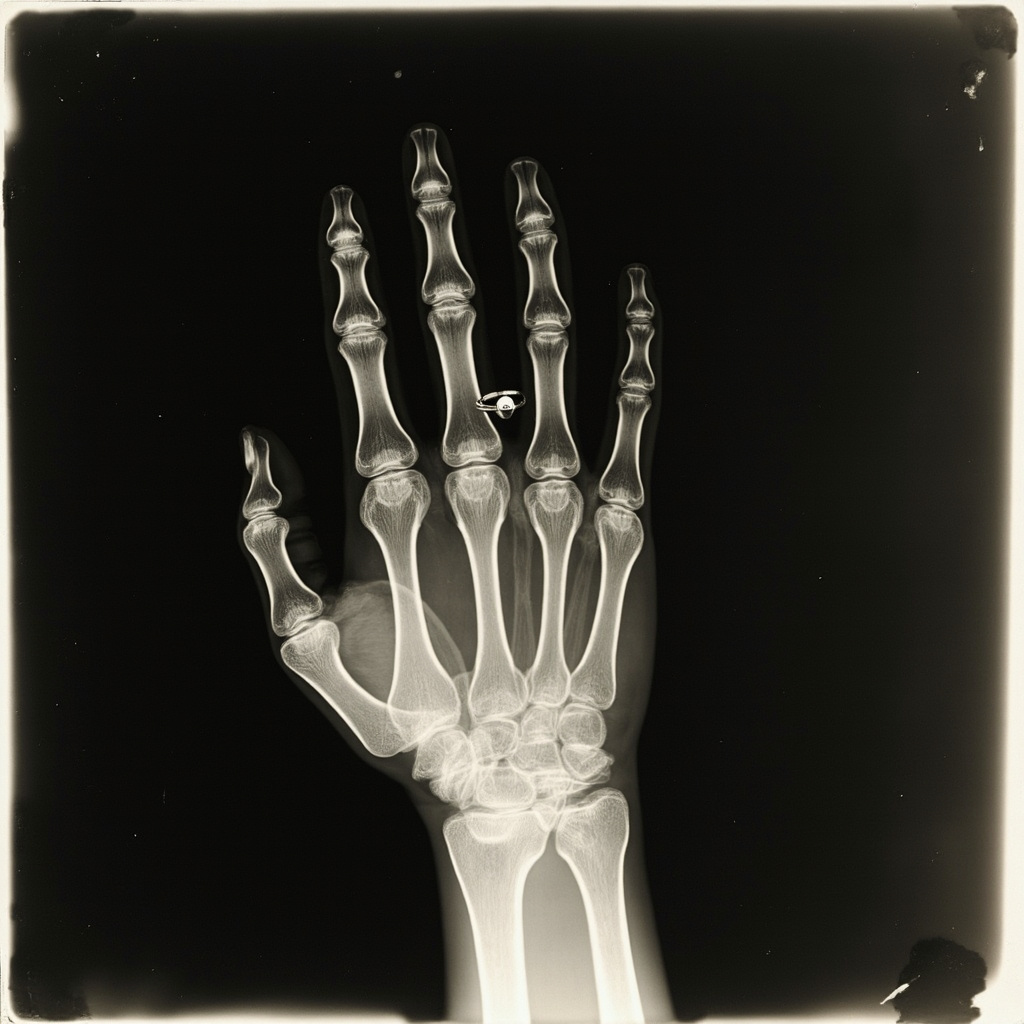
The famous first X-ray photograph of Anna Bertha Röntgen's hand, 1895

On December 22, 1895, Röntgen asked his wife Anna Bertha to place her hand on a photographic plate while he aimed his X-ray tube at it. The exposure took about 15 minutes — during which Anna Bertha had to hold perfectly still. The resulting image was haunting: the dark shadows of her bones clearly visible, her wedding ring floating ghostlike around her finger. When she saw the image, she reportedly gasped, “I have seen my death.”

Röntgen published his findings on December 28, 1895, and the news exploded across the globe with a speed that rivaled the telegraph itself. Within days, newspapers on every continent were breathlessly reporting on the “new photography” that could see through flesh to the bones beneath. The public was equal parts fascinated and terrified.

In 1901, Röntgen was awarded the very first Nobel Prize in Physics. True to his modest character, he donated the prize money to his university and refused to patent his discovery, believing it belonged to humanity. He died in relative obscurity in 1923, during the economic chaos of Weimar Germany, while the technology he unleashed was already changing the world in ways he never imagined.

X-ray Mania: When Seeing Bones Was Entertainment

Victorian-era X-ray parlor with people lining up to see their own skeletons

The years following Röntgen’s discovery saw an extraordinary craze sweep through Europe and America. “X-ray parlors” sprang up in cities, offering curious customers the chance to see their own skeletons for a small fee. It was the Victorian equivalent of a selfie — except instead of your face, you were showing off your metacarpals.

Department stores installed X-ray machines as novelty attractions. Shoe stores offered “fluoroscopes” that let customers wiggle their toes inside their shoes to check the fit — bombarding their feet with radiation in the name of retail satisfaction. These shoe-fitting fluoroscopes remained in widespread use from the 1920s through the 1950s before someone finally asked, “Wait, is this a good idea?”

The entertainment industry embraced X-rays with gusto. Thomas Edison, ever the showman, demonstrated a large fluoroscope at the 1896 Electrical Exhibition in New York City. His assistant, Clarence Dally, operated the device extensively. Dally would become one of the first known casualties of radiation exposure in America — he developed severe radiation burns, had both arms amputated, and died in 1904 at the age of 39. Edison, shaken by Dally’s fate, abandoned all X-ray research.

The early enthusiasm was dangerously naive. Without understanding radiation’s biological effects, people treated X-rays as harmless curiosities. Doctors would demonstrate X-ray machines at dinner parties. Inventors proposed X-ray opera glasses so theatergoers could peer through walls. A London company advertised “X-ray proof undergarments” for modest ladies who feared their privacy was at risk. The fear was absurd, but the entrepreneurial spirit was very real.

From Parlor Trick to Battlefield Savior

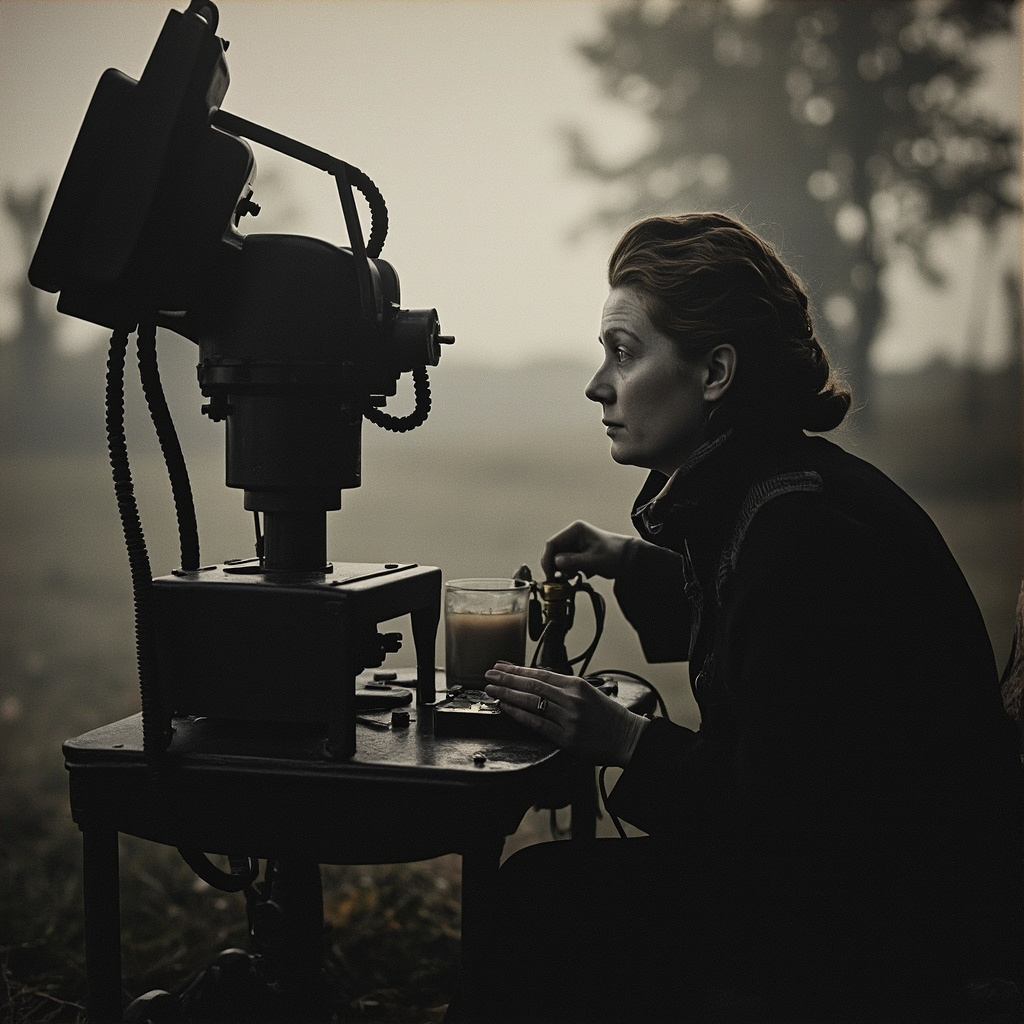
Marie Curie operating mobile X-ray equipment during World War I

While civilians were gawking at their bones in parlors, the medical community quickly recognized X-rays’ life-saving potential. During the Balkan Wars of 1897 and the Boer War (1899–1902), military surgeons used X-rays to locate bullets and shrapnel lodged in wounded soldiers — a task that had previously required agonizing exploratory surgery.

But it was World War I that truly proved X-rays’ value on a massive scale. Marie Curie — already famous for her research on radioactivity — threw herself into the war effort with characteristic determination. She equipped a fleet of vehicles with portable X-ray machines, creating the world’s first mobile radiological units. Soldiers affectionately called them “petites Curies” — little Curies.

Curie personally drove these vehicles to field hospitals near the front lines, training doctors and technicians to use the equipment. Her teenage daughter Irène joined her, operating X-ray machines in battlefield hospitals at the age of 17. Together, the Curies helped perform over a million X-ray examinations during the war, guiding surgeons to extract bullets and shrapnel that would have otherwise meant amputation or death.

The wartime experience transformed X-ray technology from a medical curiosity into an indispensable clinical tool. After the war, hospitals worldwide invested in permanent X-ray departments, and the specialty of radiology was born.

The Dark Side: Radiation’s Hidden Toll

The enthusiasm for X-rays came at a terrible price. In the early decades, no one understood the cumulative damage that radiation inflicted on human tissue. Radiologists routinely tested their equipment by X-raying their own hands. Many developed radiation dermatitis — chronic skin damage that progressed to ulceration and cancer.

By the 1930s, the toll was becoming undeniable. Hundreds of early radiologists and X-ray technicians had developed cancers, lost fingers and limbs, or died from radiation-related illnesses. A memorial erected in Hamburg, Germany, in 1936 listed 169 names of radiologists who died from radiation exposure. By 1960, the list had grown to 360 names.

The radium industry — a cousin of X-ray technology — was claiming victims too. The infamous “Radium Girls” of the 1920s, young women who painted luminous watch dials with radium-laced paint, developed devastating jaw necrosis and cancers after being told to lick their brushes to form a fine point. Their legal battle against the U.S. Radium Corporation became a landmark case in occupational health law.

These tragedies eventually forced the development of radiation safety standards. Lead shielding, exposure limits, dosimetry badges, and the principle of using the minimum radiation dose necessary all emerged from the painful lessons of the early X-ray era.

The Modern Age: From Film to Digital

Modern hospital radiology department with CT scanner

The second half of the 20th century brought revolutionary advances. In 1971, British engineer Godfrey Hounsfield introduced the CT (computed tomography) scanner, which used X-rays and computer processing to create detailed cross-sectional images of the body. It was like going from a shadow puppet show to a full 3D movie. Hounsfield shared the 1979 Nobel Prize in Physiology or Medicine for this invention.

CT scanning transformed diagnostic medicine. Doctors could now see tumors, blood clots, fractures, and internal bleeding with unprecedented clarity — without surgery. Emergency rooms became dependent on CT scanners for evaluating trauma patients. Oncologists used them to stage cancers and monitor treatment response.

The digital revolution of the 1980s and 1990s replaced photographic film with electronic sensors, bringing instant image display, computer enhancement, and electronic storage. Radiation doses plummeted as detector technology improved. Today’s digital X-ray systems deliver a fraction of the radiation that early machines produced.

The 21st century has brought further marvels: cone beam CT for three-dimensional imaging, AI algorithms that can detect diseases on X-rays with superhuman accuracy, and portable X-ray devices small enough to fit in a backpack for use in disaster zones and remote communities.

A Legacy of Light and Shadow

The story of X-rays is, in many ways, a perfect parable of human discovery. A curious scientist stumbles upon something extraordinary. Society embraces it with reckless enthusiasm. People suffer from the unintended consequences. And gradually, painfully, we learn to harness the discovery safely and effectively.

From Röntgen’s darkened laboratory to modern hospital radiology suites, from Victorian bone-gazing parlors to AI-powered diagnostic systems, the invisible light that one physicist discovered by accident has illuminated the hidden interior of the human body for 130 years. It has saved millions of lives, enabled entire medical specialties, and — in its darkest chapters — reminded us that every powerful technology demands respect.

Wilhelm Röntgen never sought fame or fortune from his discovery. He gave it freely to the world, asking nothing in return. The X stands for unknown — and in a sense, it still does. Even today, researchers are finding new applications for X-ray technology, from archaeology to art conservation to airport security. The unknown ray turned out to be one of the most versatile and consequential discoveries in human history.

Not bad for an accident on a November evening.

The War of the Bucket: When Italy Fought a Bloody Battle Over a Wooden Pail

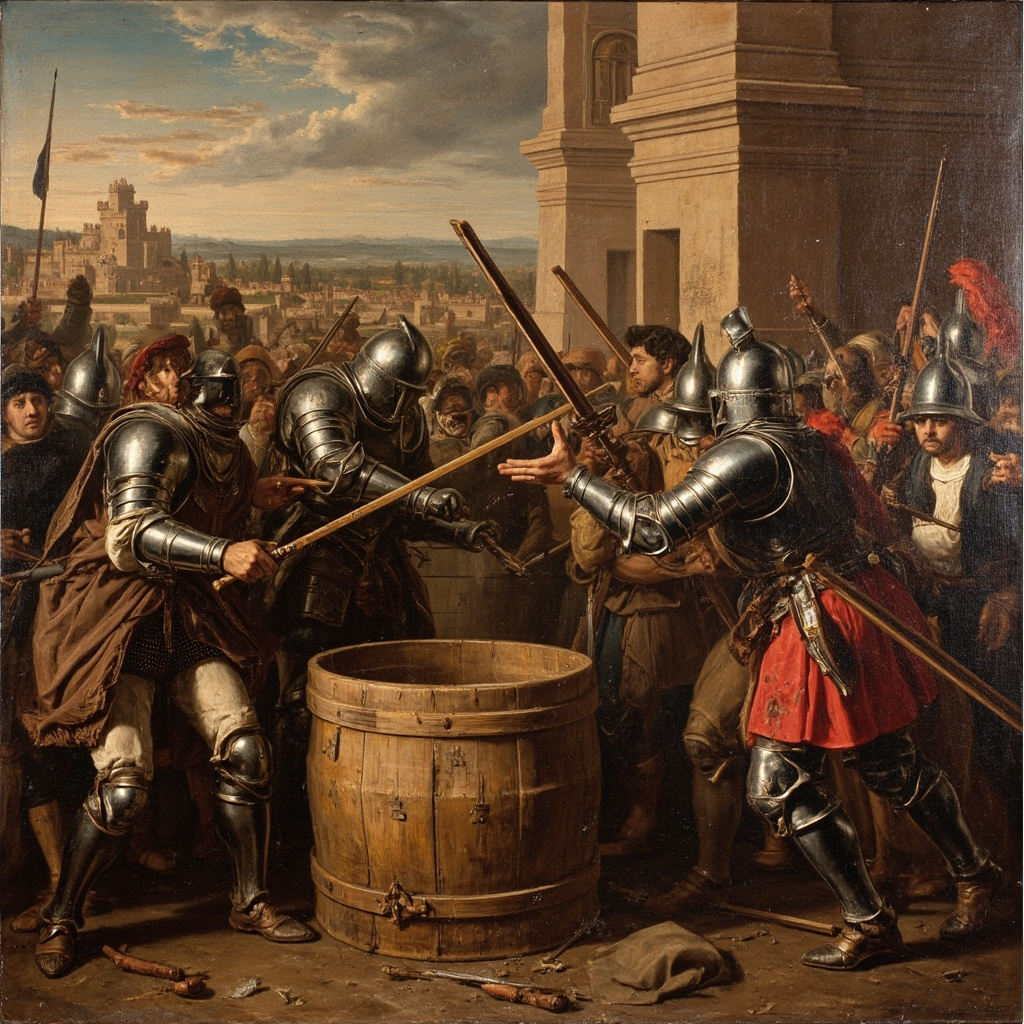
In 1325, soldiers from the Italian city-states of Bologna and Modena fought a pitched battle involving thousands of troops, cavalry charges, and considerable bloodshed. The prize they were fighting over? A wooden bucket.

The War of the Bucket — or Guerra della Secchia Rapita — is one of the most absurd conflicts in military history. But beneath its comical surface lies a story about the deadly factional politics that tore medieval Italy apart for centuries.

Guelphs vs. Ghibellines: Italy’s Endless Civil War

To understand the War of the Bucket, you need to understand the conflict that dominated Italian politics for nearly three hundred years: the struggle between the Guelphs and the Ghibellines.

The Guelphs supported the Pope as the supreme authority in Italy. The Ghibellines backed the Holy Roman Emperor. Every Italian city was forced to choose a side, and the rivalry infected every aspect of civic life. Neighboring cities often chose opposite factions specifically to justify attacking each other.

Bologna was a Guelph city — prosperous, home to one of Europe’s oldest universities, and loyal to the papacy. Modena, just 25 miles to the northwest, was Ghibelline — smaller, scrappier, and perpetually in Bologna’s shadow. The two cities had been feuding for generations, and by the early fourteenth century, tensions were at a breaking point.

The Bucket Raid

In 1325, a group of Modenese soldiers carried out a daring raid into the heart of Bologna. They fought their way into the city, and in an act of supreme provocation, stole an oak bucket from the main city well in the central square. The bucket — a secchia — was an ordinary wooden pail, worth almost nothing in monetary terms. But in symbolic terms, it was an intolerable insult.

Stealing from a city’s central well was a deliberate humiliation, equivalent to capturing an enemy’s flag. It announced to the world that Modena’s soldiers had penetrated Bologna’s defenses and taken a trophy from the very heart of the city. For proud, wealthy Bologna, this was an affront that demanded a military response.

The Battle of Zappolino

Bologna assembled a massive army. Historical accounts vary, but most sources suggest the Bolognese force numbered around 32,000 men — including 2,000 cavalry — making it one of the largest armies fielded by an Italian city-state in the medieval period. They also called upon allies from Florence, Romagna, and other Guelph cities. A papal legate accompanied the army, underscoring the involvement of the papacy itself.

Modena’s army was significantly smaller, perhaps 5,000 infantry and 2,000 cavalry, bolstered by Ghibelline allies including the fearsome warlord Passerino Bonacolsi, the lord of Mantua, who brought experienced troops hardened by years of factional warfare.

The two armies met on November 15, 1325, at the town of Zappolino, about nine miles south of Modena. What followed was a decisive and humiliating defeat for Bologna.

Despite their overwhelming numerical superiority, the Bolognese army was poorly coordinated and overconfident. The Modenese and their allies launched a devastating cavalry charge that broke the Bolognese lines. The rout was swift and total. The Bolognese army fled the field, abandoning equipment, supplies, and pride.

Modenese forces pursued the retreating Bolognese all the way back to the gates of Bologna, where, according to tradition, they carried out one final humiliation: they held a mock jousting tournament within sight of the city walls, taunting the defeated Bolognese from the safety of their own suburbs.

The Casualties and the Peace

The Battle of Zappolino was bloody by medieval Italian standards. Estimates of the dead range from several hundred to over 2,000, depending on the source. Thousands more were captured. For a conflict triggered by the theft of a bucket, the human cost was staggering.

Despite their crushing victory, the Modenese were unable to capture Bologna itself — the city’s walls were too strong and well-defended. A peace treaty was eventually negotiated, but the fundamental Guelph-Ghibelline tensions remained unresolved. The two cities would continue to skirmish for decades.

And the bucket? Modena kept it. It was never returned.

The Bucket Today

Nearly seven hundred years later, the stolen bucket still exists. It hangs in the bell tower of the Cathedral of Modena — the Torre della Ghirlandina — where it has been displayed as a trophy of victory for centuries. A replica can be seen in the town hall. Modenese citizens remain proud of their ancestors’ audacious theft and the military triumph that followed.

The War of the Bucket was immortalized in 1622 by the Italian poet Alessandro Tassoni, whose mock-heroic epic La Secchia Rapita (“The Stolen Bucket”) used the conflict as the basis for a satirical poem that mocked the absurdity of Italian factional warfare. The poem was a bestseller in its day and remains a classic of Italian literature.

More Than a Joke

It’s tempting to treat the War of the Bucket as a historical punchline — and it is genuinely funny that thousands of men fought and died over a wooden pail. But the conflict illuminates something important about how wars actually start.

The bucket wasn’t really the cause of the war. It was the spark. The underlying fuel was centuries of accumulated grievance, factional hatred, economic competition, and wounded civic pride. The theft of the bucket was simply the final provocation in a long chain of provocations, the insult that made war feel not just justified but necessary.

History is full of wars triggered by seemingly trivial incidents — a severed ear, a football match, a pig wandering across a border. In each case, the triviality of the trigger obscures the depth of the underlying tensions. The War of the Bucket reminds us that when communities are primed for conflict, even the most absurd catalyst can unleash devastating violence.

So the next time someone tells you that a particular dispute is “too silly to fight over,” remember Modena and Bologna. Remember the bucket that launched a war, killed hundreds, and still hangs in a cathedral tower as a proud trophy of victory. In politics, as in life, nothing is ever really about the bucket.

The Great Stink of 1858: How a Smell Saved Millions of Lives

In the summer of 1858, London — the capital of the most powerful empire on Earth, the richest city in the world, the beating heart of the Industrial Revolution — was brought to its knees by a smell. Not a plague, not an invasion, not a financial crisis. A smell. And that smell would ultimately save millions of lives.

The Great Stink of 1858 is the story of how the river Thames became so catastrophically polluted with human sewage that Parliament itself was forced to flee its chambers, and how the resulting crisis finally compelled the British government to build one of the greatest engineering achievements of the 19th century: Joseph Bazalgette’s London sewer system.

A River of Filth

To understand the Great Stink, you need to understand what London had done to its river. By the mid-19th century, London’s population had exploded. In 1800, roughly one million people lived in the city. By 1850, that number had swollen to nearly 2.5 million. And every single one of them produced sewage.

For centuries, Londoners had relied on cesspits — underground chambers beneath homes and businesses that collected human waste. “Night soil men” would periodically empty these cesspits and cart the contents away to be used as fertilizer. The system was unpleasant but functional — as long as the population remained manageable.

Then came the flush toilet. The widespread adoption of water closets in the early 19th century was considered a triumph of modern hygiene. But it created an unforeseen catastrophe. Flush toilets used enormous quantities of water, which rapidly overwhelmed the old cesspits, causing them to overflow into street drains and ditches. These drains were never designed to handle sewage — they were meant for rainwater — and they all emptied into the same place: the River Thames.

By the 1850s, the Thames had become an open sewer. Raw, untreated human waste from millions of people poured directly into the river. The same river, it should be noted, from which many Londoners drew their drinking water.

Cholera and the Wrong Theory

The consequences were devastating. Cholera — a waterborne disease caused by bacteria in contaminated water — swept through London in terrifying epidemics in 1832, 1849, and 1854. Tens of thousands died. But the medical establishment of the time didn’t understand how cholera spread. The prevailing theory was miasma — the belief that diseases were caused by “bad air” arising from rotting organic matter. If it smelled bad, it could make you sick. The stench of the Thames, under this theory, was literally poisonous.

A brilliant physician named John Snow had demonstrated during the 1854 Broad Street outbreak that cholera was spread through contaminated water, not bad air. He famously traced cases to a single water pump and had its handle removed, stopping the outbreak. But Snow’s waterborne theory was largely rejected by the medical establishment. The miasma theory held firm.

Ironically, it was the wrong theory that would ultimately produce the right solution.

The Summer of 1858

The summer of 1858 was unusually hot. Week after week of blazing sunshine baked the Thames and its banks of accumulated sewage. The heat accelerated decomposition. The smell — already bad in normal years — became apocalyptic.

Contemporary accounts describe the stench as physically unbearable. It wasn’t merely unpleasant; it was a wall of foulness that made people retch, faint, and flee. The smell penetrated buildings, permeated clothing, and hung over the city like a toxic fog.

And nowhere was the smell worse than at the Houses of Parliament, which sat directly on the banks of the Thames. Members of Parliament attempted to continue their work with curtains soaked in chloride of lime hung over the windows. They tried every deodorizing agent available. Nothing worked. Committee rooms on the river side of the building were abandoned entirely. There was serious discussion of relocating Parliament to Oxford or St. Albans.

The Times thundered: “What a pity it is that the thermometer fell ten degrees yesterday. Parliament was all but compelled to legislate upon the great London nuisance by the force of sheer stench.”

Benjamin Disraeli, then Chancellor of the Exchequer, was seen fleeing a Commons committee room with a sheaf of papers in one hand and a handkerchief clutched to his nose with the other. The Great Stink had achieved what decades of cholera deaths, public health campaigns, and engineering proposals had failed to do: it had made the problem personal for the people in power.

Bazalgette’s Vision

Joseph Bazalgette was the Chief Engineer of the Metropolitan Board of Works, and he had been waiting for this moment. For years, he had championed an ambitious plan to solve London’s sewage crisis: a vast network of intercepting sewers that would catch the waste before it reached the Thames and carry it miles downstream to treatment works east of the city.

Previous proposals had been debated, revised, rejected, and shelved for years — victims of political infighting, cost concerns, and bureaucratic inertia. The Great Stink swept all of that away. Parliament passed the enabling legislation in just eighteen days — an almost unprecedented speed for Victorian government. Bazalgette was given his funding and told to get to work.

What he built was extraordinary. Over the next six years, Bazalgette oversaw the construction of 83 miles of brick-lined intercepting sewers, fed by 1,100 miles of street sewers. The system used gravity to channel sewage from across London into massive trunk sewers that ran parallel to the Thames, carrying waste eastward to pumping stations at Crossness and Abbey Mills, where it was lifted into holding reservoirs and released into the river on the outgoing tide, far downstream from the city.

The engineering was brilliant, but Bazalgette’s true genius was in his foresight. When calculating the diameter of the main sewers, he estimated the maximum capacity London would ever need — then doubled it. “We’re only going to do this once,” he reportedly said, “and there’s always the unforeseen.” That decision to overengineer the system is the reason Bazalgette’s sewers still form the backbone of London’s sewage infrastructure today, more than 160 years later.

The Result

The impact was transformative. Cholera, which had killed tens of thousands in London across multiple epidemics, essentially vanished from the city after the sewer system was completed. The Thames, while still far from pristine, was no longer an open cesspool. Life expectancy in London increased dramatically. The system became a model for cities around the world.

Bazalgette also used the construction project to reshape London’s riverfront. The massive trunk sewers running along the Thames were enclosed within new embankments — the Victoria Embankment, the Albert Embankment, and the Chelsea Embankment — which reclaimed land from the river, created new roads, and housed an underground railway line. These embankments remain some of London’s most recognizable landmarks.

The Lesson

The Great Stink is a story about the perverse mechanics of political will. London’s sewage crisis had been killing people for decades. John Snow had identified the mechanism. Engineers had proposed solutions. The evidence was overwhelming. But nothing happened — until the smell reached Parliament.

It took the personal discomfort of the ruling class to produce action that the deaths of thousands of ordinary Londoners could not. The cholera victims were mostly poor. The smell was democratic. And so, in one of history’s great ironies, a city was saved not by science or compassion, but by the simple, unavoidable reality that sewage stinks — and that even the most powerful men in the British Empire couldn’t legislate with a hand over their nose.

The London Beer Flood of 1814: When 135,000 Gallons of Porter Destroyed a Neighborhood

On October 17, 1814, just after 5:30 in the afternoon, a massive iron band snapped on a 22-foot-tall brewery vat at the Meux and Company Brewery on Tottenham Court Road in London. Within moments, the enormous wooden vessel — containing over 3,500 barrels of aged brown porter — ruptured catastrophically. The force of the explosion set off a chain reaction, smashing into adjacent vats and releasing a combined tidal wave of approximately 135,000 gallons of beer into the streets of one of London’s poorest neighborhoods.

The London Beer Flood had begun.

The Brewery

The Meux Brewery (pronounced “mews”) was one of the great porter breweries of Georgian London. Porter — a dark, heavy beer that was the drink of choice for London’s working class — was big business in the early 19th century, and breweries competed fiercely to produce it in ever-larger quantities.

The key to this competition was the brewing vat. Breweries took enormous pride in their massive wooden vessels, which served both practical and promotional purposes. The bigger your vat, the more porter you could age at once, and the more impressive your operation appeared to investors and rivals. The arms race in vat size had been escalating for decades.

Meux’s prize vat stood 22 feet tall, was bound together with massive iron hoops, and held the equivalent of over 3,500 barrels of beer. It sat alongside several other enormous vats in the brewery’s storage rooms, all filled nearly to capacity with porter in various stages of aging. The combined volume of liquid in that room was staggering — hundreds of thousands of gallons, held back by nothing more than wooden staves and iron bands.

On the afternoon of October 17, one of those iron bands gave way.

The Flood

George Crick, a storehouse clerk, noticed the broken hoop and reported it to his supervisor. But broken hoops were not uncommon — the massive vats were under constant strain, and bands occasionally snapped. It was noted for repair but not treated as an emergency.

About an hour later, the vat exploded.

The rupture was violent and sudden. The force of 3,500 barrels of beer bursting free was enough to smash into the neighboring vats, which ruptured in turn. A cascade of destruction tore through the storehouse. Brewery walls crumbled. A fifteen-foot wave of dark porter surged out of the building and into the surrounding streets.

The area immediately behind the brewery was the St. Giles rookery — one of the most notorious slums in all of London. The residents of St. Giles lived in desperate poverty, crammed into crumbling basements and cellars that sat below street level. Many families lived, cooked, and slept in these underground rooms. When the wave of beer hit, it poured directly into these basement dwellings with no warning.

The flood smashed through walls, collapsed at least two houses entirely, and swept through a pub called the Tavistock Arms, where a wake was being held for a young boy who had died the previous day. The mourners were engulfed.

The Victims

The beer flood killed eight people — though some accounts say nine. The victims were almost exclusively women and children from the poorest households in St. Giles:

Eleanor Cooper, a teenager, was killed when the flood demolished the wall of the Tavistock Arms where she was working as a servant. Hannah Banfield and her daughter, four-year-old Hannah, drowned in their flooded basement room. Elizabeth Smith, a girl of about fourteen, was killed in another basement dwelling. Mary Mulvey, who had been attending the wake at the Tavistock Arms, was swept away and drowned. Ann Saville was killed in the collapse of a house. Two other women and a young boy rounded out the tragic toll.

Beyond the deaths, scores more were injured. People were pulled from the wreckage soaked in beer, many suffering from hypothermia — October evenings in London are cold, and being drenched in liquid in a demolished basement was life-threatening even without drowning. The entire neighborhood reeked of porter for months afterward.

The Aftermath

Rescue efforts were hampered by the chaos. Crowds descended on the neighborhood — some to help, others to scoop up free beer. Reports describe people cupping their hands to drink from the flood, and opportunists filling pots, pans, and kettles with the porter flowing through the gutters. At least one account claims that a ninth victim died days later from alcohol poisoning after drinking too much of the flood beer, though this is disputed by historians.

The scene was devastating. Homes were destroyed. Possessions were ruined. The families of St. Giles — already among the most vulnerable people in London — were left with even less than the little they had before.

An inquest was held at the Workhouse of St. Giles parish. The jury heard testimony from brewery workers, engineers, and local residents. Meux and Company’s representatives argued that the disaster was an unforeseeable accident — an act of God. The iron hoops had been regularly inspected, they claimed, and the vat showed no signs of imminent failure.

The jury’s verdict: “Died by casualty, visitation of God, and accidental death.” No one was held responsible. Meux and Company faced no criminal charges and paid no compensation to the victims’ families.

The brewery did, however, successfully petition Parliament for a refund on the excise duty it had paid on the lost beer — receiving back the tax on 135,000 gallons of porter that was now soaking into the floorboards of a London slum. The financial loss from the flood itself nearly bankrupted the company, but the tax refund and subsequent insurance claims kept it afloat.

Legacy

The London Beer Flood accelerated a shift already underway in the brewing industry. The massive wooden vats that had been status symbols for decades were gradually replaced by lined concrete storage vessels, which were far safer and more practical. The era of competitive vat-building was effectively over.

But the deeper legacy of the disaster lies in what it reveals about early 19th-century London. The Beer Flood was not a natural disaster — it was an industrial accident that killed people because they were poor. The residents of St. Giles died because they lived in basement rooms below street level, in structures so flimsy they collapsed under the weight of beer. They died because no safety regulations governed the enormous pressurized vessels sitting yards from their homes. And they received no justice or compensation because, in the eyes of the law, their deaths were simply an act of God.

The flood is sometimes treated as a quirky historical footnote — the day London was flooded with beer, ha ha. But for the families of Eleanor Cooper, Hannah Banfield, and the other victims, there was nothing funny about it. It was a preventable catastrophe that killed vulnerable people and held no one accountable. In that sense, the London Beer Flood of 1814 is less a curiosity than a parable — about the costs of industrial recklessness, the expendability of the poor, and the terrible things that happen when profit is valued above safety.

The Cadaver Synod: When the Catholic Church Put a Dead Pope on Trial

In January 897 AD, in a grand hall within the Basilica of St. John Lateran in Rome, a trial was convened that would become one of the most macabre spectacles in the history of the Catholic Church. The defendant was Pope Formosus. The charge was perjury, coveting the papacy, and violating church canons. The problem? Pope Formosus had been dead for seven months.

His corpse was exhumed from its tomb, dressed in full papal vestments, and propped up on a throne to face his accusers. A teenage deacon was appointed to stand behind the rotting body and answer the charges on the dead pope’s behalf. The presiding judge was Pope Stephen VI — Formosus’s successor — who reportedly screamed accusations at the cadaver throughout the proceedings, demanding answers from a man whose lips had long since ceased to move.

Welcome to the Cadaver Synod — the trial that put papal politics, medieval brutality, and human pettiness on full, horrifying display.

The Rise of Formosus

To understand why a dead pope ended up on trial, you need to understand the chaos of 9th-century Roman politics. The papacy during this period was not the stable, centralized institution we know today. It was a prize fought over by rival aristocratic families, ambitious clergy, and competing political factions, with alliances shifting as quickly as daggers could be drawn.

Formosus had been the Bishop of Porto before ascending to the papacy in 891. He was by most accounts a capable and respected churchman — so respected, in fact, that he had nearly been elected pope decades earlier, in 872. But his ambition made enemies. Pope John VIII accused him of abandoning his diocese and conspiring to seize the papacy, excommunicating him in 876.

Formosus was eventually rehabilitated and restored to his bishopric. When he finally became pope in 891, he inherited a political nightmare. Italy was fractured among warring factions, and Formosus needed military protection. He made the fateful decision to invite Arnulf of Carinthia, the East Frankish king, to march on Rome and be crowned Holy Roman Emperor — a move that infuriated the powerful Spoleto dynasty, who had their own candidate for the imperial throne.

Formosus died on April 4, 896, apparently of natural causes. But his enemies were far from finished with him.

Stephen VI’s Revenge

After a brief intervening papacy (Boniface VI, who lasted only fifteen days), Stephen VI ascended to the papal throne. Stephen was a creature of the Spoleto faction — the very family Formosus had betrayed by crowning Arnulf. Whether driven by genuine political calculation, pressure from his Spoleto patrons, personal hatred, or sheer instability, Stephen ordered Formosus’s body dug up and put on trial.

The scene in the basilica was beyond grotesque. January in Rome is cold, and the body had been in the ground since April — roughly nine months of decomposition. The stench must have been overwhelming. The corpse sat slumped on its throne in elaborate vestments while Stephen paced and raged, hurling questions at the silent, decaying figure.

“Why did you usurp the See of Rome?” Stephen reportedly demanded. “Why did you leave your diocese of Porto for ambition?”

The teenage deacon standing behind the body offered feeble responses, but the outcome was never in doubt. This was not a trial — it was a spectacle of humiliation designed to send a message.

The Verdict

Formosus was found guilty on all charges. His papacy was declared illegitimate. Every ordination he had performed, every decree he had issued, every appointment he had made was retroactively annulled — a decision with staggering political consequences, since it invalidated the authority of dozens of bishops and clergy across Europe.

Then came the punishment. The papal vestments were torn from the corpse. The three fingers of his right hand — the fingers used to give papal blessings — were hacked off. The mutilated body was briefly reburied in a common grave, then dug up again and thrown into the Tiber River.

According to legend, a monk fished the body out of the river downstream and quietly preserved it. Other accounts say fishermen recovered it after it became tangled in their nets, and that miracles began occurring in its presence.

The Aftermath

If Stephen VI intended the Cadaver Synod to consolidate his power, the plan backfired spectacularly. The Roman public was horrified. Whatever political grievances existed against Formosus, the desecration of a pope’s corpse was a step too far even for a city accustomed to political violence.

Within months, a popular uprising turned against Stephen. He was seized, stripped of his papal vestments — a deliberate echo of what he had done to Formosus — thrown into prison, and strangled to death in his cell in August 897, barely seven months after the Cadaver Synod.

The years that followed were dizzying. Subsequent popes alternately upheld and reversed the Cadaver Synod’s verdict depending on which political faction held power. Pope Theodore II annulled the synod’s proceedings and had Formosus’s recovered body reburied in St. Peter’s Basilica with full honors. Pope John IX held a synod that declared cadaver trials illegal. But Pope Sergius III, a Spoleto ally who took power in 904, reaffirmed the guilty verdict and reportedly had the body desecrated yet again.

Why It Matters

The Cadaver Synod is more than a ghoulish curiosity. It represents one of the lowest points of the medieval papacy — a period historians sometimes call the “pornocracy” or “Rule of the Harlots,” when the papal office was treated as a political trophy to be seized, exploited, and abused by Rome’s aristocratic families.

The trial exposed the fundamental tension at the heart of medieval Christianity: the pope was supposed to be God’s representative on Earth, yet the office was controlled by utterly worldly forces. The man who sat in judgment — Stephen VI — was himself the product of corrupt patronage, and his gruesome theater accomplished nothing except to further destabilize an already fractured church.

The Cadaver Synod also illustrates something timeless about human nature and power. The desire for revenge doesn’t end at the grave. Stephen’s rage against Formosus was so consuming that death itself wasn’t punishment enough — the dead man had to be dragged back into the world of the living to be humiliated one final time.

Over a thousand years later, the image endures: a dead pope on a throne, a living pope screaming at a corpse, and a room full of clergy too frightened or too complicit to say what everyone surely knew — that this wasn’t justice. It was madness. And it was a mirror held up to an institution that had lost its way.

The Dancing Plague of 1518: When Hundreds Danced Themselves to Death

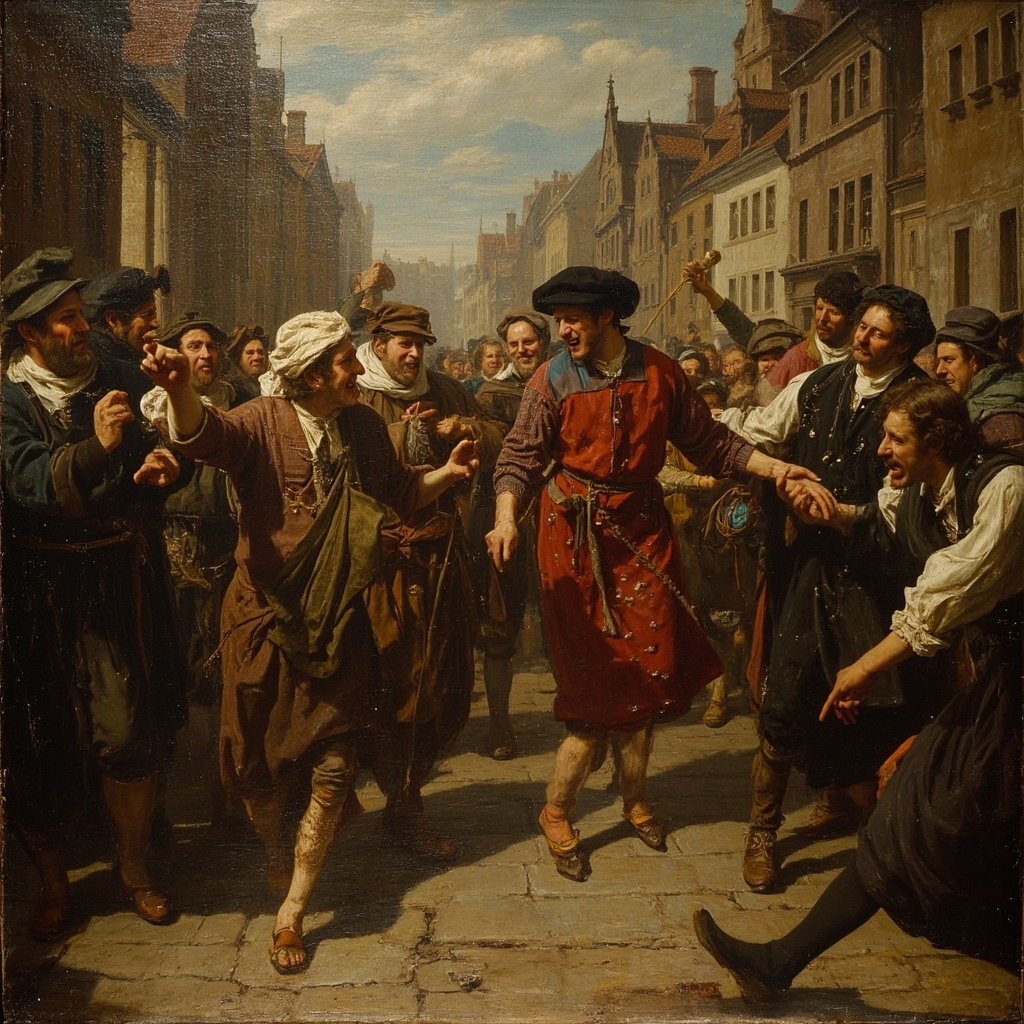
In the sweltering heat of July 1518, a woman named Frau Troffea stepped into a narrow street in Strasbourg, Alsace (then part of the Holy Roman Empire), and began to dance. There was no music, no celebration, no apparent reason. She simply danced — twisting, turning, and flailing her arms with wild abandon. She danced for hours. She danced until her shoes were soaked with blood. And she did not stop.

Her husband begged her to rest. Neighbors stared in bewilderment. Local authorities scratched their heads. But Frau Troffea danced through the night, and into the next day, and the day after that. Within a week, 34 others had joined her in the streets. Within a month, the number had swollen to approximately 400 people, all dancing uncontrollably in what would become one of the strangest and most disturbing episodes in European history: the Dancing Plague of 1518.

A City in Crisis

Strasbourg in 1518 was already a city under immense strain. The years leading up to the dancing plague had been brutal. A series of harsh winters and scorching summers had devastated crops across the region. Smallpox, syphilis, and other diseases swept through the population with terrifying regularity. Famine was widespread, and the poor — who made up the vast majority of the city’s residents — were desperate and starving.

Into this cauldron of misery came the dancing. The afflicted didn’t dance with joy or rhythm. Witnesses described their movements as frenzied and tormented. Many wept and screamed as their legs carried them in endless, exhausting circles. They begged for help. They pleaded for it to stop. But their bodies refused to obey.

The city council, desperate for a solution, initially made a decision that seems baffling in hindsight: they decided to encourage the dancing. Operating under the theory that the afflicted needed to “dance it out of their systems,” authorities opened two guild halls and even constructed a wooden stage. They hired musicians — pipers and drummers — to play accompanying music, hoping that structured rhythm would help the dancers exhaust themselves and recover.

It didn’t work. The music only seemed to attract more dancers. The epidemic grew worse.

The Toll

Historical accounts vary, but chroniclers of the time reported that at the peak of the plague, as many as fifteen people were dying per day from heart attacks, strokes, and sheer exhaustion. Their feet were bloody and blistered. Some collapsed and never rose again. The city’s physicians were completely baffled.

When it became clear that encouraging the dancing was catastrophically counterproductive, the authorities reversed course. The musicians were dismissed. The guild halls were closed. The afflicted were loaded onto wagons and transported to a mountaintop shrine dedicated to Saint Vitus, the patron saint associated with dancing and epilepsy. There, the dancers were given small crosses, led around holy altars, and placed in red shoes that had been blessed with holy water and anointed with oil.

Remarkably — whether through divine intervention, psychological relief, or simply the passage of time — the plague began to subside. By early September, the dancing had largely stopped. The survivors were left physically shattered but alive.

What Caused It?

For centuries, the Dancing Plague of 1518 was dismissed as legend or exaggeration. But extensive research by historian John Waller and others has confirmed that the event absolutely happened. City council records, physician notes, cathedral sermons, and regional chronicles all document it in remarkable detail.

So what caused hundreds of people to dance themselves to injury and death?

One popular theory involves ergot poisoning. Ergot is a fungus that grows on grain, particularly rye, and contains chemicals related to LSD. Consuming contaminated bread could cause convulsions, hallucinations, and involuntary muscle movements. However, most experts have rejected this explanation for the dancing plague — ergot poisoning typically causes constricted blood flow to the extremities, making coordinated dancing essentially impossible.

The most widely accepted modern explanation is mass psychogenic illness — sometimes called mass hysteria. Under this theory, the extraordinary psychological stress of life in 1518 Strasbourg created the perfect conditions for a collective psychological breakdown. The people were starving, sick, and terrified. They lived in a culture that deeply believed in supernatural punishment, particularly the curse of Saint Vitus, who was said to afflict sinners with compulsive dancing.

Waller argues that Frau Troffea, overwhelmed by the misery of her circumstances, entered a stress-induced trance state. In a community primed by superstitious belief, others who witnessed her dancing interpreted it through the lens of Saint Vitus’s curse — and their terror of the same fate actually triggered it. Fear became a self-fulfilling prophecy. One by one, the most psychologically vulnerable members of the community fell into the same dissociative state.

Not an Isolated Incident

As bizarre as the 1518 event seems, it was not unique. Outbreaks of compulsive dancing — known as “choreomania” or “dancing mania” — were documented repeatedly across Europe between the 7th and 17th centuries. A major outbreak in 1374 swept through towns along the Rhine River, affecting thousands. Smaller episodes were recorded in Switzerland, Germany, and Holland throughout the medieval period.

These outbreaks shared common features: they occurred during times of extreme hardship, they spread through communities like contagion, and they were deeply intertwined with religious belief and superstition. They typically affected the poorest and most vulnerable members of society.

Legacy

The Dancing Plague of 1518 remains one of history’s most fascinating medical mysteries. It offers a window into the extraordinary power of the human mind — how belief, fear, and collective psychology can produce physical symptoms that are entirely real and genuinely deadly, even without any biological pathogen.

It also serves as a sobering reminder of what happens when communities are pushed to the breaking point. The dancers of Strasbourg weren’t performers or revelers. They were people in profound distress, trapped in bodies that had betrayed them, dancing not with joy but with desperation — a physical manifestation of a suffering too great for words.

Five hundred years later, we still can’t fully explain what happened in those streets. But we can recognize in those tormented dancers something deeply, unsettlingly human: the knowledge that sometimes, when the weight of the world becomes too much to bear, the mind finds its own terrible way to scream.